
Best of the Week
Most Popular
1. Will Iran Kill the PetroDollar? - Marin Katusa
2. Tail Events, Isolation, New Normal Of Hyper Monetary Inflation - Jim_Willie_CB
3. Kodak's Former Moment, A Lesson for You, Me and America - Gary_North
4.The Five Stages of Collapse and the Coming Paradigm Shift in Silver - Steve_St_Angelo
5. UK Recession 2012 Certain as Bank of England Prepares to Ramp Up Money Printing Presses - Nadeem_Walayat
6. HMRC Extends Tax Deadline by 2Days for Self Assessment Online Filing - Nadeem_Walayat
7. Gold GLD ETF Investors Mass Exodus - Zeal_LLC
8. Credit Crisis Perfect Storm, Robert Prechter Discusses What's Backing Your Dollars - Robert Prechter
9. Best Cash ISA 2012 to Reduce Stealth Inflation Theft of Value of Savings - Nadeem_Walayat
10.Financial Markets 2012, When Leverage Fails - Ty_Andros
Last 5 Days Analysis
Ben Bernanke is Every Gold Bug's Best Friend - 9th Feb 12
Apple Stock Heading Over $600 on iTV and iPad3 - 9th Feb 12
Money Market Funds Are in the Fight of Their Lives - 9th Feb 12
China's Economic Rebalancing Should Be Good for Gold Demand - 9th Feb 12
Waiting to Pounce on Gold and Silver Profits - 9th Feb 12
Learn How to Apply Fibonacci Retracements to Your Stock Index Trading - 8th Feb 12
Do Low Interest Rates Power Stock Markets Higher? - 8th Feb 12
SILVER: The Illegitimate Child Of The Commodities Family - 8th Feb 12
A New Reason Gold Stocks Will Soar - 8th Feb 12
The Deception of 0% Interest Rates, High Costs and Capital Destruction - 8th Feb 12
Bring Down the New World Order with Free Market Education - 8th Feb 12
Gold Increases In Value During Inflation or Deflation Scenarios - 8th Feb 12
Gold Holds Steady as U.S. Dollar Hits 2-Month Low - 8th Feb 12
Markets Risk Train Chugs Along, Overbought Does Not Mean a Correction is Coming - 8th Feb 12
Banking, U.S. Housing Market and Mortgages - 8th Feb 12
Has Zero Interest Rate Policy Held Back Economic Recovery? - 8th Feb 12
Graphite and Rare Earth Metals for the 21st Century - 8th Feb 12
Gold Odysseus Journey Continues! - 8th Feb 12
The Fed Resumes Printing Money to Monetize U.S. Government Debt - 7th Feb 12
Timing the Market: Predicting When the FED Will Act Next (Feb 12) - 7th Feb 12
U.S. War With Iran? - 7th Feb 12
Abandoning the U.S. Dollar for Gold - 7th Feb 12
Financial Crisis American Gridlock, Why The “Left” And The “Right” Are Both Wrong - 7th Feb 12
The Fed is Engineering Barack Obama’s Re-Election Campaign - 7th Feb 12
Finding Fundamentals Key to Gold Stocks Investing - 7th Feb 12
US Debt Will Explode Without Changes - 7th Feb 12
Gold Compared to Past Bubbles - 7th Feb 12
Illusion Of Economic Recovery – Feelings & Facts - 7th Feb 12
In the Gold Bullring - 7th Feb 12
This Precious Metal Could Rise 125% Over the Next 10 Months - 6th Feb 12
Washington Heading for War on Syria - 6th Feb 12
Gold "Rollercoaster" Heads Yet Lower as Greece Hits "Crunch Time for Bankruptcy" - 6th Feb 12
Did Friday's Gold Price Action Signal a Stock Market Top? - 6th Feb 12
Monday Financial Markets Madness – What’s This Greece Thing? - 6th Feb 12
Stock Market Investors Dangerous Times Ahead, Will Impact Gold - 6th Feb 12
Gold, Stocks and Euro Fall As Possible Greek Debt Default Looms - 6th Feb 12
Bond Investors Pour into Emerging Market Debt in Hunt for Higher Yields - 6th Feb 12
New Spy Technology Could Be Worth Billions - 6th Feb 12
U.S. Fraudulent Election Year Unemployment Data, Lies, Lies, More and Bigger Lies - 6th Feb 12
Double Liability for Bank Shareholders, Officers and Directors - 6th Feb 12
Stock Market Next Short-term Top in Sight - 6th Feb 12
U.S. Home Foreclosures and Shadow Banking: Why All the "Robo-signing"? - 5th Feb 12
Look at What 'Worked' in the Great Depression - 5th Feb 12
Putting Good U.S. Employment Numbers in Perspective, College Education Isn’t Enough - 5th Feb 12
Stock Market Weekend Update - 5th Feb 12
The Doomsday Machine - 4th Feb 12
Are US Treasury Bond Markets a Sell? - 4th Feb 12
Obama’s Refinancing Swindle, Banks Want to Dump Millions of Risky Mortgages Onto FHA - 4th Feb 12
The Euro Zone and the Crisis of Sovereign Debt - 4th Feb 12
Is the U.S. 'Decoupling' From the European Debt Crisis? - 4th Feb 12
The Crucial Pillar of the New World Order - 4th Feb 12
Gold Junior Mining Stocks Poised to Rebound - 4th Feb 12
U.S. January Employment Situation Shows Widespread Improvement, but Short of Full Employment Mandate - 4th Feb 12
U.S. Non Farm Payrolls Interesting Market Divergences - 4th Feb 12
Gold and Silver Mining Stocks Tops Might Be Just Around the Corner - 4th Feb 12
Critical Materials for Critical Technologies - 3rd Feb 12
Junior Gold Mining Stock - 3rd Feb 12
SOPA, PIPA, The State of US Surveillance - 3rd Feb 12
Essential Investor Preparations for The Big Crisis - 3rd Feb 12
U.S. Jobs, El-Erian U.S. Structural Issues Aren't Being Dealt With - 3rd Feb 12
What Every U.S. Investor Should Know About Inflation - 3rd Feb 12
U.S. Mint Gold Coin Sales Return to Fundamental Driven Demand - 3rd Feb 12
Gold Bull Market Bigger than Ever - 3rd Feb 12
Banking Crisis 2012 "Robo-Signing" of Foreclosure Affidavits Just Tip of Iceberg - 3rd Feb 12
Stock and Financial Markets Crash is Coming, Key Signs of Reversal - 3rd Feb 12
Real U.S. Economic Picture: "There is No Recovery" - 3rd Feb 12
Poland Gives Green Light to Massive Natural Gas Fracking Efforts - 3rd Feb 12
Where to Invest 2012 and What to Avoid - 2nd Feb 12
Liquid Natural Gas Stocks Are Set to Take Off - 2nd Feb 12
Godzilla Will Come Out of Tokyo Bay Before Japan Economy and Stock Market Rebounds - 2nd Feb 12
Gold Challenges Resistance at $1,750/oz – Technicals and Fundamentals Remain Very Positive - 2nd Feb 12
German Central Bailing Out Europe - 2nd Feb 12
In the Wake of Davos: "Strong Economic Medicine" for the European Union - 2nd Feb 12
The American Economy is "Dead": The Illusion of Economic Recovery - 2nd Feb 12
Irish People Bailout of Bond Holders, Vincent Browne v The European Central Bank Video - 2nd Feb 12
How Far Will Debt Deleveraging Go? How Much LSD Can an Elephant Take? - 2nd Feb 12
Great Deals on Gold and Silver 2012 - 2nd Feb 12

Free Instant Analysis

Free Instant Technical Analysis


Market Oracle FREE Newsletter

How You Can Identify Stock Market Turning Points Using Fibonacci

US Dollar Devaluation is a Supply and Demand Problem

Currencies / US Dollar Nov 17, 2007 - 02:03 PM

By: Andy_Sutton

Currencies

Best Financial Markets Analysis ArticleDollar falls to all-time low against the Euro"
"Canadian dollar hits all-time high versus US counterpart"
"Australian dollar at multi-year high"
"British Pound crosses $2 threshold"

These are just some of the headlines that have emerged during the past year concerning the ails of the US Dollar. There have been hundreds, perhaps thousands of explanations for why this is a good or bad thing. Thousands more questions asked, but never answered. At the end of the day though, it is really about our old friend: The law of Supply and Demand.


The Demand Side

There are three major areas of demand for US dollars. The first is the domestic US economy, which needs enough dollars to run smoothly. This includes the broader categories such as mortgages, credit cards, various consumer loans, corporate credit and circulating specie (printed dollar) currency. We have seen waning demand for dollars in the area of mortgages, and an overall flattening in terms of consumer spending. If the consumer spending numbers were adjusted honestly, we would likely be seeing real declines in consumer spending.

This all translates into a decreased demand for dollars. One point worth mentioning in this case is that it explains on several levels the Fed's decision to drive their target interest rates lower. They are attempting to induce borrowing through lowered costs of money. This is a classic response to diminished demand. The Fed was clearly at a crossroads. They could have saved the dollar or the debt-reliant economy. They chose to save the economy. Given the hyper-dependent condition of our society, it was the only choice really.

There is a tug of war going on with regard to decreased demand for dollars and the perceived counterparty risk when loaning dollars. Those lending want to be compensated for the risk they take when making loans. However, their desired rate of return doesn't match the rates at which borrowers are willing to take on more debt. The result? Turmoil, volatility, and eventually, panic in even the shortest-term money markets.

The second is the foreign demand for dollar denominated assets to soak up their accumulated dollars. The below diagram is a graphic representation of the flow of dollars around the globe:
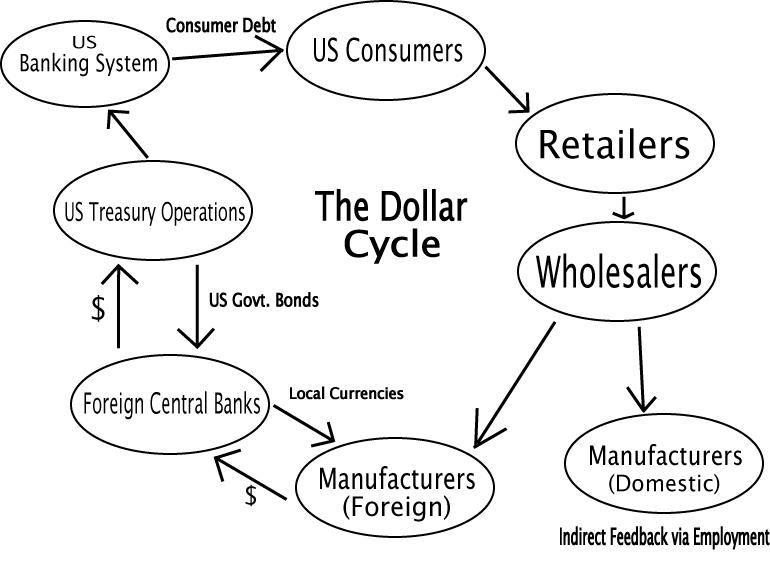
The Dollar Cycle

As can easily be seen by the chart, the demand for dollars exists only so long as there is profit to be had from re-enabling US consumers to buy products they could otherwise not afford. For decades now we have not been able to pay for our consumption with production. This is the reason for our persistent trade deficits. Our overconsumption fuels the dollar cycle. When enough of our wealth has been transferred to foreigners, they will no longer need us to purchase their products since they will be able to afford to purchase the products themselves. Headlines screaming of the fact that Chinese automobile, retail and household electronics are increasing at a rapid pace fuels speculation that the fuel for the Dollar Cycle pump is beginning to run out.

The third source of demand is for petrodollars. Since the dollar is still used as the medium of exchange for many (although a slowly shrinking) number of oil transactions, countries that are net importers of oil need to keep a stock of dollars around for financing their oil habit. Smaller examples of oil-producing nations demanding something other than dollars for purchase of their oil have been emerging recently. These actions while individually small, in aggregate, serve to erode demand for the dollar. When the combined effect of petrodollars, flattening US consumption, and the drying up of the Dollar Cycle are considered, it is easy to understand the concept of diminishing dollar demand.

The Supply Side

There are several mechanisms by which the supply of dollars may be manipulated. First, the Fed can create electronic digits and infuse them directly into the banking system. Secondly, they can purchase assets of compromised value at par (near what they used to be worth). Third, they can purchase bonds directly from the Treasury, thereby monetizing our debt. In effect, what the Treasury is doing is robbing Peter (future generations of Americans) to pay Paul (current and prior deficits). The Treasury takes the dollars they get from the Fed in exchange for the debt they sold to the Fed and spends them into the economy causing inflation. There is a common misunderstanding among many individuals.

They think that the Fed is part of the government. It is not. The Fed is a private banking cartel whose ownership is divided up among the world's largest banks. Every dollar they create is a debt that is owed them with interest. In addition to the Fed, the banking system itself can create money out of thin air with fractional reserve banking by using ridiculously low reserve requirements. Combined, our money supply growth is accelerating at an alarming rate.  One look at the reconstructed M3 chart from www.nowandfutures.com tells the story:
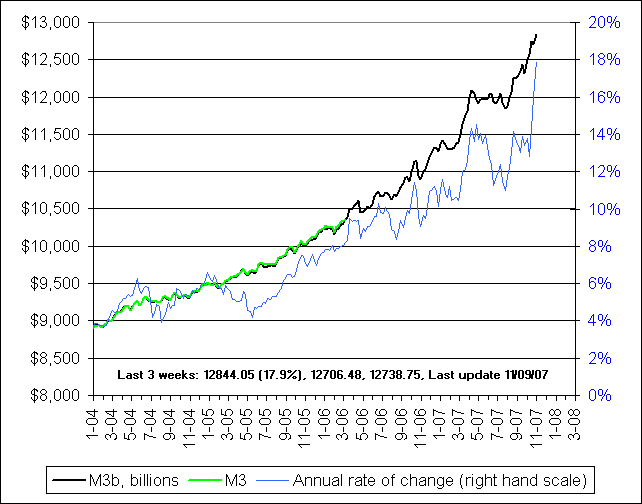
M3 Reconstruction

In summary, the demand for dollars is beginning to wane while the supply is clearly growing at an ever-increasing rate. The results are predictable: The price (value) of the dollar will go down against other types of currency and real money. One caveat to this analysis is that it is not safe to assume that the Euro et al are ‘hard' currencies just because they are appreciating versus the dollar. Nothing could be further from the truth. While it is true that many of these other currencies have implicit backing by natural resources or strong productive economies, none of them have the one true hallmark of a stable money system: an indestructible link to tangible value.

For those individuals who are interested in specific companies and recommendations, please contact us. Due to a growing number of requests, we are going to begin offering, among other services, a paid newsletter that will profile specific recommendations on companies and industries. For a nominal fee, subscribers will receive a monthly newsletter that will discuss current issues in personal finance, investment, macroeconomics and related strategies designed to navigate today's difficult financial landscape. All interested parties should visit www.my2centsonline.com for forthcoming information or email us at info@my2censtonline.com Tomorrow's investments…Today


By Andy Sutton
http://www.my2centsonline.com

Andy Sutton holds a MBA with Honors in Economics from Moravian College and is a member of Omicron Delta Epsilon International Honor Society in Economics. He currently provides financial planning services to a growing book of clients using a conservative approach aimed at accumulating high quality, income producing assets while providing protection against a falling dollar.

Andy Sutton Archive

© 2005-2012 http://www.MarketOracle.co.uk - The Market Oracle is a FREE Daily Financial Markets Analysis & Forecasting online publication.


Comments


Post Comment (Moderated)


Commenting Issue - If on submitting you are returned to the main Index Page (50% chance) then your comment has not been accepted, Follow below steps for 95% chance of comment being accepted.

  1. Click your browser Back button (from main index page).
  2. COPY your comment text from Comment box (i.e. copy to clipboard).
  3. Press PAGE Refresh - You should see the message "You are not authorized to carry out this operation"
  4. Paste your comment back into the comment text box.
  5. Click Submit - If everything goes okay you will remain on the article page with the message "Your comment was held for moderation and will be reviewed shortly".
  6. If instead you are again returned to the main index page then repeat 1-5, alternatively EMAIL to comments @ marketoracle.co.uk quoting the article number.

FREE Deflation Survival GuideFREE Updated 118 Page Independant Investor E-book