
Best of the Week
Robert Prechter's - The DEFLATION Survival Guide - FREE 60 page Ebook
Most Popular of the Week
1.The Government Will Default on Its Debts- Gary_North
2.How and Why China Will Flood the Gold Market - Jeff Clark
3.Telegraph UK House Price 55% Crash Forecast Revisited- Nadeem_Walayat
4.Nouriel Roubini's 2009 Stock Market Calls Track Record- Nadeem_Walayat
5.Is Debt-Deflation Economic Depression Just Beginning?- Mike_Shedlock
6.Stocks, Dollar and Gold Bull Markets Inter-market Analysis- Nadeem_Walayat
7.United States Catching the Argentinian Economic Disease of Hyperinflation?- John_Mauldin
Weeks Analysis
What the #@!!*&# am I Doing Out Here in Indonesia?- 7th Nov 09
Risk Trade Collapse Could Trigger Global Economic Depression- 7th Nov 09
Fed Signals “All Systems Go” for More Inflation- 7th Nov 09
Stock Market Top Likely Reached- 7th Nov 09
Financial Transaction Taxes Would Cause Stock Market Crash- 7th Nov 09
It's Time to Rally for Financial Reform - 7th Nov 09
Global Leveraged Speculation Upsurge, Financial Crisis Not Over - 7th Nov 09
Fed Attempts to Export Inflation Will Fail- 7th Nov 09
U.S. Budget Deficit Debt Crisis, Austrian, East European or Glide Option Solution?- 7th Nov 09
U.S. Economy, Investors Say No Worries Mate- 7th Nov 09
What Happened to the Stock Market Crash?- 7th Nov 09
U.S. Dollar Tops, while Precious Metal Stocks Bottom- 6th Nov 09
Financial Markets Profit Opportunity Thresholds Today- 6th Nov 09
Stock Market Investors Open Mind Warning on Highest U.S. Unemployment In 26 Years- 6th Nov 09
Financial Paper Assets Bubble Mania, What Record High Dollar Volume Says- 6th Nov 09
SPX Stock Market and HUI Gold Stocks Pullbacks- 6th Nov 09
Freaking Out over Global Warming- 6th Nov 09
The Path To Runaway U.S. Inflation- 6th Nov 09
Flashback: Bernanke on Unemployment: ‘we don’t think it will get to 10 percent’- 6th Nov 09
Jim Rogers Vs Nouriel Roubini, Can The Commodities Boom Survive? - 6th Nov 09
The Technical Alignment of Gold- 6th Nov 09
Crude Oil Classic Bullish Continuation Pattern- 6th Nov 09
Research In Motion (RIMM) Stock Buyback Chart Analysis- 6th Nov 09
Has Asia Dethroned Detroit as the Auto Sector Leader?- 6th Nov 09
India Buying 200 Tons of Gold, What does it Mean? - 6th Nov 09
The Ultimate Conditions For Economic Recovery- 6th Nov 09
S&P Stock Market Rally To Fail, Lower Lows Ahead- 6th Nov 09
Gold Market Reaching The Breaking Point- 5th Nov 09
Ryan Davies Finds Hot Technology Produces Solar Power for Half the Price- 5th Nov 09
Robert Prechter Current Stock Market Bear and Crash Calls- 5th Nov 09
The Great U.S. Housing Market Foreclosure Robbery Of The 21st Century- 5th Nov 09
Trading and Investing Books to Keep You Sane in an Insane Market- 5th Nov 09
Rethinking the Growing China Stock Market Bubble- 5th Nov 09
Any Way You Slice It, We’re at a Stock Market Top- 5th Nov 09
Five Tips for Trading ETFs- 5th Nov 09
Gold's Last Hurrah? - 5th Nov 09
Who Cares About the U.S. Dollar? - 5th Nov 09
Gold Price Collapse and Market Behaviourism- 5th Nov 09
Is Warren Buffett Implying the Stock Market Will Crash?- 5th Nov 09
When the U.S. Dollar Rallies, the Stock Market Will Crash - 4th Nov 09
The Significance of the IMF India RBI Gold Sales - 4th Nov 09
S&P 500 Stock Market Trends Analysis for November 2009- 4th Nov 09
London Bullion Market Association 2009, The Last Word on Gold- 4th Nov 09
Current Gold Silver Ratio Screams Buy All Things Silver!- 4th Nov 09
China Up / U.S. Down Investment Risk Theme Checkup- 4th Nov 09
Why Gold Has a LONG Way to Go Higher- 4th Nov 09
Can Capitalism Survive? Creative Destruction and the Global Economy - 4th Nov 09
The Best Simple Gold Indicator Around - 4th Nov 09
Gold Price is No Bubble- 4th Nov 09
Dethroning of the U.S. Dollar Will Happen Sooner Than You Think- 4th Nov 09
Stock Market S&P 500 Chart Tells the Truth- 4th Nov 09
Robert Prechter Latest Financial Market Analysis and Forecasts- 4th Nov 09
Central Banksterism- 4th Nov 09
Fed Preventing Financial Institutions From Deleveraging by Propping Up Asset Prices- 4th Nov 09
Peak Silver and Mining by a Falling EROI- 4th Nov 09 - Steve_St_Angelo
Are Biotechnology Stocks Heading for A Downturn?- 4th Nov 09 - Oxbury_Research
Scary Specter of '30s-Style Economic Depression- 4th Nov 09 -Jay Taylor
Telegraph UK House Price 55% Crash Forecast Revisited- 4th Nov 09 - Nadeem_Walayat
Nouriel Roubini's 2009 Stock Market Calls Track Record- 3rd Nov 09
U.S. Dollar at Crossroad, Gold Rally About to End?- 3rd Nov 09
Securitization Bankrupted America, So Who Owns It Now?- 3rd Nov 09
Jeremy Grantham, Stock Markets Being Silly Again- 3rd Nov 09
Make 20 Times Your Money Investing in this Hated Industry- 3rd Nov 09
What is Money and How Does One Measure It?- 3rd Nov 09
Investing in Preferred Shares Dividend Stocks- 3rd Nov 09
Silver set to Soar as it did in the 1970’s- 3rd Nov 09
Has the Stock Market Broken Major Support?- 3rd Nov 09
How to Ride the Commodities Bull Market- 3rd Nov 09
Gold NOT in Bull Market, Nadler Nonsense?- 3rd Nov 09
Life and Debt Video - 3rd Nov 09
State Budgets, How Bad Will it Get?- 3rd Nov 09
States Should Cut Wall Street Out! Own Your Own Bank - 3rd Nov 09
U.S. Third Quarter GDP Too Good to Be True? - 2nd Nov 09
Agri-Food Commodities Continue to Defy Forecasts by Trending Higher- 2nd Nov 09
Are Bank Safe Deposit Boxes Safe? No- 2nd Nov 09
Obama and the U.S. Strategy of Buying Time- 2nd Nov 09
Long Term Equity Valuation, Replacing the P/E Ratio for DR3- 2nd Nov 09
The Political Economy Postponing Providence- 2nd Nov 09
The Ayn Rand Cult- 2nd Nov 09
The Government Will Default on Its Debts- 2nd Nov 09
Economic Recovery, The Great Hoax of 2009-2010- 2nd Nov 09
Is the U.S. Dollar About To Crush Stocks?- 2nd Nov 09
Gold Survived the Test- 2nd Nov 09
Global Economy is Firing on All Cylinders- 2nd Nov 09
Is Debt-Deflation Economic Depression Just Beginning?- 2nd Nov 09
Gold, Silver and Stocks Analysis, Forecast- 2nd Nov 09
Gold Confiscation Risk- 2nd Nov 09
Stocks, Dollar and Gold Bull Markets Inter-market Analysis- 2nd Nov 09
Stocks Bull Market Forecast Update Into Year End - 2nd Nov 09
Geithner Signals Gold Going Much Higher, What to Buy Now- 1st Nov 09
Gold Bull Market Forecast 2009, 2010 Update- 1st Nov 09
U.S. Dollar Bull Market Scenario Update- 1st Nov 09
The Nanny State and the Cost of Unfunded Government Liabilities- 1st Nov 09
Economic Crisis in the Post-industrial Age- 1st Nov 09
Stock Market Down Draft Warning- 1st Nov 09
Stock Markets Sharply Lower on Sustainability Worries of Global Economic Recovery- 1st Nov 09
Halloween and it's Candy Economy- 31st Oct 09
U.S. Dollar Fiat Reserve Currency Root of the Global Financial Crisis- 31st Oct 09
Healthcare Company Profits Sensitivity to Obamacare- 31st Oct 09
UK House Prices Post Annual Gain for First Time in 18 Months- 31st Oct 09
How and Why China Will Flood the Gold Market - 31st Oct 09
Chinese Yuan the Most Undervalued Currency in the World- 31st Oct 09
Financial Markets React Negatively to Reducing Emergency Economic Stimulus- 31st Oct 09
The US Recession Is Not Over, But The Stock Market Party Is- 31st Oct 09
Is the Debt Fuelled Economic Recovery Sustainable?- 31st Oct 09
United States Catching the Argentinian Economic Disease of Hyperinflation?- 31st Oct 09

News Feeds
RSS Feeds

Free Instant Analysis

Free Instant Technical Analysis


Market Oracle FREE Newsletter

Most Popular 2009
1.UK Housing Market Crash and Depression Forecast 2007 to 2012 - Nadeem_Walayat (67,933)
2.Gold Price Forecast 2009 - Nadeem_Walayat (60,634)
3.Depression 2009 The Largest Train Wreck in Economic History - Darryl_R_Schoon (56,968)
4.Nouriel Roubini 2009 U.S. GDP Forecasting 40% Home Mortgage Failures? - Andrew_Butter (47,613)
5.Baby Boomers- Your Generation's Crisis Has Arrived - James Quinn (36.400)
6.The Financial War Against Iceland, Being Defeated by Debt is as Deadly as Outright Military Warfare - Prof Michael Hudson (35,542)
7.Ten Major Threats Facing the U.S. Dollar in 2009 - Eric_deCarbonnel (35,401)
8.Emerging Giants Russia, China, Brazil and India Looming Collapse 2009 - Martin Weiss (34,247)
9.Dow Jones Stock Market Forecast 2009 - Nadeem_Walayat (33678 )
10.Stealth Bull Market Follows Stocks Bear Market Bottom at Dow 6,470 - Nadeem_Walayat (33,082)
11. Economic & Financial Markets Forecast 2009: Collapsing Global Financial System Ponzi Scheme -Ty_Andros (32,413)
12.Hyperinflation Begining in China and Will Destroy the U.S. Dollar - Eric_deCarbonnel (31,215)
13. Stock Market Crash 2009: Fine Tuning DJIA Target To 5,800 - Eric_Chevrette (30,784)
14. .Stock Market to Fall AT LEAST Another 40%! - Martin Weiss (30,336)
15. Economic Forecast 2009: Deflation, Deleveraging, and Recession - John_Mauldin (28,922)
16.How Hedge Funds, Pyromaniacs and Gangsters Caused the Global Financial Crisis - Martin Hutchinson (28,636)
Most Popular 2008
1. The Great Depression 2008 - It can't happen to us....can it?”
2. The Battle for America Has Begun- Strategic Forecasts
3. UK House Prices Plunge Over the Cliff
4. US Banking System Teetering on the Brink of Collapse
5. US Economy Forecast 2008 - First Recession then Recovery
6. How Safe is My FDIC-Insured Bank Account?
7. Rising Risk of a Systemic Financial Meltdown:The 12 Steps to Financial Disaster By Nouriel Roubini
Most Popular 2007
1. US Housing Market Crash to result in the Second Great Depression
2. Operation FALCON - The USA is turning into a Police State
3. UK Housing Market Crash of 2007 - 2008 and Steps to Protect Your Wealth
4. US Housing Bubble Meltdown: "Is it too late to get out"?
5. Global Liquidity Crisis when the Credit Boom comes to an End
Most Popular 2006
1. Last Warning! Three-Pronged Collapse ... Stocks, Bonds and Real Estate
2. UK Interest Rate forecast for 2007 - Bank of England to do battle with inflation
3. UK Interest Rates Forecast to rise much higher due to rising Inflation and high Money Supply Growth
4. Emerging Markets outlook for 2007 - India, China, Russia, Eastern Europe and Brazil

Links

Money Forums
Certz
TradingTheCharts
Housing Market Forecasts
Local Issues


Free Access to Robert Prechters Current Forecasts

Is the US Economy Already in Recession?

Economics / US Economy Jan 21, 2008 - 04:29 PM

By: Gerard_Jackson

Economics Figures from the Institute of Supply Management are painting a grim picture. Its PMI (performance manufacturing index) stood at 47.7 in December against 50.8 November. (Anything below 50 indicates a contraction). For the same period production fell from 51.9 to 47.3 while employment remained largely unchanged. Ordinarily this would be enough for anyone ' including me ' to declare the US economy in recession. Unfortunately the situation is not that clear because we have yet to learn what Bernanke will do in the near future.


Last week President Bush hosted a press conference where he announced a stimulus package of $145 billion that mainly consisted of tax cuts.? So will it work? The US is a $14 trillion economy (about 30 trillion if one takes in to account total spending). As a per centage of GDP the package comes in at a mere 1 per cent. In any case, the idea that increased spending on consumption would avert recession is a fallacy. All it would do is misdirect more and more resources and making things more difficult for manufacturing.

Bernanke is in a very tight spot on this one, thanks to his Keynesian training. The standard approach would be a combination of tax cuts and interest rate cuts. Some would argue that cutting interest rates has the same effect on industry as a cut in capital gains taxes. Therefore the US can have the best of both world's in that an effective interest rate cut would increase the amount of capital gains and hence tax revenue, not to mention the revenue from other incomes.

This is thoroughly fallacious. Genuine capital gains are profits, therefore cutting them increases genuine savings which expand the capital structure. On the other hand, interest rate cuts - meaning forcing interest rates below the market rate - expand credit without creating genuine savings. This leads to more malinvestments that will have to be liquidated at a later date. This is called having a recession.

How interest rates influence the pattern of production is not generally known, even among economists. Let us take a simple situation where the market rate of interest is 4 per cent. The central bank now decides to lower the rate to 3 per cent. It does this by expanding credit through the banking system. At 4 per cent a company will borrow $100 million for expansion. By forcing the rate down to 3 per cent it will now pay the company to borrow $133.3 million. (This figure is equivalent to a 4 per cent loan for the company).

(Now it would be nice if there were strict economic laws that could be neatly expressed in formulas as is the case in physics. But economics deal with human action and is therefore a qualitative discipline with its own ineluctable logic. However, as we can see, a hypothetical situation can be created that will mirror to a considerable degree the real world).

While it does not follow from our example that our company will borrow all of the additional $33.3 million the example clearly shows why forcing down the rate of interest encourages further borrowing while adding nothing to savings. (For the sake of simplicity I have ignored the phenomenon of forced savings). All things being equal, the 25 per cent interest rate cut will misdirect production and exert an upward pressure on prices and a downward pressure on the exchange rate

What this means is that Bernanke is snookered. A worthwhile ? worthwhile from industry's point of view ? cut in interest might very well cause manufacturing to expand, cut unemployment further and cause GDP to grow. This is precisely what happened in Australia. The PriceWaterhouseCooper PMI stood at 52 in March 2000: by December it had fallen to 44.2. Manufacturing was obviously contracting but then there was a sudden reversal: by August 2001the PMI had jumped to 51.9 and by December it had risen to 55.4.

The trend was similar for production in general which stood at 42.6 in December 2000 before rising to 56.3 in December 2001. It was the same for the employment index which rose from 48 to 53.5 in the same period. So what happened? The Reserve Bank of Australia cut rates from 6.25 per cent to 4.25 per cent, a full two per centage points. This sent M1 leaping by 22 per cent in 2001 and bank deposits by 25 per cent. This monetary explosion added further fuel to the current account deficit, aggravated our foreign debt and triggered a massive housing boom which we are still enduring.

The consequences for the world of Australia's dangerous monetary policy are insignificant. The same, unfortunately, cannot be said of the US. But that's a topic for another article.

There is near-hysteria about the amount of debt. Reports like the one about Merrill Lynch having to write-off $16 billion in mortgage-related investments is certainly not helping matters. But where in heavens name do all these billions come from? Well, we already know the answer. Furthermore, the economists at Merrill Lynch should also know it. There is nothing new about financial fiascos that are built on excess credit. History, if nothing else, show us that the consequences of continued credit expansion is that ' you guessed it ' people tend to accumulate more debt. Richard von Strigl, an eminent pre-WWII Austrian economist (he died in 1942) observed that when

'.expansion progresses, the greater will become the share of additional credits in the overall volume of credits within the economy. ( Capital and Production , Mises Institute, 2000, first published 1934).

Note: When the recession comes the Democrats and their media lackeys will once again denounce free market policies while the real culprit ' lousy economics ' escapes scot free. Part of the problem is not just the economic illiteracy of journalists but also their political bigotry, of which Marc Moncrief at The Age is a nasty little example. On 19 January he 'reported':

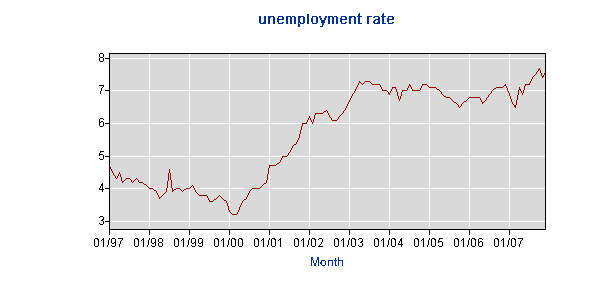
Hard times in the US economy have treated Michigan badly and the state's unemployment rate last month hit 7.6% -' well above the 5% measured nationally. ( The Age , Down for the count-' . 19 January 2008).

That's right, folks, that nasty President Bush and his crummy economy is the cause of Michigan's woes. The following chart clearly shows that the unemployment rate in Michigan began to rise about February 2000, peaked in 2003 after which it was comparatively stable. As Bush was not inaugurated until 20 January 2001 I fail to see how he could be responsible for the state's rising unemployment. Little things like facts, however, will never stop political bigots like Moncrief and that's why he did not tell his readers how the policies of the state's ruling Democrats had badly damaged the economy.
By Gerard Jackson
BrookesNews.Com

Gerard Jackson is Brookes' economics editor.

Copyright © 2008 Gerard Jackson

Gerard Jackson Archive


Comments


Post Comment (Moderated)


(Note Commenting Issue: If after Submitting you are returned to the Main Index Page then due to site caching your comment has not been accepted. Solution - Click the Browser Back Button to the article page and Press PAGE REFRESH (you should see the message "You are not authorized to carry out this operation") Now re-enter your comment (ignoring the notice) - If all's well then you will remain on the article page after submitting, a moderator will check and authorise the comment. Alternatively EMAIL to comments @ marketoracle.co.uk , quoting the article number.

FREE Deflation Survival GuideFREE Updated 118 Page Independant Investor E-book
