


Grain Exporting Countries of Africa to Mirror Crude Oil OPEC Boom
Commodities / Agricultural Commodities May 15, 2008 - 12:37 AM GMTBy: John_Mauldin

 What countries are truly the have and have nots of the world? Good friend and business partner Niels Jensen of Absolute Return Partners suggests we look at the old equation in a new way? Food and energy resources may be at least part of the definition in the future. In this week's Outside the Box we continue a them I mentioned a few weeks ago: agricultural needs are going to be a new and important force in the world and when coupled with energy may shift the balance of power in the world in strange a different ways.
When, as Niels points out, Afghanistan poppy farmers are shifting to wheat farming, the world is truly a different place. I think you will find the research he has done to be truly worth a few minutes of your thinking time.
And as a preface, I was reminded a little while ago that a Financial Times headline story last Friday mentioned that China is buying African farmland and building massive amounts of railroads and infrastructure to get grains to the market. I have long been bullish on African farmland. This week's OTB will tell you why.
John Mauldin, Editor
Outside the Box
The Absolute Return Letter
May 2008
"There is nothing so disastrous as a rational investment policy in an irrational world." - John Maynard Keynes
You just know that something is astray when Afghan poppy growers begin to switch from opium to wheat. According to the Independent newspaper here in the UK, that's exactly what is now happening. I have no desire to enter into a pound for pound risk/reward analysis of producing wheat versus opium. However, the consequences of the rapid rise in energy and agricultural commodity prices are far reaching and perhaps not as well understood as they should be. That is the content of this month's letter.
The Silent Tsunami
 My story begins with Al Gore. While most of us lulled ourselves into the belief that he was onto something when he tried to convince us that global warming (or climate change, as I prefer to call it) was the most formidable challenge facing this planet, a silent tsunami 1 , also known as the global food crisis, began to develop and is now threatening to undermine global political and economic stability, the latter of which has been key to the benign financial markets we have all benefited from in recent years.
According to the World Bank, just over 1 billion people live on one dollar or less per day. People in the poorest countries in the world spend 80% of their income on food. So when you and I have hardly noticed that the bread we pick up from the local bakery has doubled in price over the past year, it is because only 10-15% of our budget is spent on food items 2 . In many emerging economies the number is much higher. Chinese consumers spend 28% of their income on food. In India it is 33%. If you want to know how much it is in your country, go to: http://www.ers.usda.gov /briefing/cpifoodandexpenditure s/data/2006table97.htm .
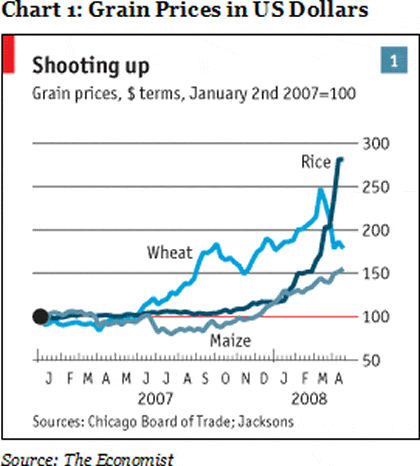
There are three food staples in the world today which dwarf all other food ingredients in terms of importance. They are (in alphabetical order) corn, rice and wheat. As you can see from chart 1 below, they have all experienced rapid price appreciation since last summer. What is it that has driven this price explosion and what does it mean to financial markets? As with most things in life, there is no simple explanation; a number of factors have conspired to create a situation which is exceptional but also destabilising and hence dangerous.
It Is The Bio-Fuel Policy Stupid!
The explanation given by most commentators is the bio-fuel policy currently being pursued by the Bush administration in Washington. The policy is driven by a desire to unlock the United States from its rising dependence on imported crude oil. The problem, as Bush and his government have been slow to recognise, is the stupidity of the policy in its current form. Let's back that claim up with some hard facts.
In the United States, corn (better known as maize over there) is the primary ingredient in ethanol production although wheat and soybeans are also used. According to a recent UN report, it takes 232 kg of corn to fill an average 50 litre car tank with ethanol - enough corn to feed a child for an entire year. It is estimated that almost 20% of total US corn production will go towards ethanol this year and the number is set to rise to 45% by 2015 3 .
The problem with corn is that it is low on carbon hydrates, which is where the energy comes from. Instead, American ethanol producers rely heavily on fertilisers with the energy being extracted from the nitrogen in the fertiliser. This is an inefficient and very costly approach - in particular in an environment of rising energy prices because crude oil and/or natural gas are major ingredients in fertiliser production. 33,000 cubic feet of natural gas are required to produce just 1 ton of ammonia!
So what does all this mean? According to estimates from Goldman Sachs, the cost of ethanol from corn is now over $80 per barrel, it is about $145 from wheat and over $230 from soybeans. Other countries recognised this problem a long time ago and use crops with higher carbon hydrate content. In the Philippines they use coconut oil and the Brazilians use sugar cane. Goldman reckons that the cost of one barrel of ethanol based on sugar cane is about $35. So why not import sugar cane from Brazil instead of using corn? One simple answer: Brazilian farmers do not vote at American elections. Idaho farmers do.
Are Investors To Blame?
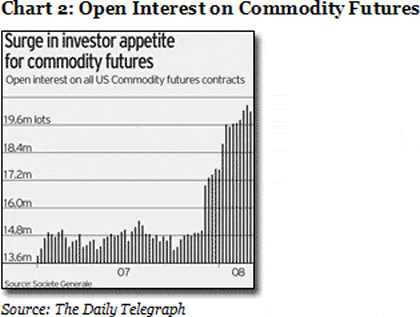 There is no question that the US bio-fuel policy which, by the way, is now being copied in other parts of the world including the EU, has to take its share of the blame. But it is by no means the only reason for the food crisis. The next culprit on my list is our very own industry - investors of all kinds. In recent years there has been rising demand for commodity-linked investment products from investors all over the world. Pension funds, hedge funds, mutual funds and private investors have all allocated more and more to commodities and, in recent months, demand growth has been explosive, as is evident from chart 2 below. It is estimated that the aggregate value of commodity-linked index funds now exceeds $200 billion, a very significant number in a not very large market.
For those of you following the market for exchange traded funds (ETF), you will have noticed that not a day has passed in recent months without yet another new commodity ETF being launched. Since the issuers of these ETFs do not want to take any risk on their books, all these ETFs are hedged - typically through commodity futures. In other words, every time you buy a commodity ETF, you contribute to the continued rise of commodity prices and hence inflation.
For that very reason, it is possible - but not a given - that much of the recent rise in commodity prices is based more on market technicalities than on fundamentals. If so, this could be the next bubble waiting to burst. We continue to hear stories about institutional fund managers being overloaded with commodity futures but have found limited hard evidence so far.
Water Shortages Are A Problem
Water is next on my list. Australia - one of the world's largest grain producers - suffered badly last year due to severe drought with its wheat harvest being only 50% of the prior year's output. However, water, or rather lack thereof, has played havoc in more ways than one. In China, water depletion is a serious problem and the problem is exacerbated by top soil erosion and poor fertility. China has an estimated annual water shortfall of 40 billion cubic metres. Closing that gap through artificial means (desalination, etc.) would consume the equivalent of 3% of the world's oil output.
Until recently China has been one of the world's major grain exporters. Those days are now over. By 2010 China expects to import the equivalent of 40% of US corn exports. According to estimates from UBS, China's foreign currency reserves, which are the largest in the world, could be slashed in half over the next few years if grain prices were to double again from current levels. As an aside, China has recently decided to abandon its bio-fuel programme. The reasons? A lack of water and cost inefficiencies.
In Saudi Arabia, a country of 28 million people, water depletion is a serious problem. Estimated recoverable water reserves are now less than 10 years and falling rapidly. For that reason, the Saudis have decided to wind down their domestic agricultural industry. Historically, the Saudis have been self sufficient on food. They now say that they will import 100% of their food requirements by 2016.
Have We Been Complacent?
Number 4 on my list is complacency. Al Gore (yes, him again!) seduced us all into focusing on the climate. Many a government agency around the world took its eyes off the ball and allowed food stocks to deplete. US wheat inventories, for example, are now at the lowest level since 1947/48 when the US population was only half the size it is today.
Similar problems have caused panic buying in the rice market in recent weeks where stocks are at the lowest levels since 1976. 3 billion people in Asia and Africa rely on rice as their primary food staple. Governments in India, Thailand, Vietnam, Argentina, Cambodia, China and Egypt have all imposed export controls in order to secure domestic needs. The World Bank is so concerned about the situation that it now predicts food riots in more than 30 countries around the world.
 Productivity Levels Are Falling
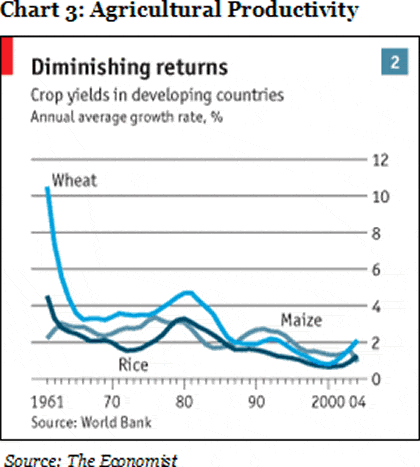
Number 5 and 6 on my list are closely related. The total amount of arable land in the world is diminishing, primarily as a result of urbanisation. China alone has lost 3 million hectares of rice land to concrete in the past 10 years. In order to compensate for the reduced acreage, higher productivity levels are required. But higher yields require increased use of fertilisers which is not an option available to everyone given the price of oil. In some parts of the world, for example in Africa, there is now evidence of farmers planting less than in prior years as they cannot afford fertilisers. Falling yields are not a new phenomenon, though, as you can see from chart 3.
In one of the largest grain producing areas of the world - the former Soviet Union - the total acreage planted has dropped 12% since the iron curtain came down. The 3 largest producers in the area all suffer not only from reduced acreage but also from low yields compared to western standards. In Kazakhstan, grain yields are 1.1 tonnes per hectare, in Russia they are 1.8 and in the Ukraine 2.4. US grain yields, by comparison, are 6.4 tonnes per hectare 4 . The good news is that there is plenty of land available in places like Russia and Kazakhstan. The bad news? Experience suggests that it will take about 10 years to turn non-farm land into fertile farm land.
The Meat Culture Prevails
The final factor has to do with changing eating habits. This phenomenon has received its fair share of the blame in the media in recent months, but I actually think this is more of a concern for the future than a reason why food prices have exploded in recent months. Eating habits do not change overnight. At the macro level, a changing diet takes years to materialise. Having said that, there is clear evidence that Asia's growing middle classes are switching to meat based diets. If the rest of Asia were to follow Japan's example, the protein intake across Asia will explode over the next couple of decades. The Japanese are consuming almost 10 times as much protein as they did 50 years ago. Why is that a problem? Because it takes over 3 kg of corn to produce 1 kg of pork and over 8 kg of corn to produce just 1 kg of beef!
So What Does It All Mean?
 There are very good reasons to believe that high food prices will stay with us for quite some time. Yes, there may be some elements of speculation behind the recent explosion in grain prices, maybe even hints of a bubble, but underlying supply and demand factors are such that we'd better get used to lofty food prices for years to come. That has implications for financial markets left right and centre (finally I get to what this actually means!).
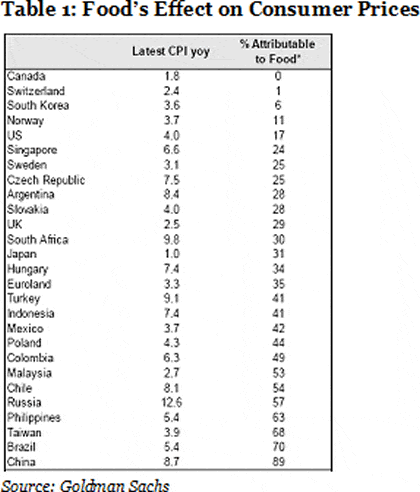
The analysts at Goldman Sachs have calculated the effect rising food prices have had on overall consumer prices (see table 1). The conclusion is inevitable. Whereas in most OECD countries the feedback process between food inflation and non-food inflation is modest, in virtually all emerging economies the feedback is significant. Secondly, non-food inflation is most affected by high food inflation in countries with high inflation rates such as Russia, Indonesia, Argentina and Mexico (see chart 4).
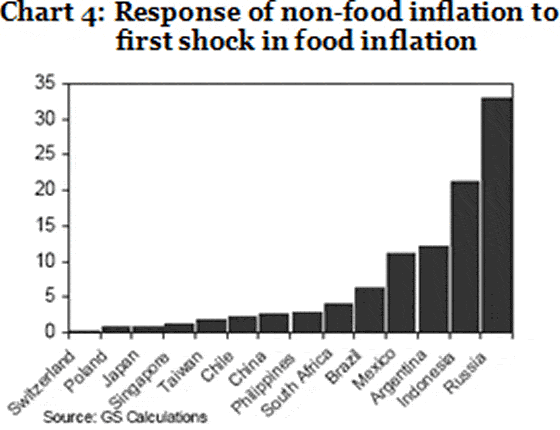
This is an important observation because the investment community is almost universally in favour of emerging markets these days. Rarely have I experienced a period where the bulls have been more plentiful and the bears fewer and farther between. Most investors seem to believe that headline inflation will gradually come back to core inflation levels over the next year or so. Few investors seem to think the unthinkable - that core inflation will gradually rise to headline levels.
Asia May Pay A High Price
Even fewer seem to realise that if oil prices and agricultural prices continue to run amok, the Asian miracle story, upon which so many investors have pinned their hopes for the next few years, may, in fact, turn into a nightmare. The reason is simple enough. Asian countries are large importers of both oil and food staples. Very large!
To give you an idea of the appetite for oil in Asia, take a look at chart 5. As you can see, over 50% of the incremental global demand for oil over the past few years has come from Asia - almost 35% from China alone. In fact, over the last 5 years, China's energy consumption has grown 5% faster than its GDP per year. Yes - per year!
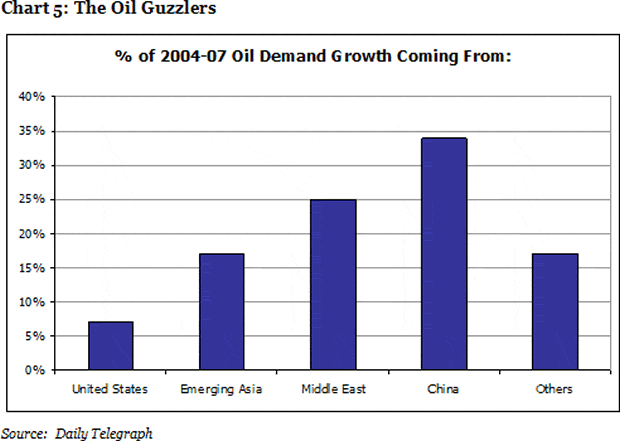
It is now projected that China will overtake the US as the world's largest energy consumer by 2010 despite its GDP being only 1/5 the size of the US GDP. No wonder the Chinese are running around in obscure parts of the world attempting to secure long term crude oil deliveries.
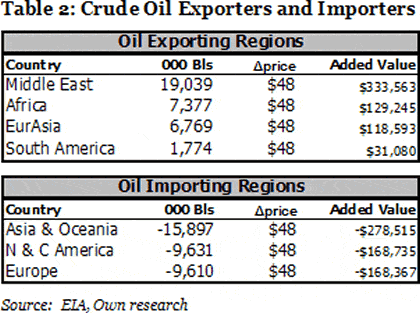 Based on the current crude oil price of $112, and an estimated average price of $64 over the course of 2007, I have calculated the net gains and losses to oil exporters and importers (see table 2). Not surprisingly, the Middle Eastern producers stand to gain the most - $333 billion of incremental revenues - but African producers and Russia also stand to benefit significantly. On the import side, Asia is paying the highest price. The current level of crude oil prices should add about $278 billion to the bill over and above what Asian countries paid for their oil imports last year.
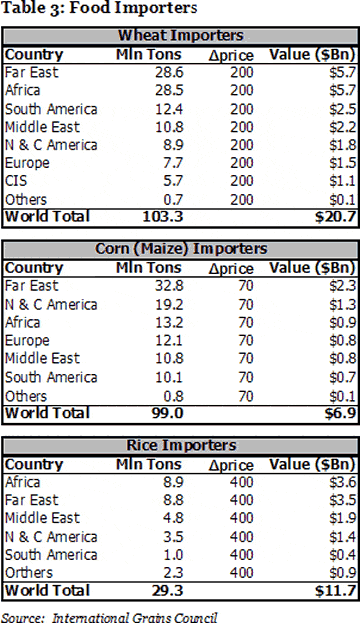
Rising agricultural goods prices, although significant, are not having the same aggregate wealth effect as rising oil prices. In table 3, I have estimated the added cost of rising food prices from importing the three main food staples. Again you will see that rising prices are hitting Asia the hardest. Remember table 3 only looks at the import of raw materials. The effect from rising prices on processed foods is not included.
Neither does table 3 do any justice to the damage done at the micro level. Of the 3 billion people who rely on rice as their primary source of food, over 2 billion live on $2 or less per day. The recent price jump spells disaster for these people and could potentially cause massive economic dislocation throughout Asia. Riots are now a real possibility in many of these countries.
As far as the investment story goes, here is the problem. The prevailing view today is that the western world is yesterday's story and that the best way to ensure continued high returns in your portfolio is to focus on emerging markets - in particular Asia. The argument runs approximately as follows:
 The Consensus View
The OECD area (the old world) is plagued by a rapidly ageing population with all the negatives that follow - rising health care costs being the most important. Many OECD countries also have unfunded pension liabilities and large budget deficits, raising serious questions about whether the 21 st century society can afford to maintain the retirement system as we know it today. Some even argue that structures such as the Euro are doomed because of dramatic discrepancies in performance within the Euro zone. Now consider the US dollar. The greenback is probably the most disliked currency in the world today (well, not taking the Zimbabwe dollar into consideration). If you buy these arguments it is no wonder that many investors shy away from the more established markets.
On the other hand, emerging markets - and Asia in particular - beam with opportunities. The population in most emerging market countries is still young, savings rates are high and the optimism is there for everyone to see. In short, it is exceedingly hard to find anyone who wouldn't agree that Asia offers the best growth prospects going forward. So overwhelming is this view that it is virtually impossible to find a single brokerage house, institutional investor, commentator, punter, etc. who doesn't advocate an overweight of Asian shares in equity portfolios.
Do Not Assume One-Way Traffic
While I agree that emerging markets offer better growth prospects than OECD countries, I disagree that it is going to be one-way traffic. As demonstrated above, rising commodity prices will hit Asia much harder than any other region in the world as it is in fact the only region in the world today which is a net importer of both crude oil and food staples.
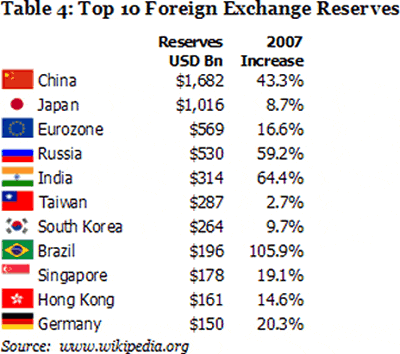
In table 4 I have listed the largest holders of foreign exchange reserves in the world today. As you can see the list is dominated by Asian countries. All those investors who buy into the Asian growth story pin their argument either directly or indirectly on the size of these reserves. Growth requires investments; however, due to the high savings rates across Asia, and hence the plentiful reserves, the money is there to finance those investments without the countries becoming net debtors. What the argument does not take into consideration is that, at least in some countries, those reserves will be increasingly going towards paying for the rising cost of oil and food imports.
The 'haves' And 'have Nots'
Instead I believe investors will increasingly differentiate between the 'haves' and 'have nots'. And the 'haves' are those countries which control the world's resources. In fact, few countries are net exporters of both oil and foods on a large scale. Come to think about it, it is less than a handful. And no Asian country is on the list. So who is on it? In the old world only one - Canada. In the grey zone (emerging economies but not necessarily young and dynamic populations) perhaps two - Russia and Kazakhstan. And amongst full blooded emerging economies? Noone today, although Brazil has the potential to turn itself into a winner and so does Africa, if it can sort itself out.
All this is not to say that investing in Asia is doomed to fail. There are many good reasons why you want to invest there. However, the invest case is not as straight forward as it appears at first glance, and throwing in a bit of Africa, Brazil and/or Russia may not be a bad idea.
An Afterthought
For over 30 years, the world has had to suffer the consequences of OPEC - an organisation as keen to enrich its members as we in the Western world are hooked on its main produce - crude oil. Has pay-back time finally arrived? Should we be tempted to create OGEC - the Organisation of Grain Exporting Countries - with the objective of ensuring overall resource stability, i.e. food will only be exported to oil producing countries provided they deliver oil to us at a reasonable price?
The largest wheat exporters today are (in order of rank) the US, Canada, Russia, the EU, Argentina, Kazakhstan and Australia. Most of these countries happen to be net importers of oil. Is it unreasonable to apply a 'tit for tat' approach? My heart (as does my bank manager) tells me yes but my gut feel says no. The world has always been a better place when government interference has been kept at a minimum. The problem we face in this particular situation, though, is that not everyone plays by the same rules. If that could be fixed, the world would indeed be a better place.
Footnotes:
[1] A term borrowed with thanks from The Economist newspaper.
[2] Our food statistics come from the US Department of Agriculture and indicate that consumers in countries such as the UK and the US spend less of their income on food than consumers in other countries. This is due to the fact that take-aways and restaurant visits are not included in the USDA numbers. Adjusted for that, almost all OECD countries spend 10-15% of household expenditures on food.
[3] Source: The Daily Telegraph
[4] Source: The Daily Telegraph
Your thinking about agricultural opportunities in Africa analyst,
John F. Mauldin
johnmauldin@investorsinsight
John Mauldin, Best-Selling author and recognized financial expert, is also editor of the free Thoughts From the Frontline that goes to over 1 million readers each week. For more information on John or his FREE weekly economic letter go to: http://www.frontlinethoughts.com/learnmore
To subscribe to John Mauldin's E-Letter please click here:http://www.frontlinethoughts.com/subscribe.asp
John Mauldin is the President of Millennium Wave Advisors, LLC (MWA) which is an investment advisory firm registered with multiple states. John Mauldin is a registered representative of Millennium Wave Securities, LLC, (MWS) an FINRA registered broker-dealer. MWS is also a Commodity Pool Operator (CPO) and a Commodity Trading Advisor (CTA) registered with the CFTC, as well as an Introducing Broker (IB). Millennium Wave Investments is a dba of MWA LLC and MWS LLC. Millennium Wave Investments cooperates in the consulting on and marketing of private investment offerings with other independent firms such as Altegris Investments; Absolute Return Partners, LLP; Pro-Hedge Funds; and Plexus Asset Management. All material presented herein is believed to be reliable but we cannot attest to its accuracy. Investment recommendations may change and readers are urged to check with their investment counselors before making any investment decisions.
Opinions expressed in these reports may change without prior notice. John Mauldin and/or the staffs at Millennium Wave Advisors, LLC and InvestorsInsight Publishing, Inc. ("InvestorsInsight") may or may not have investments in any funds cited above. Disclaimer PAST RESULTS ARE NOT INDICATIVE OF FUTURE RESULTS. THERE IS RISK OF LOSS AS WELL AS THE OPPORTUNITY FOR GAIN WHEN INVESTING IN MANAGED FUNDS. WHEN CONSIDERING ALTERNATIVE INVESTMENTS, INCLUDING HEDGE FUNDS, YOU SHOULD CONSIDER VARIOUS RISKS INCLUDING THE FACT THAT SOME PRODUCTS: OFTEN ENGAGE IN LEVERAGING AND OTHER SPECULATIVE INVESTMENT PRACTICES THAT MAY INCREASE THE RISK OF INVESTMENT LOSS, CAN BE ILLIQUID, ARE NOT REQUIRED TO PROVIDE PERIODIC PRICING OR VALUATION INFORMATION TO INVESTORS, MAY INVOLVE COMPLEX TAX STRUCTURES AND DELAYS IN DISTRIBUTING IMPORTANT TAX INFORMATION, ARE NOT SUBJECT TO THE SAME REGULATORY REQUIREMENTS AS MUTUAL FUNDS, OFTEN CHARGE HIGH FEES, AND IN MANY CASES THE UNDERLYING INVESTMENTS ARE NOT TRANSPARENT AND ARE KNOWN ONLY TO THE INVESTMENT MANAGER.
© InvestorsInsight Publishing, Inc. 2007 ALL RIGHTS RESERVED
John Mauldin Archive |
© 2005-2022 http://www.MarketOracle.co.uk - The Market Oracle is a FREE Daily Financial Markets Analysis & Forecasting online publication.
