


Will the Sub-Prime Mortgages Implosion Meltdown the Stock Market?
Stock-Markets / Subprime Mortgage Risks Mar 31, 2007 - 12:28 AM GMTBy: Clif_Droke

Most of the focus among investors and non-investors alike recently has been the sub-prime mortgage “implosion” and its possible impact on the stock markets and the economy. Therefore I'm dedicating most of tonight's report to an analysis of this special situation.
Since I'm not an expert in this particular area, the best analysis I can offer other than anecdotal evidence based on personal observation is to share with you my own collection of opinions from those whose expertise and analysis of similar situations in the past has proven correct in a vast majority of cases. In other words, we're going to see what some of the best in the business have to say on this subject. Then we'll take the analysis once step further and turn to the ultimate barometer of business/economic conditions, namely the stock market, and see what Mr. Market itself has to say.
Let's start with an overview of what the mainstream press has been saying about the sub-prime problem. The following excerpt comes from an Associated Press news article of March 16:
“It's easy to see why the implosion in mortgages to people with weak credit has panicked stock investors. Their biggest fear is that the sub-prime blowup could hit the broader economy hard, potentially leading to a recession. It was no secret that people with spotty credit histories were increasingly allowed to borrow money to buy homes more costly than their limited income would deem prudent.
“The business grew sharply in recent years. About 20 percent of total new mortgage issuance in 2006 was to sub-prime borrowers, up from 5 percent a decade ago. That created $600 billion in new obligations last year.
"'As the Fed was raising rates over the past three years, mortgage lenders were offering teaser rates to suck more borrowers into the mortgage market,' said economist Ed Yardeni. ‘If you lend money to someone who doesn't qualify to borrow money in the first place, why the surprise when they don't pay?'
“For the sub-prime woes to widen to the overall economy, Americans who don't have low credit scores will have to start struggling to pay off the money that they also borrowed. A hint of that showed up in a report by the Mortgage Bankers Association this week that said prime fixed-rate mortgage delinquencies rose to 2.27 percent in the fourth quarter from 2.10 percent in the third quarter.
“Also worrisome is whether there will be a widespread credit squeeze if all lenders start clamping down on borrowing. That would be especially bad for the already battered housing market, since it would likely mean fewer mortgages issued at a time when there is a growing glut of housing supply available.”
Here is what a few leading analysts had to say about the impact of the sub-prime issue on the economy. Quoting from the Financial Times of Mar. 13: “Steven Wieting, economist at Citigroup, said rising mortgage delinquencies were a more significant issue for financial institutions and investors than as indicator of economic trends. ‘In all likelihood, credit problems for low-net-worth consumers are not a substantial issue for the overall pace of consumption,' he said. ‘The modest share of the population and the low share of national income associated with adjustable rate sub-prime loans also suggests little consumer demand impact.
The bears, however, are singing another tune. The current rage among them is how the sub-prime problem will lead to a possible credit crunch and diminution of global liquidity, thereby bringing about a stock market crash and/or global economic recession. To highlight what some leading bears are saying, here's another quote from the Mar. 13 FT: “However, Jorma Korhonen, manager of the $2.8 bn Fidelity Global Special Situations Fund, warned the difficulties in the U.S. sub-prime mortgage market contained all the ingredients of a possible credit crunch. ‘If this were so, it could trigger a reduction in global liquidity. Obviously, this would have negative implications for other asset classes, including equities,' he told a Q&A on FT.com.
“The Mortgage Lender Implode-o-Meter, a website tracking the woes of the U.S. sub-prime market, said the number of sector lenders that had ‘croaked' since late last year had gone up to 36.” (FT, by Tony Tassell, Richard Beales and Chris Flood)
To stir things up in favor of the bears, former Federal Reserve Chairman Alan Greenspan in his talk last week suggested the sub-prime problems would spread and that a recession could come by year's end.
Another economist, Nouriel Roubini, chairman of Roubini Global Economics in New York and a professor of economics at New York University, had predicted a recession to begin in the first or second quarter of this year and said Tuesday's market downturn provided more evidence of recession to come. “We have lousy economic news,” Roubini, a former White House and Treasury Department economist, told the FT on Feb. 28. “It's just the beginning of much worse things to come.”
But one of the very best economists out there today, Ed Yardeni, president of New York-based Yardeni Research, said recession talk “has been brewing” among analysts this year, and Greenspan simply brought it front and center. Yardeni expects the economy will rebound to 3 percent growth by year's end as consumers continue to spend, making a recession “not possible” this year. ''There's
going to be more and more talk about the economy being weak and the prospects for the Fed lowering interest rates,'' Yardeni told the Los Angeles Times of Mar. 1. ''My view is so far the economy continues to demonstrate that it's remarkably resilient, with consumer spending and unemployment numbers still looking good,'' he said.
Moreover, in his Feb. 12 report Yardeni wrote: “In the January 29 th Morning Briefing, I wrote, ‘It's getting closer to showtime for the sub-prime mortgage market. It may soon blow up. The question is, will it matter to the economy? I don't think so, but we should soon find out.' The sub-prime hit finally arrived last week when New Century Financial and HSBC – the second and third largest providers of such loans, respectively – admitted that bad loans were rising rapidly.
“HSBC upped its provisions for bad debts by $1.76 billion in 2006 to $10.56 billion. Banks are scrambling to tighten their lending standards and there is talk of a credit crunch. Indeed, in the February 8 th Wall Street Journal, Ruth Simon reported that some homeowners who would like to refinance their ARMs are finding they can't. “This raises two questions:
(1) Will this become a widespread financial contagion?
(2) Will it become an economy-crippling credit crunch and depress the stock market?
On the first question, I was encouraged by Jamie Dimon, CEO of J.P. Morgan Chase, who said that the sub-prime mortgage market was one area of the economy ‘which looks like a recession.' Most of the problems have related to loans originated in the last couple of years, and Mr. Dimon said J.P. Morgan had sold-off most of the loans it had taken on in 2006 (Financial Times, 2/9/07).
“That's only one big money center bank, but my guess is that most of the originators securitized their sub-prime loans; they did not keep them, as did New Century Financial and HSBC. So I don't expect a financial contagion and a widespread credit crunch.
“Previously, I've noted that the sub-prime mortgage market accounts for about ten percent of the total mortgage market. That's about $1 trillion. According to a few worst-case scenarios, 20 percent of these mortgages are likely to go to foreclosure, affecting as many as one million households. These are big numbers, but not relative to the size of the credit market or the total number of households.” (Ed Yardeni, Feb. 12, www.yardeni.com )
Further commenting on the mortgage-related market pressures, Donald Rowe of the Wall Street Digest wrote: “I do expect the Fed Chairman to continue creating money at a faster pace in order to push GDP growth up enough to help alleviate the problems in: the housing industry, the sub-prime mortgage industry, and the auto industry....
“In mid-February Fed Chairman Bernanke gave the markets a lift in his semi-annual report on the economy to the Senate Banking Committee and the House Financial Services Committee. Bernanke said inflationary pressures continue to recede, meanwhile “the economy seems likely to expand at a moderate pace.” Bernanke implied that a rate hike soon is unlikely even as housing stabilizes.” (Donald Rowe, March 2007, www.wallstreetdigest.com )
Now let's discuss what the leading barometer of business conditions itself, namely the stock market, has to say on the sub-prime mortgage meltdown issue. Since the stock market “sees” into the future and anticipates recessions and other major problems a good 6-9 months in advance, has the market's recent action been indicative that it expects to see the mortgage problem develop into something far more severe? My answer would be “no it doesn't.” In spite of all the negative news and commentary that has been thrown at this market in the past few weeks it has actually held up quite well.
The most impressive thing about this market is how well the breadth (in the form of the new highs/new lows) has held up in spite of it all. Question: If the sub-problem means the market is on the verge of a major crash and bear market, and if the economy on the verge of recession, shouldn't we have seen it register in stock prices by now in the form of an extended decline and weakening internals? Wouldn't the Dow Jones REIT Index (DJR) be in far worse shape than it is now? The REITs have mainly overlooked the potential for trouble within the real estate market and broader economy and haven't been as negatively impacted by the sub-prime problem as you'd think.
The real question that investors should be asking themselves at this time is, “What was the point of the media hype surrounding the sub-prime ‘melt down'?” After all, if sub-primes represent a mere fraction of the mortgage market as we're being told, why would the mainstream press go out of its way to frighten everyone with those big, scary headlines to begin with? Remember, the press didn't *have* to focus on sub-primes. There were plenty of other stories going on in the world, including other financial-related problems (or perceived problems), including the yen-carry trade. Why so much emphasis on sub-primes? Is it because the media *wanted* the average retail investor to be scared into dumping his stocks so the “smart money” could pick it up at bargain prices? I recall that economist Dr. Stuart Crane used to say that “whatever you're reading in the newspapers is put there because someone wanted you to read it….the news media doesn't exist to inform you, but to lead you into a particular way of thinking.”
Notice that no sooner had the damage been done by the Greenspan comments, et al, on Feb. 27, that insider buying picked up drastically just the public had dumped record volumes of shares onto the market. And notice, too, that as soon as most of dust from the stock market panic cleared the mainstream press started coming out with softer, soothing comments concerning sub-primes, as if to reassure the investor that everything would be okay after all. These were the same scare-mongers who only days before were telling everyone to run for cover! Could it be that their job of assisting the insiders with takeovers and stock buying, private equity, etc., was accomplished and so now it was time to stop the scare-mongering and allay the public's fears? By “reading between the tape” I believe the astute reader will come to just that conclusion. Also worth pointing out is that past bear market and economic recessions have always been preceded by rate of change slow
downs in aggregate money supply. This was true heading into the stock market crash of 1929 and the Great Depression of the early 1930s. The stock market declines and recession of the early 1970s were all preceded by rate of change declines in money supply. This was also true of the market crash of 1987 as well as the bear market/recession of 2000-2002. So why haven't we seen it this time around? Money supply is strongly growing on an actual as well as a rate of change basis. For the market to implode from here would be a precedent in the face of rising liquidity.
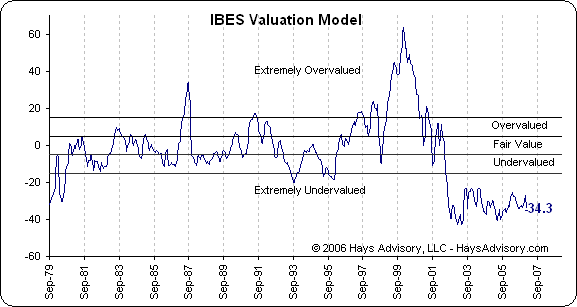
Another consideration in this analysis is the Institutional Broker Estimate Service (IBES) Valuation Model of the stock market. Every major bear market of the last 28 years has been preceded by an over-valuation of stocks as measured by the IBES Valuation Model chart. For instance, just prior to the 1987 stock market crash the IBES model showed aggregate stock prices to be 35% over-valued. Just before the 2000-2002 bear market kicked off the model was showing stocks to be an astounding 62% over-valued. Today the model shows stocks to be 34% *under-valued*. Does that sound like a bear market to you? For a major bear market to begin under current fundamental conditions would also be a precedent.
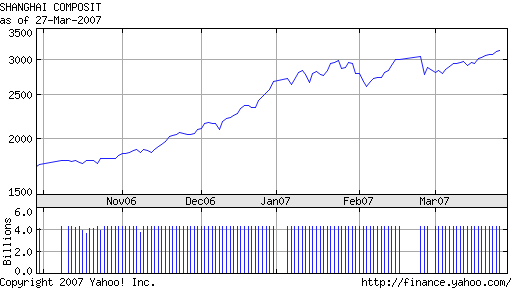
Another indication that the global market scare will be short-lived is the recent action of the Shanghai Composite Index (SSE). The SSE is the index that basically got the ball rolling on the global correction the markets have been through in late February through mid-March. As of Tuesday, Mar. 20, the SSE had completely retraced all of its losses and made a full recovery on an intraday basis, closing at its all-time high on Tuesday. Thus the first major event-driven panic has recovered nearly all its losses just as expected based on history. This proves what I've been saying since the panic began that losses following an even-driven panic are usually recovered within a short time.
The bottom line is that the sub-prime mortgage market delinquency problem isn't likely to cause significant damage to the broad market and general economy. There are always worries when it comes to predicting the future, and I'm certainly not trying to completely shrug off the sub-prime problem. It's still a problem but the market's “shock absorbers” have done a fine job of protecting the market from taking major hits from exogenous forces, such as the real estate slowdown, sub-primes, the yen-carry trade threat, dollar weakness, Fed interest rate policy, etc., etc. The market's strength to date in holding up to a near constant barrage of bad news is impressive and is not to be ignored. It strongly suggests the intermediate-term uptrend will remain intact.
By Clif Droke
www.clifdroke.com
Clif Droke is editor of the 3-times weekly Momentum Strategies Report which covers U.S. equities and forecasts individual stocks, short- and intermediate-term, using unique proprietary analytical methods and securities lending analysis. He is also the author of numerous books, including most recently "Turnaround Trading & Investing." For more information visit www.clifdroke.com
© 2005-2022 http://www.MarketOracle.co.uk - The Market Oracle is a FREE Daily Financial Markets Analysis & Forecasting online publication.
