


Trading Stock Bear Markets
Stock-Markets / Stocks Bear Market Oct 10, 2008 - 11:24 AM GMTBy: Zeal_LLC

 Last week was one of the wildest witnessed in the stock markets in modern history. On Monday September 29th stocks started plunging immediately after the US House of Representatives voted down the Wall Street bailout. This steep decline ignited a massive fear spike unlike anything seen in years. It was awe-inspiring to behold.
The flagship S&P 500 (SPX) stock index, plunging to new bear lows, ultimately finished that exceedingly intense day down 8.8%. This was a gargantuan daily decline, unheard of in such an elite broad index. It was certainly unlike any day I could remember, so I ran the numbers to see just how extreme relative to market history was losing nearly 1/11th of America's stock wealth in just 6.5 hours.
While the SPX is professionals' stock-market metric of choice today, it is an upstart compared to the venerable Dow 30. Still, the SPX was launched more than a half century ago in 1957. And upon its creation its custodians back-calculated it to January 1950. This gives us nearly 58 years of data to compare September 29th to, almost 15k trading days. Even within this long span, the 29th was very extraordinary.
Amazingly, there have only been 3 trading days in the SPX's history when it lost more than 7%. The first was the infamous October 19th, 1987 crash sparked at the dawn of computerized trading. That day the SPX plummeted 20.5%! It was the biggest single down day ever, dwarfing anything that happened to the Dow 30 in one day even in 1929 . We'll never see another day like this again though, thanks to the circuit breakers implemented after this crash that halt program trading at key points in accelerating selloffs.
The third biggest down day in the SPX's history happened a week later, October 26th, 1987's 8.3%. This was the result of the markets bouncing around post-1987-crash trying to find stability at new levels. Bracketed by these two October 1987 days, September 29th, 2008's massive down day was the second largest in the SPX's entire history! Outside of the unrepeatable October 1987 event, it was unprecedented.
To drive such exceedingly rare big down days , incredible levels of fear are necessary. Fear is such a fascinating emotion. Its potency is very asymmetrical compared to greed. Fear flares up much faster. But like greed it still leads traders to make poor decisions. So all good traders must ultimately suppress their own fear to escape its bad influence. Then they must simultaneously game others' fears by going long when popular sentiment is scared, which leads to great bargain prices.
While this ethereal emotion is not directly measurable, some great tools exist which infer its levels. My favorites are the implied volatility indexes. These brilliant tools collate and analyze real-time options trades on stock indexes, actual bets made with real money, and distill them out to one number. It expresses the annualized expected volatility of an index over the next month. An implied volatility level of 30 indicates options traders expect 2.5% swings (30% divided by 12 months) in either direction in the coming month.
The flagship volatility index is the venerable VIX. Launched in 1993, it estimated near-future volatility in the S&P 100. The S&P 100 is the top 20% of the S&P 500 stocks, or the biggest and best American companies with very high trading volumes. In times of great distress, it is these S&P 100 companies that are sold the hardest. Their great liquidity ensures traders can sell fast with minimal price impact for any individual trader. So when fear drives selling, these elite companies are the go-to stocks to cash out.
Unfortunately today's VIX is not this original battle-tested version. In September 2003 the same VIX moniker was given to a totally new implied volatility index based on the broader S&P 500. This sounds innocuous and reasonable, but the VIX's custodians also considerably changed its calculation methodology. Thus today's VIX has never been tested in a stock bear so we have no idea what extreme fear levels for it really are. Thankfully the original S&P 100 VIX was preserved in the form of the VXO.
By studying how this VXO (the original VIX back then) behaved during the 2000-to-2002 stock bear, we can gain an understanding of just how extreme fear can get as measured by it. And that bear, with a brutal 49.1% loss in the SPX, was much meaner than today's so far. Traders can game today's stock bear, fading popular sentiment especially at fear climaxes, by using the VXO as a guide to when fear is extreme enough to bet against.
But before we delve into fear in the last bear, let's examine it in our current bear. And although fear really didn't start getting extreme until September 29th, before which the SPX was already down 26.1% bear-to-date, fear has certainly made up for lost time since. The sheer levels of fear witnessed in the last couple weeks are truly mind-boggling. The recent selloff has driven the VXO well into record territory.
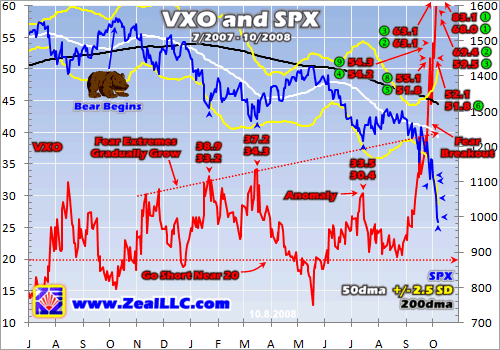
For most of our current bear until the last couple of weeks, traders really didn't take it seriously. Even during steep selloffs like we saw in January, March, and July, the VXO was never driven particularly high. At each fear extreme above, two VXO levels are noted. The lower one is the highest VXO close of that particular selloff while the upper one is the corresponding highest VXO intraday extreme.
And while these fear extremes were gradually increasing as this bear grew bigger and stronger, they were still pretty modest relative to history. As you'll see in the next chart of the VXO during the last cyclical bear between 2000 and 2002, the VXO doesn't get truly extreme until it heads towards 50. And prior to September 18th, the highest VXO levels we'd seen in this bear were just high 30s intraday and mid-30s on close.
This evolution of fear is certainly logical. Early on within a period of retreating stock prices, few traders believe it even could be a bear. It takes many months of stocks grinding lower on balance, and distancing themselves from the preceding bull top, for belief in the reality of the bear to grow. And the greater the proportion of traders that believe they're in a bear, the higher the periodic fear extremes generated by selloffs can spike.
Interestingly, this pattern of fear growing more intense at subsequent interim lows was actually interrupted in mid-July. This anomaly is readily apparent above. For some reason, traders were not as scared in mid-July as they were in mid-March, hence the lower VXO peak in July. This is strange because the SPX was 4.6% lower by its July bounce. Generally the lower the headline stock indexes, the more anxiety they generate which directly leads to larger fear spikes in selloffs.
But the VXO really didn't start showing serious fear until the morning of September 18th when it soared to 45.8. That was the day when the rumors of the Wall Street bailout plan started to emerge. So much happened in September, and it is so critical for the stock markets' near-future direction, that I broke down the month in depth in the new issue of our Zeal Intelligence newsletter. It was a month unlike any other and very important for traders to understand.
The VXO didn't approach 40 on close in this bear until September 24th's 39.3. This was an interesting number as it was right in line with the increasing VXO-extreme trendline rendered above. And this trendline may have held and generated a bounce, but all the government mucking around in a good old-fashioned free-market capitulation threw awry normal corrective processes. The resulting fear, partially driven by this meddling, was staggering to behold.
Before we explore this awesome fear spike, which was one of the biggest ever, a brief diversion into VXO history is in order. Remember that today's VXO was the VIX until September 2003. It was created in 1993, but upon launch as is common in new indexes it was back-calculated to January 1986. So true VXO history only extends to 1993, but its synthetic history goes back to 1986. Of course this encompassed the unparalleled and never-to-be-repeated October 1987 stock-market crash.
On October 19th, 1987, the VXO (then VIX) skyrocketed to 150.2 on close on the biggest single down day in the stock markets in history by far. The next morning, the VXO surged even higher to 172.8 intraday! This reading implies options traders were collectively gaming 14.4% swings in the SPX over the coming month! So when you hear of the legendary VIX 150 superspike, it is technically true but somewhat misleading.
First, it was based off synthetic back-calculated data. And even if this doesn't bother you, it happened during an extraordinary crash event that is unrepeatable. Because of that day, all kinds of so-called “circuit breakers” were implemented. These include bans on program trading at certain percentage declines, temporary halts of all trading at bigger daily declines, and even early closes or market holidays in worst-case scenarios. So no future selloff will ever be allowed to shed 20% in 6.5 hours (one trading day). We may see another 20% selloff over a few days, but never again in just one.
So claiming today that the VXO could spike to 150 again because it did in 1987 is simply incorrect. Without circuit breakers, sure. With them, no way. Since that October 1987 event was such an extreme anomaly, I think it is logical to start considering VXO history since January 1988. By that time most of the dislocations and volatility tremors had passed and the stock markets functioned much like they do today.
Back to the present extreme fear spike, September 29th's 51.8 close on the VXO was the highest ever (excluding October 1987 and its aftermath) at the time. Fear was unbelievably high on the SPX's second biggest decline in history. Intraday the VXO reached 55.1 that day, the fifth highest ever witnessed to that point. But amazingly a few days later on October 2nd, fear levels ramped even higher. That Thursday the VXO climbed to 54.3 intraday and closed at an awe-inspiring 54.2. It was a new post-1987 record of fear!
The next day (Friday the 3rd) the US House passed the bailout bill it had previously voted down, and traders expected a rally. Yet it didn't happen. The SPX edged 1.4% lower that day, to a fresh new bear closing low, which drove the VXO to another stellar 51.8 close. The 3rd's lackluster post-bailout action scared the world stock markets, which sold off prior to the US opening again on Monday October 6th. Yet again that was a day unlike any other.
This first full trading day after the US House passed the bailout bill Wall Street had so long been begging for, selling pressure was so great that fear reached levels never before witnessed . On a broad and deep general selloff that ultimately saw the SPX finish 3.9% lower, the VXO rocketed to 69.4 intraday! I could scarcely believe my eyes. Ultimately the VXO closed that fateful Monday at 59.5.
Fear was so extreme it defied belief, yet it somehow still continued growing. On Tuesday the VXO not only shot into the 60s again intraday, but it closed at 63.1 for another new post-1987 record! And it was trading into the low 70s on Wednesday even after the Fed's surprise coordinated global rate cut designed to restore confidence in the heavily beaten-down stock markets. We are witnessing events never before seen in history friends! What an amazing time.
Nevertheless, traders have to realize that fear is not infinite . It does have boundaries. Normally VXO 50 or so is the primary one. Fear can only grow until everyone remotely interested in selling immediately has already sold. After they are out, selling pressure abates dramatically so any bidding starts driving prices higher. And of course higher prices cause fear to deflate fast. Thus extreme fear is self-limiting. The more extreme a fear spike, the shorter it should last since extreme fear is so intense that it rapidly burns itself out.
And once fear reaches this point, where everyone is as scared as they can get, traders are presented with one of the greatest trading opportunities in the stock markets. The fabled V-bounce! Out of these fear extremes sparked by major bear-market downlegs, the biggest and fastest rallies ever witnessed erupt. Traders who can fight their own fear while capitalizing on others' can make fortunes in a matter of weeks by riding these exceedingly powerful and fast V-bounces.
Since this recent incredible fear spike is the first real extreme we've seen in our current bear, we have to go back to the last bear to demonstrate this relationship between extreme fear, the ends of major downlegs, and the resulting massive bear-market rallies. This next chart again shows the VXO and SPX, with identical vertical axes for comparability, during the last cyclical bear of the early 2000s.
And in both these charts, the green numbers next to intraday and closing VXO extremes represent their post-1987 rank. A green 1 on the top VXO number, for example, denotes the highest intraday VXO extreme witnessed since January 1988. A green 4 on the bottom VXO number represents the 4th highest VXO close seen over this same multi-decade timeframe.
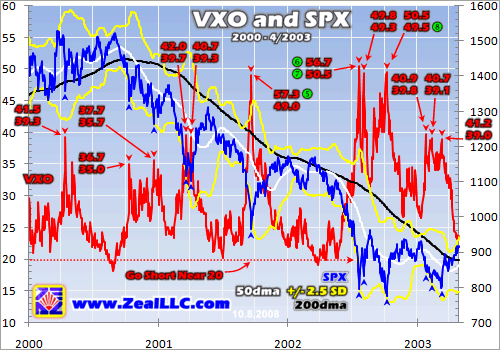
In terms of overall damage done to stock prices, the early-2000s bear was far-more devastating than our current bear (to this point at least). While the SPX ultimately fell 49.1% between March 2000 and October 2002, at worst between October 2007 and October 2008 our current bear is “only” down 36.3%. And there were plenty of episodes of extreme fear in this decade's first cyclical bear, as seen above in the VXO spikes.
Back then whenever the VXO approached 50, when popular fear reached a fever pitch, just like today it looked like the markets were going to fall forever. As always during periods of extreme fear, financial news seemed to justify the fears. Newsflow parallels traders' emotions because the financial media always tells traders exactly what they want to hear. The advertising business model for the financial media ensures this, as telling traders what they want to hear maximizes viewership. At each of these VXO (then VIX) extremes in the early 2000s, the outlook for the markets looked incredibly bleak and hopeless.
Yet out of these very fear extremes, massive bear-market rallies erupted. If you look at a distribution of the SPX's biggest up days of the past decade, which includes two strong bull periods, the biggest daily rallies still erupted within these VXO-50-spawned bear rallies. They look fast and big on this chart and they certainly were. Four of these mighty beasts were spawned in 2001 and 2002, and they averaged gains of 20.5% each in just a couple months!
Now if extreme and unsustainable fear was the catalyst for massive relief rallies in the last cyclical bear, why should we expect anything different this time around? Popular sentiment is like a giant pendulum swinging back and forth between greed and fear. When either emotion gets too great to sustain, the pendulum starts swinging back in the opposite direction. And after seeing all these crazy VXO records in the past couple weeks, it is hard to imagine fear getting greater. It is finite, not infinite.
Strong contrarian traders can capitalize on this V-bounce tendency. During periods of extreme fear, we need to be buying bargains while everyone else is selling in terror. During times when the majority expects the stock markets to fall forever, we need to be throwing long with all we've got. And with the VXO rocketing into the 70s this week, mind-bogglingly high, fear has to be at unsustainable extremes.
To many, Jim Cramer of “Mad Money” fame is the voice of the stock markets. On October 6th, the morning the VXO soared over 60, he was interviewed on NBC's “TODAY” by Ann Curry. During that interview he said the financial crisis could lead to “as much as a 20% decrease in the stock market”. He said, “Whatever money you may need for the next five years , please take it out of the stock market right now, this week. I do not believe that you should risk those assets in the stock market right now.”
Now that is fear! Right at fresh new bear lows, right at a 60+ VXO, to declare that another 20% selloff in stocks is probable and even long-term investors should exit stocks “right now” is extraordinary. Fear is peaking when even widely-lauded market gurus are convinced there is nothing but more selling ahead and hope is lost. Smart contrarian speculators love this popular despair, it is such a huge opportunity.
The key to trading stock bears is to buy fear and sell greed. When fear is extreme, like today, buy aggressively. Some key sectors' gains will even easily multiply the already-large expected bear-rally gains in the SPX. I have been discussing these high-potential sectors in our newsletters in the last couple weeks, especially our weekly Zeal Speculator where we are actively layering in new high-potential long-side plays for the coming massive bear rally. Join us today !
The opposite of a 50+ VXO is greed and complacency. This absence of fear is evident in the VXO when it trades near 20. If you study both of the charts above, it is clear a great time to go short in anticipation of a new bear downleg is when the VXO heads down near or under 20. And since cyclical bear markets in history tend to cut the SPX in half over about two years, there should be more downlegs to come after this rally.
It seems simple, buying fear (VXO 50+) and selling greed (VXO 20ish), and it is on paper. The real challenge is emotional. Can you ignore your own fear and greed, buying when it seems like a fool's errand and selling when the markets look great? Believe me, it is not easy to do. But every trader must overcome his own innate and destructive tendency to run with the herd. The big profits are only earned by fighting the herd, taking advantage of the price anomalies created by its giant mood swings.
The bottom line is bear markets are very tradable. And the best opportunities of all are the unsustainable fear extremes within them that always mark major interim bottoms. Once fear gets so excessive that everyone remotely interested in selling soon has already sold, only buyers are left. The resulting V-bounce and bear rally is fast and powerful. Stock markets' biggest daily surges in history occur during these mighty bear rallies.
Despite popular sentiment at extreme VXO spikes, the world isn't ending. Periodic fear extremes are natural and self-limiting. They will burn out on their own accord just when things look the darkest. Stocks aren't going to zero, they still represent valuable fractional ownership stakes in elite companies that are going to continue to thrive over the long-term. Going long at these fear spikes is immensely profitable for the brave.
By Adam Hamilton, CPA
So how can you profit from this information? We publish an acclaimed monthly newsletter, Zeal Intelligence , that details exactly what we are doing in terms of actual stock and options trading based on all the lessons we have learned in our market research. Please consider joining us each month for tactical trading details and more in our premium Zeal Intelligence service at … www.zealllc.com/subscribe.htm
Questions for Adam? I would be more than happy to address them through my private consulting business. Please visit www.zealllc.com/adam.htm for more information.
Thoughts, comments, or flames? Fire away at zelotes@zealllc.com . Due to my staggering and perpetually increasing e-mail load, I regret that I am not able to respond to comments personally. I will read all messages though and really appreciate your feedback!
Copyright 2000 - 2008 Zeal Research ( www.ZealLLC.com )
Zeal_LLC Archive |
© 2005-2022 http://www.MarketOracle.co.uk - The Market Oracle is a FREE Daily Financial Markets Analysis & Forecasting online publication.
