


An Optimistic Route to a Poor Stock Market Outlook
InvestorEducation / Stock Market Valuations May 15, 2007 - 08:33 PM GMTBy: John_Mauldin
 Value is a big and well-known strategy within the investment world. Many analysts and investors alike rely heavily on the P/E ratio as a metric to determine the value of a stock, indices or other form of security. But just as with any other investment metric, the data can be skewed if not viewed within the proper context.
This week's Outside the Box is by John Hussman where he discusses the importance of analyzing P/E ratios under the backdrop of the earnings cycle. John shares his view on "normalized" earnings as well as explains how he calculates the averages over a 5 year period.
Dr. Hussman is the president and principal shareholder of Hussman Econometrics Advisors, the investment advisory firm that manages the Hussman Funds. He is also the President of the Hussman Investment Trust. Prior to managing the Hussman Funds, Dr. Hussman was a professor of economics and international finance at the University of Michigan. He continues to write his "Weekly Market Comment" that provides both excellent insight and analysis into the current market climate.
I trust that you enjoy Hussman's research and find it to be valuable to thinking "outside the box."
John Mauldin, Editor
An Optimistic Route to a Poor Market Outlook
By John P. Hussman, Ph.D.
With the stock market currently reflecting a relatively rare set of overvalued, overbought and overbullish conditions, the potential for abrupt market weakness remains much higher than is typically the case. The Strategic Growth Fund has the ability to hedge the full value of its stock holdings using long-put / short-call index option positions, where no more than one of those options is "in-the-money" when the position is initiated. This is the stance currently held by the Fund.
It is important to remember that the Fund has about 1% of assets (essentially the interest we would otherwise earn on our hedge) allocated to a "staggered strike" configuration that provides better downside protection, compared with a "flat" hedge. Given this position, it will not be unusual to see the Fund gain several cents on a market decline, and even to lose that gain if a rebound occurs before we have a useful opportunity to "reset" our strike prices. Again, the option premium involved is just about 1% of assets, and unlike a "net short" position, the Fund is not exposed to extended losses of capital, or the need to "cover," in the event that the market advances substantially. Please refer to last week's comment for further remarks about interpreting day-to-day Fund movements here.
As I've frequently noted, I have no assumption that the market must necessarily roll into a bear market in the near term, or that we should rule out the possibility of positive market returns for a more extended period. However, the market has historically been vulnerable to abrupt losses once it has established overbought conditions (an extended, uncorrected advance) combined with rich valuations and elevated bullishness. The latest Investors Intelligence figures are at 53.3% bulls and just 20% bears. At such points, the average return/risk profile of the market has been unfavorable, regardless of apparent market strength. Since our investment position at any time reflects the return/risk profile of the market based on prevailing, observable conditions, speculation about whether the market will be in a bull or bear market six months from now, for example, is irrelevant to our position. For now, we remain defensive.
Normalized earnings
I received an insightful piece last week from Kate Welling, titled "Today's P/E Trap" by Steve Leuthold. Given our continued emphasis on normalized valuations, Steve's point that "normalizing earnings can be critical" was additional and welcome support for a key fact of investing - namely that it is dangerous to rely on P/E ratios without adjusting for where you are in the earnings cycle.
As I've frequently noted, market P/E ratios should be (and generally have been) dirt cheap when earnings are unusually elevated. You can run a long-term 6% growth trendline over the cyclical peaks in S&P 500 earnings about as far back as you care to go. Historically when earnings have been anywhere within 10-15% of that trendline, the average P/E on the S&P 500 has been just about 10. At a multiple of over 18 times top-of-channel earnings, present valuations clearly look rich.
So it was not surprising to read Steve's conclusion that, on a normalized basis, the valuations for the largest 3000 U.S. stocks are currently in the 97% percentile of historical experience, noting "A correction back to the historical valuation median implies a 35% decline."
What did surprise me a bit was his conclusion that as of April 30th , the normalized P/E for the large-cap stocks in the S&P 500 (using a 5-year averaging method) was only in the 81st percentile, implying a 21% decline to the historical median, and that restricting the history to the period from 1957 to-date, the current value was only in the 72nd percentile, implying just an 8% decline to the (higher) median for this period.
If you think about it for a minute though, that result makes perfect sense. Unreliable estimates of overvaluation - but perfect sense. See, people who work with statistics a lot recognize that averages can be skewed by a few extreme values or "outliers." So a careful analyst will often use medians (the middle point when you sort the data in order from lowest to highest values) to get a better idea of the "central tendency."
So far, so good. The problem is that if you reduce the number of data points, or include a whole set of extreme and unrepresentative values, even the median will give you skewed results. If you do both - your median will become unreliable.
The case in point here is the late-1990's bubble period. Here we have about 18 quarters of really extreme data in terms of normalized valuations, seen nowhere before in history and already known to have produced very unsatisfactory returns. Even including the recent advance, the total return on the S&P 500 remains below Treasury bill returns for the past 8 years.
Even if we aren't calculating an average, the addition of these points in a median calculation still ends up skewing the median higher because those points are all distributed on one side, and raise the level at which the midpoint is found. Using data since 1926, excluding the bubble, the median normalized P/E is closer to 30% below present levels. Clearly, the distortion from the bubble period is even greater if you restrict the history from 1957 to-date, because the bubble represents proportionately more of that data.
Suffice it to say that unless one expects to see late-90's level valuations with regularity in the future, they shouldn't be included in an estimate of central tendency for valuations. That said, Leuthold is doing a great service for investors by pointing out something that Wall Street, by and large, is overlooking at its peril.
A final remark has to do with using a 5-year average of earnings to normalize P/E ratios. When we look historically, we see a clear tendency for earnings growth to be higher from points when earnings were well below their long-term 6% trendline than when they were close to that level. Since trends in earnings have tended to ebb and flow over periods of more than 5 years, using a 5-year average when the general level of earnings is depressed relative to trend will still give you a relatively high P/E. Conversely, using a 5-year average when the general level of earnings is near the peak trendline will produce a lower P/E. If investors don't correct for this, they can still confuse elevated earnings for cheap valuations.
At present, we've got earnings pushing the extreme of that historical trend, and yet the normalized multiple isn't even low. That's doubly problematic.
An optimistic route to a poor market outlook
You can imagine that a P/E based on 5-year average trailing earnings will be using "unrepresentative" earnings figures anytime the economy is in recession. Using those depressed earnings will still tend to depress the 5-year average and therefore lift the resulting P/E.
As an alternative, we can take the most optimistic route, which is to base the 5-year average on the highest level of earnings attained up to each year. So for example, the current 5-year average would include the peak earnings as of 2003, the peak as of 2004, as of 2005, as of 2006 and as of 2007. If earnings in any of those years were below their peak to date, you'd use the peak value instead. If you do that, you get the following historical valuation chart, using data since 1871. You can see why one might not want to include the late 90's bubble in one's calculation of "normal valuations."
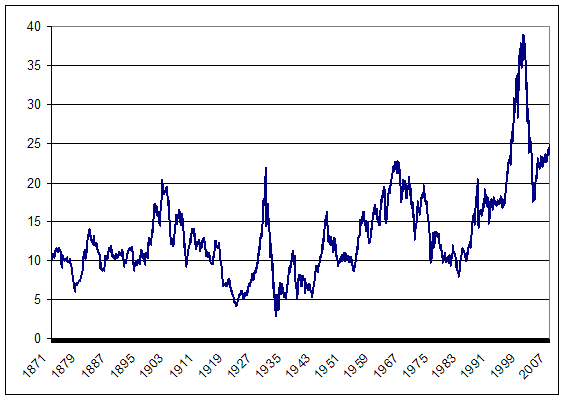
You can also see that today's values are at the same level as they were about 8 years ago. Did I mention that the S&P 500 has underperformed Treasury bill yields since then? Ah, yes. I believe I did.
Of course, one never should take much from a model of valuations unless one can also demonstrate that it has historically mattered to subsequent returns. The proof is in the pudding (a substance into which, for example, the Fed Model falls flat on its face).
On that note, the following chart is based on the P/E metric pictured above. It compares the actual 7-year return on the S&P 500 index with what would have been projected by two assumptions - the reversion 7 years later to a multiple of 15 (which corresponds roughly to a raw price/peak-earnings multiple of about 14), and 7-year earnings growth to the mid-point of the S&P 500's historical earnings channel (which would currently imply earnings growth of about 4-5% annually over the coming 7-year period).
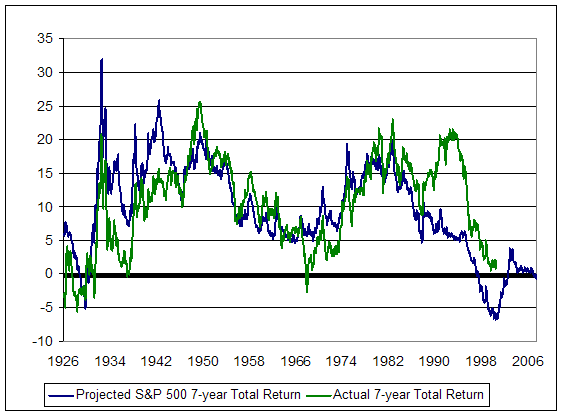
Needless to say, this version of normalized valuations has done a remarkably good job at explaining fluctuations in long-term stock market returns. With few exceptions, the margin of error has usually been within 3-4% of the actual subsequent 7-year annual return.
Aside from a few instances where returns fell well short of expectations due to the Great Depression and World War II, there are two main deviations in recent decades:
- the 7-year period that started in 1967 and bottomed in 1974, where actual returns were several percent below expectations because price/earnings ratios collapsed at the '74 trough, and;
- the 7-year periods that ended within the late 90's market bubble, where actual returns were higher than expectations because the terminal multiples were, well, psychotic.
Of course, you might not conclude that by looking at "forward operating P/Es," but you also wouldn't have much of a historical record on which to base any meaningful conclusions at all, which is evidently the way Wall Street analysts like it.
The current 7-year total return projection is below zero. A depression could produce returns far below that expectation, but I do not expect that. Conversely, a return to the late-90's valuation extremes could produce returns above expectations, but even in that case, the extra returns would be nowhere near those of the 90's because the market is already richly valued. I do not expect that either. Absent speculation about a coming depression or an extreme bubble, investors would be well advised to base their expectations for market returns in the next several years averaging somewhere in a 3-4% band around zero.
Market Climate
As of last week, the Market Climate for stocks was characterized by unusually unfavorable valuations, relatively favorable price trends, but a combination of overvalued, overbought, overbullish conditions that has historically resulted in stock returns below Treasury bill yields, on average, until that combination has been cleared. We don't require the market to clear the overvaluation in order to warrant a more constructive stance - just the combination of these conditions taken together.
In bonds, the Market Climate was characterized by unfavorable valuations and unfavorable market action, holding the Strategic Total Return Fund to a short 2-year duration, mostly in Treasury Inflation Protected Securities, with just over 20% of assets allocated to precious metals shares, where the Market Climate remains quite favorable on our measures.
Your always and everywhere a value junkie analyst,
By John Mauldin
Frontlinethoughts.com
To subscribe to John Mauldin's E-Letter please click here: http://www.frontlinethoughts.com/subscribe.asp
Copyright 2007 John Mauldin. All Rights Reserved
John Mauldin is president of Millennium Wave Advisors, LLC, a registered investment advisor. All material presented herein is believed to be reliable but we cannot attest to its accuracy. Investment recommendations may change and readers are urged to check with their investment counselors before making any investment decisions. Opinions expressed in these reports may change without prior notice. John Mauldin and/or the staff at Millennium Wave Advisors, LLC may or may not have investments in any funds cited above. Mauldin can be reached at 800-829-7273.
Disclaimer PAST RESULTS ARE NOT INDICATIVE OF FUTURE RESULTS. THERE IS RISK OF LOSS AS WELL AS THE OPPORTUNITY FOR GAIN WHEN INVESTING IN MANAGED FUNDS. WHEN CONSIDERING ALTERNATIVE INVESTMENTS, INCLUDING HEDGE FUNDS, YOU SHOULD CONSIDER VARIOUS RISKS INCLUDING THE FACT THAT SOME PRODUCTS: OFTEN ENGAGE IN LEVERAGING AND OTHER SPECULATIVE INVESTMENT PRACTICES THAT MAY INCREASE THE RISK OF INVESTMENT LOSS, CAN BE ILLIQUID, ARE NOT REQUIRED TO PROVIDE PERIODIC PRICING OR VALUATION INFORMATION TO INVESTORS, MAY INVOLVE COMPLEX TAX STRUCTURES AND DELAYS IN DISTRIBUTING IMPORTANT TAX INFORMATION, ARE NOT SUBJECT TO THE SAME REGULATORY REQUIREMENTS AS MUTUAL FUNDS, OFTEN CHARGE HIGH FEES, AND IN MANY CASES THE UNDERLYING INVESTMENTS ARE NOT TRANSPARENT AND ARE KNOWN ONLY TO THE INVESTMENT MANAGER.
© 2005-2022 http://www.MarketOracle.co.uk - The Market Oracle is a FREE Daily Financial Markets Analysis & Forecasting online publication.
