


Overbought Stock Market Expected to Correct Lower
Stock-Markets / US Stock Markets Jan 04, 2009 - 12:03 PM GMTBy: Mike_Burk

 The good news is: By current fashion, a bull or bear market is defined as a major index moving 20% off its low or high. By that definition, we are in a bull market with every major index except the Dow Jones Industrial average (DJIA) more that 20% off its November low. The Dow Jones Industrial Average (DJIA) was 19.6% off its low as of Friday's close, the S&P 500 (SPX) 23.8% off its low, the NASDAQ Composite (OTC) 24%, the Russell 2000 (R2K) 31.3% and leading the way, the Value Line Arithmetic up 39.4%.
Short Term
Every year the last week and a half of December has a strong upward seasonal bias as does the period from the day before Thanksgiving through the 1st few days of December and the last few days of October and the 1st few days of November. Those seasonally strong periods materialized on schedule last year and were followed by sharp declines. The market was up for 3 consecutive days ending Friday with the DJIA up 6.49%, SPX up 7.17%, the OTC up 8.07% and the R2K up 8.51%. If the pattern continues, we will see a decline early next week.
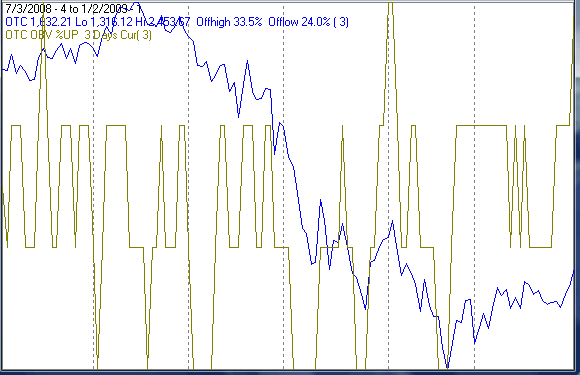
The chart below covers the past 6 months showing the OTC in blue and an indicator showing the percentage of the past 3 trading days that OTC On Balance Volume (OTC OBV) has been up. OTC OBV is a running total of daily declining volume subtracted from advancing volume. The indicator derived from OTC OBV touches the top of the chart when OTC OBV has been up for 3 consecutive days and it touches the bottom of the chart when OTC OBV has been down for 3 consecutive days. Including the current occurrence the indicator has touched the top of the chart 3 times and the bottom of the chart 6 times. Each previous occurrence of the indicator touching the top of the chart was followed by 2 consecutive down days.
Intermediate term
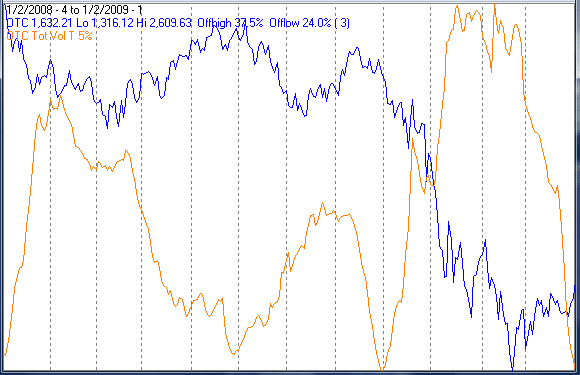
In a healthy market volume increases with prices. That has not been happening.
The chart below covers the past year showing the OTC in blue and a 5% trend (39 day EMA) of NASDAQ total volume in orange. OTC volume has been falling sharply since the November low in the index. The decline for the past week or so can be attributed to seasonal factors, but volume was falling sharply before that.
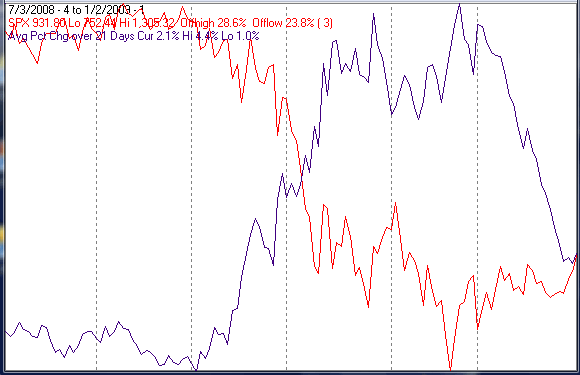
Recent headlines have declared 2008 the worst year for the DJIA since 1931. A few weeks ago, I pointed out that SPX volatility reached its highest point since late 1931.
The chart below covers the past 6 months showing the SPX in red and an indicator showing the mean of the absolute value of the daily percentage change in the SPX over the trailing 21 trading days in black.
The indicator peaked at 4.4% at the November low.
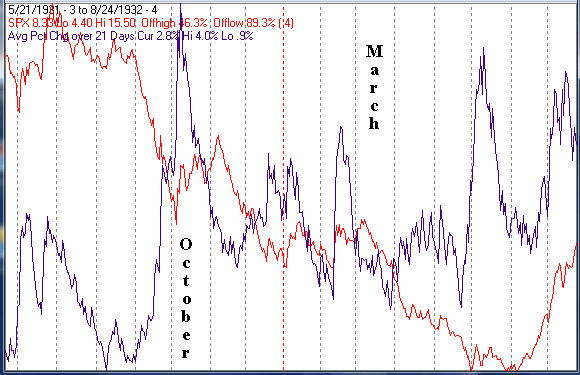
The chart below is similar to the one above except it covers the period from May 1931 to August 1932. The period was selected to show the peak in volatility along with its aftermath.
The market rallied for about a month after the volatility peak then declined until the end of December. It then rallied to a high in early March followed by a decline of 49% to the bear market low June 1, 1932.
Ben Bernanke is known to be a knowledgeable student of this period, lets hope he can do better.
Seasonality
Next week includes the 5 trading days prior to the 2nd Friday in January during the 1st year of the Presidential Cycle.
The tables show the daily return on a percentage basis for the 5 trading days prior to the 2nd Friday in January during the 1st year of the Presidential Cycle. OTC data covers the period from 1963 - 2007 and SPX data from 1953 - 2007. There are summaries for both the 1st year of the Presidential Cycle and all years combined. Prior to 1953 the market traded 6 days a week so that data has been ignored.
Performance for the week has been better over the last 20 years or so than it was prior to that.
Report for the week before the 2nd Friday of January.
The number following the year is the position in the presidential cycle.
Daily returns from Monday to 2nd Friday.
| OTC Presidential Year 1 | ||||||
| Year | Mon | Tue | Wed | Thur | Fri | Totals |
| 1965-1 | 0.31% | 0.65% | 0.55% | 0.55% | 0.31% | 2.37% |
| 1969-1 | 0.21% | -1.10% | -0.93% | -1.97% | -0.25% | -4.04% |
| 1973-1 | 0.35% | 0.08% | -0.02% | 0.05% | 0.57% | 1.03% |
| 1977-1 | -0.23% | -0.92% | -0.40% | 0.85% | 0.37% | -0.33% |
| 1981-1 | 0.30% | -0.05% | -3.29% | -0.74% | 0.90% | -2.87% |
| 1985-1 | -0.06% | -0.02% | 0.54% | 1.34% | 0.60% | 2.41% |
| Avg | 0.12% | -0.40% | -0.82% | -0.09% | 0.44% | -0.76% |
| 1989-1 | 0.14% | -0.18% | 0.19% | 0.44% | 0.02% | 0.61% |
| 1993-1 | 0.77% | -0.43% | 1.08% | 1.30% | 0.21% | 2.92% |
| 1997-1 | 0.43% | 0.86% | -0.55% | 0.44% | 0.44% | 1.62% |
| 2001-1 | -0.49% | 1.89% | 3.40% | 4.61% | -0.53% | 8.88% |
| 2005-1 | 0.40% | -0.83% | 0.62% | -1.05% | 0.84% | -0.02% |
| Avg | 0.25% | 0.26% | 0.95% | 1.15% | 0.19% | 2.80% |
| OTC summary for Presidential Year 1 1965 - 2005 | ||||||
| Avg | 0.19% | 0.00% | 0.11% | 0.53% | 0.32% | 1.14% |
| Win% | 73% | 36% | 55% | 73% | 82% | 64% |
| OTC summary for all years 1963 - 2008 | ||||||
| Avg | 0.42% | -0.13% | -0.03% | 0.48% | 0.29% | 1.03% |
| Win% | 70% | 52% | 48% | 74% | 72% | 65% |
| SPX Presidential Year 1 | ||||||
| Year | Mon | Tue | Wed | Thur | Fri | Totals |
| 1953-1 | 0.45% | -0.68% | -0.42% | -0.15% | -0.95% | -1.74% |
| 1957-1 | -0.51% | -0.37% | -0.19% | 0.24% | -0.19% | -1.03% |
| 1961-1 | 0.56% | 0.27% | 0.29% | 0.30% | 0.47% | 1.90% |
| 1965-1 | 0.04% | 0.25% | 0.27% | 0.00% | 0.43% | 0.98% |
| 1969-1 | -1.46% | -1.22% | -0.41% | 0.42% | -0.29% | -2.97% |
| 1973-1 | -0.02% | -0.10% | -0.25% | 0.68% | -0.78% | -0.47% |
| 1977-1 | 0.18% | -1.03% | -0.69% | 0.77% | -0.18% | -0.95% |
| 1981-1 | 1.20% | 0.11% | -2.20% | -1.50% | 0.32% | -2.08% |
| 1985-1 | 0.34% | -0.15% | 0.73% | 1.89% | -0.24% | 2.57% |
| Avg | 0.05% | -0.48% | -0.57% | 0.45% | -0.23% | -0.78% |
| 1989-1 | 0.11% | -0.21% | 0.58% | 0.41% | 0.25% | 1.14% |
| 1993-1 | 0.44% | 0.02% | 0.46% | 0.67% | 0.28% | 1.87% |
| 1997-1 | -0.05% | 0.75% | -0.64% | 0.86% | 0.61% | 1.53% |
| 2001-1 | -0.19% | 0.38% | 0.96% | 1.03% | -0.64% | 1.54% |
| 2005-1 | 0.34% | -0.61% | 0.40% | -0.86% | 0.60% | -0.13% |
| Avg | 0.13% | 0.06% | 0.35% | 0.42% | 0.22% | 1.19% |
| SPX summary for Presidential Year 1 1953 - 2005 | ||||||
| Avg | 0.10% | -0.18% | -0.08% | 0.37% | -0.02% | 0.16% |
| Win% | 64% | 43% | 50% | 77% | 50% | 50% |
| SPX summary for all years 1953 - 2008 | ||||||
| Avg | 0.14% | -0.21% | -0.24% | 0.25% | 0.10% | 0.04% |
| Win% | 59% | 38% | 41% | 71% | 55% | 52% |
Money Supply
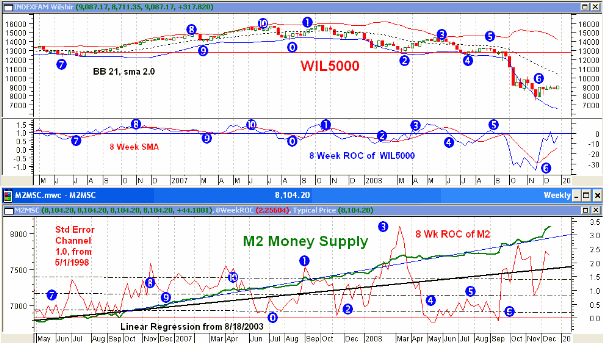
The chart below as provided by Gordon Harms. For the past few weeks money supply has been growing at a sharply accelerated rate.
1st year of the Presidential Cycle
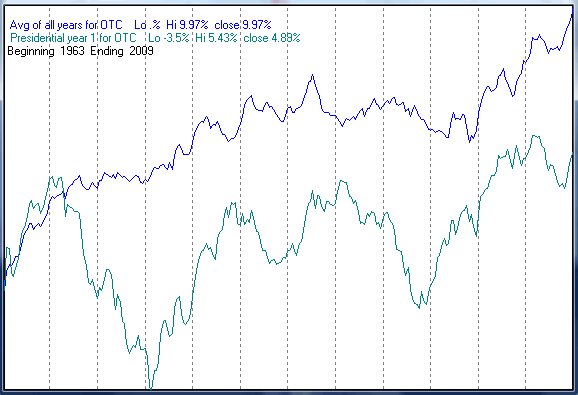
Since 1963 the OTC has been up 64% of the time during the 1st year of the Presidential Cycle with an average gain of 6.3% making it 3rd best year of the Presidential Cycle behind year 3 up 92% of the time with an average gain of 34.3% and year 4 up 75% of the time with an average gain of 7.6%. The best ever year 1 was 1985, up 31.1% and the worst ever year 1 was 1973, down 31.1%
The average month has 21 trading days. The chart below has been calculated by averaging the daily percentage change of the OTC for each of the 1st 11 trading days of each month and each of the last 10 trading days of each month. Each of the 12 months is strung together to show an average year. Dashed vertical lines have been drawn on the 1st trading day of each month.
The blue line shows the average of all years since 1963 while the green line shows the average during the 1st year of the Presidential Cycle.
Since 1928 the SPX has been up 50% of the time during the 1st year of the Presidential Cycle with an average gain of 3.1% making it the worst year of the Presidential Cycle behind year 3 up 89% of the time with an average gain of 14.9%, year 4 up 71% of the time with an average gain of 6.7% and year 2 up 55% of the time with an average gain of 4.0%. The best ever year 1 was 1997, up 31.0% and the worst ever year 1 was 1937, down 38.6%
The chart below is similar to the one above except it shows the SPX average for all years since 1928 in red and the average for the 1st year of the Presidential Cycle in green.
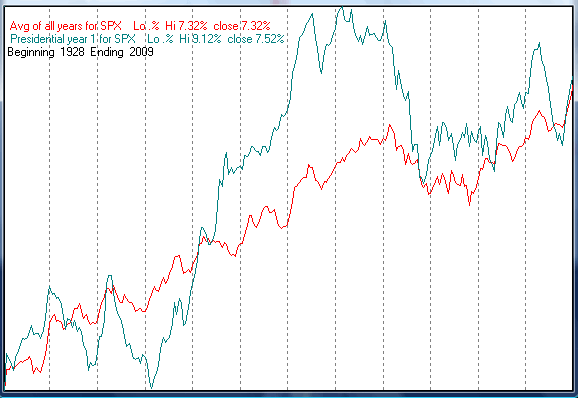
On average the low for the year has been in early April.
Conclusion
The market is overbought so the 1st few days of next week are likely to be down.
I expect the major indices to be lower on Friday January 9 than they were on Friday January 2.
Last weeks negative forecast was a miss.
Over the past year you got what you paid for in my weekly forecasts. There were 20 wins, 20 losses and 13 ties. The score for the year is at the end of each letter (just below my name). Everything will be reset to 0 after this week.
Thank you,
By Mike Burk
To subscribe to this report : http://alphaim.net/signup.html
Gordon Harms produces a Power Point for our local timing group. You can get a copy of that at: http://www.stockmarket-ta.com/ .
Disclaimer: Mike Burk is an employee and principal of Alpha Investment Management (Alpha) a registered investment advisor. Charts and figures presented herein are believed to be reliable but we cannot attest to their accuracy. Recent (last 10-15 yrs.) data has been supplied by CSI (csidata.com), FastTrack (fasttrack.net), Quotes Plus (qp2.com) and the Wall Street Journal (wsj.com). Historical data is from Barron's and ISI price books. The views expressed are provided for information purposes only and should not be construed in any way as investment advice. Furthermore, the opinions expressed may change without notice.
Mike Burk Archive |
© 2005-2022 http://www.MarketOracle.co.uk - The Market Oracle is a FREE Daily Financial Markets Analysis & Forecasting online publication.
