


China Stock Market 2007 vs NASDAQ 2000
Stock-Markets / Chinese Stock Market Jun 22, 2007 - 12:16 PM GMTBy: Zeal_LLC

The phenomenal performance of this year's red-hot Chinese stock markets has led them to become the most-eagerly-watched financial markets on the planet. While even just a couple years ago few outside of China cared about its indigenous markets, today countless speculators around the globe carefully monitor stock-trading action in China .
And with traders increasingly looking to China with a mix of awe and trepidation, the financial media has been reflecting our growing interest by doing more reporting about what is happening within this awakening giant. Reading news articles detailing the stock-trading action underway in China is incredibly fascinating.
Across the nation, the Chinese populace has become captivated by the soaring local markets. New stock-trading accounts are being opened in record numbers. A hardcore day-trading culture has emerged in the major cities, with people leaving their real jobs to become day traders. Outside of brokerage offices where tickers display real-time price action, huge throngs mill about to see how their stocks are doing.
For Americans, this should all sound eerily familiar. The general public only falls in love with the stock markets that it usually ignores when a full-blown mania is underway. Promises of a New Era, nearly instant wealth creation, and multiplying capital without any work can only take popular root and flourish after extraordinarily fast stock-market gains. Like in the NASDAQ in 1999 and early 2000.
The average investor has always been and always will be a momentum chaser, not a contrarian. The sharp NASDAQ gains in the US in 1999 sparked a popular mania when the traditionally risk-averse public decided to jump in and chase the dazzling gains being made in tech stocks. But the big problem is once the public fully buys in, there is no one left to buy. With all capital deployed, any selling quickly pops the mania-spawned bubble.
The more I read about what is happening in China 's stock markets today, the more it reminds me of all the classic historical stock manias as well as the recent NASDAQ mania in the States. Collectively the anecdotal reports I've seen paint a mania picture that could very well be describing how US investors reacted seven years ago. With such an overwhelming sense of societal déjà vu evident, I've been wondering how the actual underlying price action compares.
How does the Chinese stock mania look in pure technical terms when directly compared to the NASDAQ mania? Are today's Chinese stock markets on a similar trajectory as the NASDAQ before it crashed in 2000? Is today's Chinese stock bubble more extreme or less extreme than the ill-fated NASDAQ bubble? I really wanted to know the answers to these questions myself so I built the spreadsheets and charts behind this essay.
As you no doubt fondly remember from the exciting turn-of-the-millennium US stock markets, the NASDAQ Composite Index was the metric of choice for monitoring stocks' progress. Although professional investors continued to follow the S&P 500, the mainstream public investors eagerly watched the NASDAQ Comp like hawks. You couldn't turn on CNBC for even one minute back then without hearing updates about this index's moment-by-moment progress.
China too has several narrower indexes comprised of elite blue-chip stocks that aren't unlike the Dow 30 or S&P 500 in the US . But from a popular perspective, the Shanghai Stock Exchange Composite Index has become the metric of choice for mainstream Chinese investors to monitor progress. The Shanghai Comp, or SSEC, is as lovingly followed in China today as the NASDAQ was here in early 2000.
And since both the SSEC and NASDAQ are broad stock indexes that encompass all the trading activity on entire major exchanges, they are remarkably comparable in composition and character. Each reflects the hopes and dreams of their respective trading populaces as everyday investors were caught up in the unparalleled excitement of full-blown popular manias.
To use the NASDAQ mania as a technical reference lens through which to view today's SSEC mania, the respective peaks have to be synchronized. While the NASDAQ peak day of March 10th, 2000 is set in stone, the peak of the SSEC is not known with certainty yet. But this flagship Chinese index just achieved its latest all-time high on May 29th, so this is its latest peak. Thus the following charts map May 29th, 2007 in SSEC terms over March 10th, 2000 in NASDAQ terms and run the data series backward and forward from there.
Matching these peaks this way, a chart of the SSEC from 2005 until today corresponds with the NASDAQ from mid-September 1997 to mid-April 2000. This provides a trading-day-by-trading-day comparison of how the SSEC mania is matching up to the NASDAQ mania. Just as suspected based on trading news out of China , the SSEC's progress over the last 18 months matches the NASDAQ mania's final 18 months remarkably well.
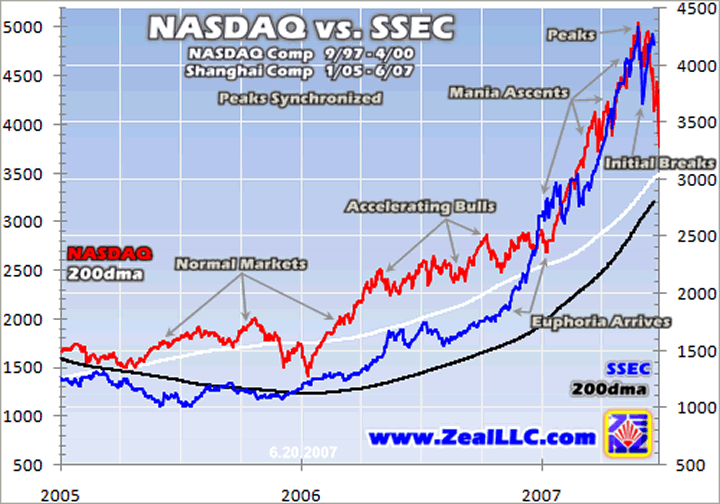
With not even the most rabid perma-bulls from back in 2000 still denying that the NASDAQ entered a textbook popular mania, the NASDAQ is a great standard for such an event. And in a strategic sense, the SSEC's performance over the last couple years or so matches up uncannily well with this mania template. While these two data series aren't perfectly interchangeable, they could sure fool a casual observer.
Back in 2005 the SSEC was a pretty normal market, which is why it was largely ignored in China and completely ignored in the rest of the world. The NASDAQ also traced a similar unimpressive track at this stage before its own mania ascent. The only major difference here, which may ultimately prove very important, is the SSEC was trending down in this stage while the NASDAQ was trending up. Note the divergence in their respective 200dmas above.
Why is this interesting? In stock-market history, popular manias usually don't ignite rapidly. The NASDAQ mania capped a monster 17-year secular bull that launched way back in 1982. China 's bull, on the other hand, actually began in mid-2005. Before that its stock markets had been trending lower on balance since mid-2001. To see a market go from a secular bear low to a mania in just two years is extraordinary.
Is a true full-blown popular mania possible with just two years of foundation? Can enough mainstream investors arrive in just two years so the populace has already fully bought in? Apparently yes, as the rest of this essay discusses. But the fact that the Chinese stock bull remains so young is the biggest wildcard in my mind arguing against the Chinese-stock-market-crash-imminent case. Two years is such a compressed time for a mania cycle to develop over, so perhaps this mania isn't mature yet.
But after this initial time-compression anomaly, the NASDAQ and SSEC comparison becomes much more mirror-like. In 2006 the SSEC bull started accelerating, just like the NASDAQ did at its corresponding pre-peak phase. Then within just a couple months of each other, euphoria arrived in both markets. There is a clear point in both the SSEC and NASDAQ charts when their slopes turn sharply higher. These mark the beginning of the near-vertical mania ascents.
And as this chart reveals, the mania-ascent slopes in these two markets are nearly identical! This is not an optical graph-construction trick either. I made a zeroed-axis version of this chart and the same interplay you see above occurred. The last five months before the peaks in each market are uncannily similar. This terminal vertical phase happens because the public finally joins in and starts throwing all available capital at the bull, driving it sharply higher.
Near the ultimate peaks (if indeed May 29th proves to be the ultimate SSEC peak), the last few months are nearly identical. Well up in their mania ascents both markets had nervous wobbles as smart money started to worry about the mania and layer out capital to preserve gains. But soon the insatiable lust of the public to buy stocks overwhelmed any contrarian selling and the all-but-identical terminal vertical runs to the peaks commenced.
And after these peaks, sharp initial breaks occurred. In China's case, after its latest May 29th top it plunged a gut-wrenching 15% in just four trading days! To make such a brutal decline easier to understand for us Americans, imagine if the Dow 30 lost 2100 points in the next four days! That would certainly get our attention, just as it has in China . Yet even after these initial breaks, mania psychology remains strong and investors put up a brave face and continue buying.
The NASDAQ had a similar initial break and false recovery . In the first three trading days after its peak, it plunged over 9%. Yet only seven trading days after this low, it had climbed back to within 1.7% of its peak. The SSEC's 15% plunge over four days was considerably worse. Yet over the next eleven trading days, ending this past Tuesday, it recovered back to within 1.5% of its peak. These patterns across time, nations, and cultures are uncannily similar and ought to disturb anyone invested in Chinese stocks.
This first chart intrigued me as it clearly shows Chinese stock markets doing nearly exactly what the NASDAQ did before its own bubble burst. But I wanted a more direct constant-percentage comparison to better understand these respective bubbles. To create this, I once again matched the index peaks. Then I went back 18 months before the peaks and individually indexed both the SSEC and NASDAQ at 100. So if either went to 150 on its individual indexing, for example, it would be up 50%.
This constant-percentage comparison running from peak-minus-18 months to peak-plus-3 months is rendered below. The percentage gains for each index show how far each index climbed from a certain point, say 6 months out, to its ultimate peak. Incredibly this perspective reveals that the SSEC's mania ascent is not only comparable to the NASDAQ's, but it is considerably more extreme!
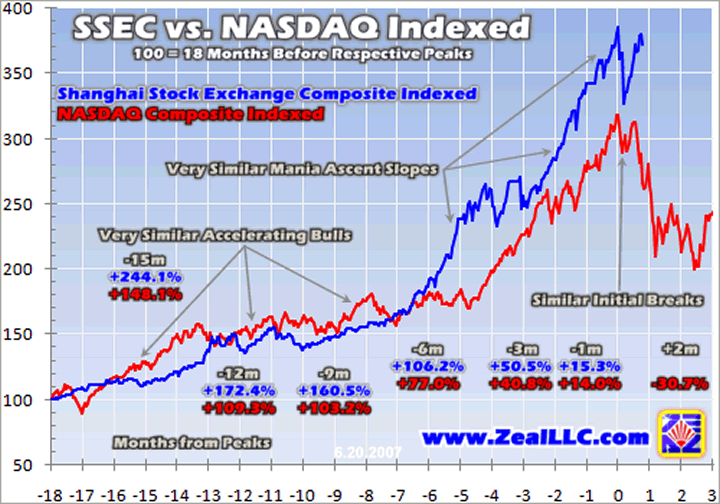
From 18 months out to 7 months out from their respective peaks, the SSEC and NASDAQ exhibit very similar accelerating bulls. Over this period of time both indexes rose about 60%. Now gains of this magnitude over less than a year are massive, but they are nothing compared to the mania-ascent stages that followed.
While the NASDAQ started its unsustainable vertical mania ascent about 5 months out from its peak, the SSEC started earlier. Chinese stocks pulled away from the NASDAQ's example 7 months before their latest peak. This early start helped drive the SSEC even higher than the NASDAQ. Indexed from 18 months out, the SSEC peaked at 386 (a 286% 18-month gain) while the NASDAQ peaked at 318 (218%).
So in constant-percentage terms, the stock action witnessed in China over the last six months or so looks just like a somewhat-amplified version of the last six months before the NASDAQ peak of 2000. And as is apparent above, even the slopes of the respective mania ascents are rising at the same angle . With the NASDAQ terminal ascent proving unsustainable, odds are the mirror-image SSEC one won't fare much better.
Once again the problem with markets once the public aggressively buys in and pushes them vertical is all buyers are soon fully invested. When effectively no more capital remains outside a market that is willing to buy and bid up prices, even relatively modest selling sparks a price decline since there are no offsetting buy orders. This initial selling spooks the public which bought in way too high and they start selling in fear, and soon the post-bubble bust is off to the races.
Before we get into this, carefully examine the staggering performance numbers noted above from various times to the respective peaks. In their last month before their peaks, the SSEC rose 15% and the NASDAQ 14%. The farther back in time you travel, the greater this disparity grows. The final 3-month gains ran 51% in China and 41% in the States. At 6 months this widens to 106% and 77% respectively. And in the 12 months leading up to the peaks, the SSEC soared 172% higher while the NASDAQ “only” managed a 109% gain.
Now contemplating these raw gain numbers is very important, as it offers a key insight into why all bubbles must mathematically burst. To have major broad stock markets more than double in a year, and expect this rate of gain to be sustained, is absurd. Yet near mania peaks the mainstream public, who never study the markets, think such gains are normal and wrongly assume they have entered a New Era.
These totally irrational 100%-gain-as-normal expectations remind me of a mathematical parable I first heard as a kid. A wise man did a great favor for a king so the king asked what the wise man wanted as a reward. The wise man said all he wanted was some wheat and a chessboard. On day one, the king was to put one grain of wheat on the first square of the chessboard. Then on day two, two grains on the second square. On day three four grains on the third, on day four eight grains on the fourth, and so on. The king, having great wealth, eagerly agreed to this curious yet seemingly modest request.
But of course when you double something over and over again, soon the absolute amount of it grows far beyond comprehension. Way, way before the king got 64 days into his promise to pay the wise man, he was totally broke. Exponential growth is always ultimately unsustainable, whether it occurs in parables, in the natural world, or in the financial markets. No big asset class can sustain doublings for very long. When mainstream investors start to think 100%+ annual gains are normal, rational, and expected, it is time to sell out.
With exponential Chinese stock-market gains mirroring and even outdoing the NASDAQ's mania example, and the Chinese public going bonkers over the stock-trading game, this is reason enough to expect a crash is drawing nigh. But the SSEC action of the past few weeks really is the icing on the cake for this argument.
Note above the sharp initial breaks off the peaks in both the SSEC and NASDAQ, as well as the very similar quick recoveries back up to almost the peak levels over a matter of weeks as if nothing had happened. Well, from this very place in its own mania, the NASDAQ started selling off sharply. Within just 2 months from its peak, it was already down 31% and the bust was well underway. Will the SSEC follow a similar bust course?
As a mere mortal who cannot see the future I certainly don't know the answer, but it will sure be interesting to find out. Provocatively, the reason the SSEC initially started plunging in late May was Beijing announced it was tripling a key tax on stock trading to 0.3%. This announcement started the selling off the peak. Beijing did this to dampen the mania, of course. Back in 1997 when Beijing raised this same tax from 0.3% to 0.5%, the Chinese stocks fell 30% over the next four months.
If such a decline happens today, the Chinese stock markets will indeed follow the NASDAQ into its early bust cycle. The symmetry between all of this is really quite amazing. Countries may change, markets may change, and people may change, but the greed inherent in all of our human hearts is universal. And the consequences of this greed for an entire nation of investors collectively manifesting itself in stocks is a popular mania that will run sharply higher, blow up, and then deflate even faster than it originally grew.
When these NASDAQ technical similarities are combined with the mania anecdotes coming out of China , the argument that the Chinese stock markets are near the end of their mania feels pretty strong. Based on this and all I've read on the Chinese markets this year, I suspect the odds overwhelmingly favor an imminent sharp decline in these markets.
If you are directly invested in the Chinese stock markets one way or another, this is going to be a big problem for you when it comes to pass. In the initial major selloff after a mania top, usually about a third of the stock-market's value is lopped off in a matter of months. The selling is fast and furious and offers to sell stock outnumber bids to buy it by a massive margin. This crash phase is no fun at all to suffer through.
But even if you are not directly invested in the Chinese stock markets, the implications of a Chinese stock selloff could be profound. Remember when the US stock markets swooned rather dramatically in late February in response to a selloff of stocks in China ? If a relatively minor head-fake in China led to such dramatic consequences for the worldwide markets, what would a full-on China crash and bust do?
As this concern is very important for all investors to consider, I analyzed it in the current June issue of our acclaimed Zeal Intelligence monthly newsletter. In it I discussed the likely implications of a Chinese selloff for the US stock markets in general as well as various classes of commodities stocks. Some should fare well while most others will likely suffer. A mania top in a major world market is not a trivial event to navigate.
A serious Chinese selloff is really going to complicate investing and speculating worldwide and you need to be ready for the fallout. Subscribe today ! New subscribers to the e-mailed PDF edition of our newsletter will get a complimentary copy of this June issue with this Chinese spillover analysis. Your paid subscription will start with next month's upcoming issue.
The bottom line is the crazy technicals of China 's flagship stock index match all the crazy anecdotes on popular stock trading that we are hearing out of China . The SSEC's technical path not only looks remarkably like the NASDAQ's before its own mania abruptly ended, but the Chinese situation is even more extreme than the classic American bubble in some ways. These are ominous tidings.
All stock manias must come to an end as exponential price growth is inherently unsustainable. Eventually the public has bought all the stock it can buy so there are no untapped pools of capital left to bid on stocks. At this point the whole house of cards starts to implode. The SSEC's behavior in the last month mirrors the NASDAQ's around its own March 2000 top remarkably well. Caveat emptor.
By Adam Hamilton, CPA
So how can you profit from this information? We publish an acclaimed monthly newsletter, Zeal Intelligence , that details exactly what we are doing in terms of actual stock and options trading based on all the lessons we have learned in our market research. Please consider joining us each month for tactical trading details and more in our premium Zeal Intelligence service at … www.zealllc.com/subscribe.htm
Questions for Adam? I would be more than happy to address them through my private consulting business. Please visit www.zealllc.com/adam.htm for more information.
Thoughts, comments, or flames? Fire away at zelotes@zealllc.com . Due to my staggering and perpetually increasing e-mail load, I regret that I am not able to respond to comments personally. I will read all messages though and really appreciate your feedback!
Copyright 2000 - 2007 Zeal Research ( www.ZealLLC.com )
Zeal_LLC Archive |
© 2005-2022 http://www.MarketOracle.co.uk - The Market Oracle is a FREE Daily Financial Markets Analysis & Forecasting online publication.
