


U.S. Treasury Bonds, The Worst Investment for 2013 and the Next Decade
Interest-Rates / US Bonds Jan 04, 2013 - 11:01 AM GMT

 Sasha Cekerevac writes: One of the biggest investor mistakes by the average retail investor is to be late to cash in on an investment theme. These investor mistakes are not limited to just the stock market, but all types of investments. If we look at investor mistakes by the retail public for buying real estate, most people were bullish at the top of the market and were selling, or were forced to sell, their real estate at the bottom. Buying high and selling low is one of the most common investor mistakes by the majority of the public.
Since 2008, the biggest trend for the average investor has been to get out of stocks and to park money in U.S. bonds. EPFR Global, a provider of data, reports that since 2008, equity funds have had a net redemption of $467 billion, compared to bond funds that have seen an influx of $1.1 trillion. (Source: “Desperately Seeking Yield,” The Economist, November 10, 2012, last accessed January 2, 2013.)
According to Morningstar, money flowing into bond mutual funds accelerated in 2012, with 26% of household investments in U.S. bonds up from 14% in 2008. This was during a year in which the S&P 500 was up a solid 13%, now up over 111% since the low in March 2009. Meanwhile, 10-year U.S. bonds are currently offering a negative yield after inflation, meaning people are willing to lose money over 10 years because they are so scared of the market. (Source: “Bond Craze Could Run Its Course in New Year,” New York Times, December 31, 2012.)
This type of thinking is one of the most common investor mistakes. While people believe the safety of U.S. bonds will prevent massive losses, considering how much money has flowed into U.S. bonds over the past few years, the returns are exceedingly limited.
Essentially, there is only a slight possibility of a continued move up in the price of U.S. bonds; conversely, there is a high probability that the price of U.S. bonds will go down dramatically over the next few years.
When the price of U.S. bonds goes up, the yield goes down; conversely, when U.S. bonds drop in value, the yield goes up. If an investor holds U.S. bonds directly, they will get paid their principal, while holders of mutual bond funds will see the value decrease as interest rates rise.
The questions to ask are: is it more likely for interest rates to rise or fall over the next decade, and how does this compare to other asset classes as an investment?
The retail public makes many investor mistakes, one of which is not calculating the probability of an event occurring. While some might say that many investors lost money by betting on Japan bonds decreasing, which they haven’t for decades, I would make the argument that U.S. bonds are in a dramatically different position.
There are essentially two reasons why interest rates rise. The first is a stronger economy, and the second is higher inflation, both of which were lacking in Japan.
If we take a look at the actions by the Federal Reserve, I believe that it is unlikely that deflation will occur, when compared to inflation or a stronger economy. For recent examples we can look at continued rising home prices and rising commodity prices, and frankly, there are very few areas in the economy that are seeing a dramatic drop in prices.
At the very least, inflation will become a problem necessitating higher interest rates. This is very bearish for U.S. bonds.
Many investor mistakes occur due to the slow adjustment period by the retail public. While many large investors have already begun shifting out of U.S. bonds and into equities, helping fuel the rally this year, the hundreds of billions of dollars in funds sitting in U.S. bonds will ultimately end up being sold and shifted into other asset classes, such as stocks or gold. However, one does not want to be late to such a transition.
As an example to show how low U.S. bonds really are in historic comparison, the average 10-year yield was 1.79% in 2012. This was the lowest average yield for 10-year treasuries since 1941, when they averaged 1.95%, according to A History of Interest Rates by Sidney Homer and Richard Sylla.
With the Federal Reserve purchasing $45.0 billion of U.S. bonds each month and $40.0 billion of mortgage-backed securities per month, this is expected to total approximately 90% of all bond issuances in 2013. (Source: “Treasury 10-Year Yields Head for Record Low on Demand for Haven,” Bloomberg, December 29, 2012.)
I think that beginning in 2013 and looking out over the next decade, buying U.S. bonds at this point would be one of the biggest investor mistakes. The Federal Reserve has stated it will keep rates low until 2015; however, this can be adjusted.
If either inflation or an improving economy shows signs of appearing, U.S. bonds will decline substantially. Personally, I think inflation is likely to show up sooner than most people think, which is extremely toxic to U.S. bonds.
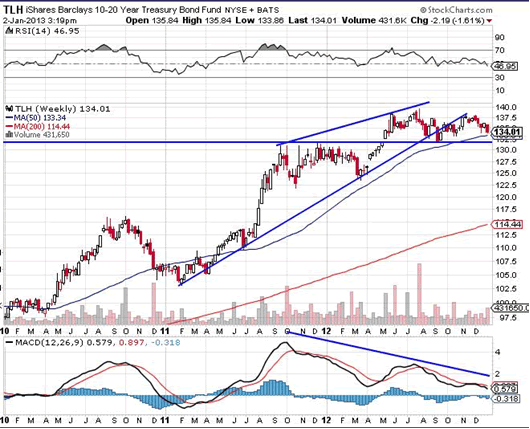
Chart courtesy of www.StockCharts.com
Above is a three-year weekly chart of a fund of U.S. bonds with a 10–20-year duration. Notice that U.S. bonds have had a massive run over the last three years. Another one of the worst investor mistakes is staying in the trade too long, especially after a big move.
As noted by the long-standing support line, it appears U.S. bonds have broken their long-standing uptrend. There is also a negative divergence with the moving average convergence/divergence (MACD) indicator.
It is always dangerous to call a top in any market. Looking out over the next few years, I think it’s highly likely that U.S. bonds will have higher yields and a lower price. I also think that there are far better investments in stocks and commodities, such as gold. Avoid the common investor mistakes of the average retail public, and start looking to shift into other asset classes for the next decade.
Source: http://www.investmentcontrarians.com/biggest-investor-mistake....
By Sasha Cekerevac, BA
www.investmentcontrarians.com
Investment Contrarians is our daily financial e-letter dedicated to helping investors make money by going against the “herd mentality.”
About Author: Sasha Cekerevac, BA Economics with Finance specialization, is a Senior Editor at Lombardi Financial. He worked for CIBC World Markets for several years before moving to a top hedge fund, with assets under management of over $1.0 billion. He has comprehensive knowledge of institutional money flow; how the big funds analyze and execute their trades in the market. With a thorough understanding of both fundamental and technical subjects, Sasha offers a roadmap into how the markets really function and what to look for as an investor. His newsletters provide an experienced perspective on what the big funds are planning and how you can profit from it. He is the editor of several of Lombardi’s popular financial newsletters, including Payload Stocks and Pump & Dump Alert. See Sasha Cekerevac Article Archives
Copyright © 2012 Investment Contrarians - All Rights Reserved Disclaimer: The above is a matter of opinion provided for general information purposes only and is not intended as investment advice. Information and analysis above are derived from sources and utilising methods believed to be reliable, but we cannot accept responsibility for any losses you may incur as a result of this analysis. Individuals should consult with their personal financial advisors.
Investment Contrarians Archive |
© 2005-2022 http://www.MarketOracle.co.uk - The Market Oracle is a FREE Daily Financial Markets Analysis & Forecasting online publication.
