


Big Daily SPX Stock Market Moves Indicative of Bear Markets
Stock-Markets / Stocks Bear Market Mar 14, 2008 - 01:00 PM GMTBy: Zeal_LLC

 On Tuesday March 11th, the flagship S&P 500 (SPX) stock index rocketed 3.7% higher in a single trading day! This big rally proved a welcome respite for embattled stock traders. Not only did it nicely boost most sectors, but it temporarily dispelled the oppressive fog of fear billowing out of the mortgage markets.
While it was certainly a profitable day for me as a speculator, I found it far more interesting as a student of the markets. The catalyst for this particular surge as well as the extensive commentary on CNBC about how long it had been since we'd last seen a similar rally led me to ponder big SPX daily moves in general.
Understandably, the Fed is getting all the credit for this rally. But before we get into its role, some background is in order. On the morning of January 23rd during that wicked global stock-market panic, the SPX plunged as low as 1270 intraday. Yet such an extreme fear-drenched low was totally irrational and couldn't be sustained. So the index rallied 5.4% off this low into its close that day!
Despite this stunning intraday recovery, since then the majority of traders have expected a retest of those deep January lows. They believed the SPX once again needed to revisit 1270 and then bounce successfully off of it to confirm a major interim bottom. Naturally this universal expectation made traders hesitant to buy big US stocks so it soon became a self-fulfilling prophecy.
Fast forward to this week. On Monday the SPX closed near its lows at 1273. It was a retest, on a closing basis no less, of the deep intraday lows of late January. Traders were ready to buy early the next morning to game this retest, as SPX futures were up 0.5% or so even before the Fed's latest machination went live.
On March 11th, one hour before the stock markets opened, the Fed announced it was offering $200b in loans to the struggling Wall Street banks. In addition to the enormous amount, the Fed was offering this capital for 28-day terms instead of the usual overnight duration. Even more amazing, the Fed said it would accept universally unwanted GSE mortgage-backed securities as collateral for loans of US Treasuries!
On this news the SPX futures, due for a technical rally anyway thanks to the retest, accelerated dramatically. They were up about 2.0% before the markets opened. As the Fed was effectively saying that Fannie and Freddie paper was as good as US Treasuries, perhaps the mortgage debt crisis was really turning a corner. The SPX powered higher into the close and racked up an impressive 3.7% daily gain.
Since such big daily rallies are so profitable, I wanted to know more about them. How rare are they? When do they tend to rear up within stock-market cycles? Is Fed action necessary to drive such extraordinary daily moves? Can we deploy call options in advance to game such big moves?
To learn more I analyzed big daily SPX rallies going back a decade or so, to 1998. Not only is this modern period most relevant to today's markets, but it encompasses massive bull and brutal bear markets alike. It is a good sample of wildly different stock-market environments. And since I was studying big daily rallies, I figured I may as well look at big daily plunges too. They could also be gameable via put options.
Interestingly, this week's big SPX surge was only the 17th largest daily rally in this index since 1998! But it was still the best day we've seen since October 15th, 2002 's massive 4.7% daily surge (the 6th largest). Any headline market event rare enough to only be seen one time in over 5 years is certainly worthy of further study.
I was curious about the size, relative rank, and temporal distribution of big SPX daily moves. So I plotted them on the next two charts. The top 12 biggest SPX daily surges and plunges are marked below. I wanted to include more, but this chart was getting too busy. Each big move's relative rank (white), gain or loss (green or red), and any Fed rate cut on that particular day (yellow) are noted. The results are interesting.
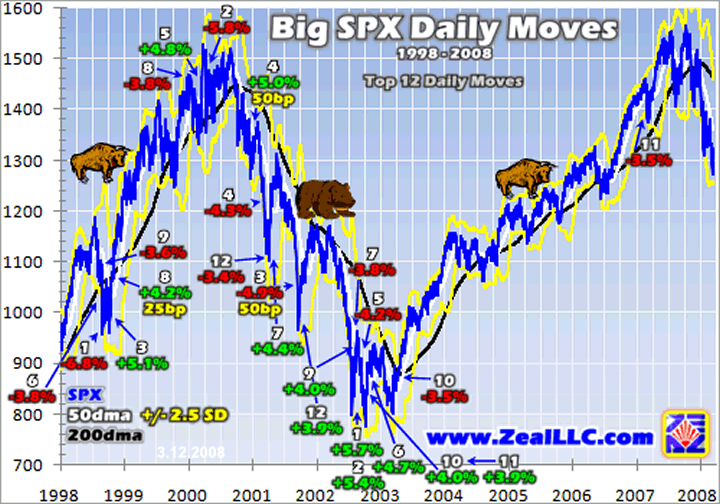
Due to the stark asymmetry marring this chart, you'd think I failed to finish it. But the crowded left and deserted right is no oversight. The biggest daily SPX moves, both rallies and plunges, tend to happen almost exclusively in bear markets. Only the terminal downleg-ending plunges in full-on bears are able to consistently generate extreme-enough volatility to drive such huge daily moves.
Of the top 12 daily rallies in the SPX over the last decade or so, 9 happened during the brutal SPX bear of 2000 to 2002. And 2 of the remaining 3 happened during the 1998 Russian debt crisis, a short period of extreme bearishness within a bullish trend. I don't think most casual traders realize that bear markets and crises are where the biggest daily rallies erupt. Bull markets are seldom volatile enough to spawn them.
Of the top 12 daily plunges in the SPX since 1998, 6 erupted within the SPX bear. The Russian debt crisis spawned 3 more in 1998. Understandably such big daily declines are exceedingly rare in bull markets. The last one witnessed was the 3.5% plunge in late February 2007 driven by a vicious 8.8% slide in the Chinese stock market the day before. Sometimes exogenous events spark randomly-timed big moves.
So if you want to game big SPX daily rallies or plunges, don't even bother unless we are in a bear market. The extreme volatility late in bear-market downlegs is the only force powerful enough to consistently generate outsized daily swings. A crisis in a bull can sometimes pull it off, but crises are almost always very unpredictable in their arrivals and short-lived to boot. This makes it tough to game them with options relentlessly ticking away towards expiration.
Another striking attribute of big daily moves is their symmetry. Big daily rallies tend to arrive soon after big daily plunges, and vice versa to some extent. It is relatively rare to have a big daily move in one direction without a big daily move in the other direction close by. While not so apparent with the limited dataset I could fit in these charts, this trait becomes really clear once you make your way through the top 50 big daily moves in both directions.
This is logical too. In order to stand out historically, the SPX has to push 4% in either direction. Out of the 2563 trading days since 1998, there have only been 10 days with gains exceeding 4% and 5 days with losses exceeding 4%. 4%+ daily swings in either direction are exceedingly rare events. They are utterly unsustainable and only extremely unbalanced sentiment can generate them.
To many traders, especially the gunslingers playing wildly volatile sectors like commodities stocks, 4% might not seem like a big deal. 4% days in gold stocks are more norm than exception! But remember we are talking about the S&P 500 here. It is the 500 biggest and best companies in America with a massive collective market capitalization up near $12,373b. Essentially whenever this index moves 4% in either direction in a single day, American stock investors have gained or lost 4% of their total stock wealth in less than 7 hours!
It is true theoretically that an index could gain (or lose) 4% a day forever. But imagine if the initial 4% swing was converted into raw dollars of market cap and then this number was extended forward. If the capital equivalent of the initial 4% gain persisted daily for 25 trading days, the SPX would double. If the capital equivalent of the initial 4% loss persisted daily for just as long, the SPX would hit zero in five weeks! 4%+ moves in such a giant index are gargantuan wealth-affecting events.
To drive such anomalous moves, sentiment has to be really unbalanced. You need an awful lot of greed to spill into 500 stocks with enough fury so this entire group rises 4%. On the other side of the coin, only extreme fear can force such a broad group of elite stocks to fall 4% in a single day. But the markets abhor sentiment extremes, they are never sustainable. Excessive greed or fear never last too long.
Since these emotions that drive such massive moves simply can't remain so intense, strings of consecutive big up or down days just don't exist. Big up days are only probable right after big down days driven by unsustainable fear. And as we saw this week, fear can evaporate in a nanosecond. As a herd, stock traders are incredibly fickle and capricious in their sentimental biases. They are as emotional as schoolgirls.
Thus the very best odds for a massive daily rally occur right after a massive daily plunge. Any afternoon where the SPX is pushing 4% to the downside and fear is extreme is a high-probability-for-success time to buy call options. I'd add them in two sectors. The irrationally beaten-down sector driving the fear is probably way oversold by this time. In addition, whatever hot sector the bulls were chasing before the fear is also a great place to buy. Traders can buy calls on the leading stocks in both sectors.
And despite the Fed's apparent role in our big rally this week, the Fed is really irrelevant across the biggest SPX moves of the past decade. Rate cuts only happened on the days of 3 of the 24 biggest moves rendered above. In each case, even for surprise rate cuts, the markets continued on following their primary trends soon after the rate cut. Even though the Fed tries to meddle in stock-market sentiment, it is virtually always unsuccessful. Greed or fear will work themselves through in their own good time.
This next chart zooms in to just the 2000-to-early-2003 bear period since 18 of the 24 biggest daily moves of the past decade happened in this time frame. This higher-resolution view shows where in bear markets the biggest daily rallies and plunges are likely to occur. Traders can game these times and deploy options trades in anticipation.
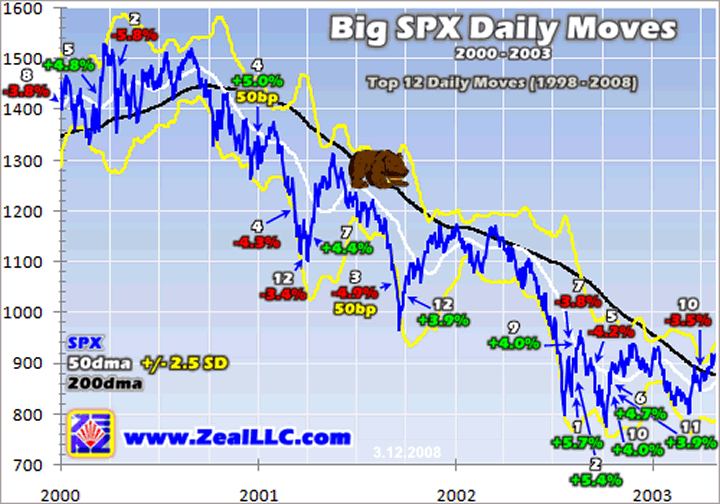
Bear markets have a fearsome reputation, but most of the time they are just plain boring . While the SPX ultimately lost 49.1% of its value from March 2000 to October 2002, this loss happened over 637 trading days. This yields an average loss per day of bear of less than 0.1% . This slow burn is the primary reason why bear markets are so effective and devastating at destroying capital. It is brilliant psychological warfare.
When markets are falling fast, traders get scared fast. They want to sell out immediately to end their bleeding. Thus a bear can't fall too fast too often or it will generate too much fear and drive out too many traders too soon. So truly fast plunges are rare even within bears, as the bear needs to allow enough rallying between the plunges to breed general complacency and keep fear from getting out of line.
Bears do most of their revaluing work in short periods of time, their downlegs. Three massive downlegs bloomed in the SPX bear rendered above, in Q1 2001, Q3 2001, and straddling Q2 2002. It is near the bottoms of these downlegs, and their resulting sharp V-bounces, where most of the biggest SPX daily moves occur. The SPX falls off a cliff leading into their terminal descents, but then it bounces sharply.
Late in bear-market downlegs is when fear is most likely to temporarily spin out of control, driving the brutal and unsustainable 4% daily declines. Interestingly the biggest SPX daily plunge we've seen in 2008 was February 5th's 3.2%. It ranks as the 17th biggest daily plunge of the past decade. It occurred after a sharp 16.3% decline in the SPX between early October and late January. Interestingly this looks an awful lot like a bear-market downleg!
Right after these downlegs bounce, when their fear gets too extreme, is when the biggest daily rallies tend to erupt. Following such aggressive selloffs, prices are so low and so much capital is driven to the sidelines that it isn't too difficult to drive big daily rallies. Note in the chart above that all of these biggest SPX daily rallies occurred just after a sharp decline. So did our latest big rally of March 11th, 2008 .
So if you want to game these big moves, your best odds for hitting them are late in bear-market downlegs for the massive daily plunges and just after that in the resulting V-bounces for the massive daily rallies. The biggest moves ever witnessed in the stock markets are clustered around these bear downleg bottoms. Although calling a major interim bottom on any particular day is risky, options traders who succeed can earn giant profits very rapidly.
Provocatively, the fact that we witnessed the 17th largest SPX daily plunge of the last decade a month ago and the 17th largest rally in the SPX this week increases the odds we are in a new bear market today . Big daily moves are almost entirely a uniquely bear-downleg and V-bounce phenomenon. This piece of evidence joins other threads of research illuminating the growing probabilities that a new bear is upon us.
An occupational hazard of speculation is an almost preternatural focus on probabilities. Since no mere mortal can see the future in advance, the best we can do is clumsily attempt to understand the odds governing it. Studying the past helps us better game how likely future events are. So as I did this research, I felt compelled to build a probability distribution of the all the daily SPX moves.
The total dataset modeled in this chart is the 2563 trading days from January 2nd, 1998 to March 12th, 2008 . Each column below is mutually exclusive for its integer range. The +1% column, for example, shows the odds of the SPX gaining between 1.00% and 1.99% on any given trading day. Not surprisingly this particular probabilities distribution forms a nice bell-curve approximation.
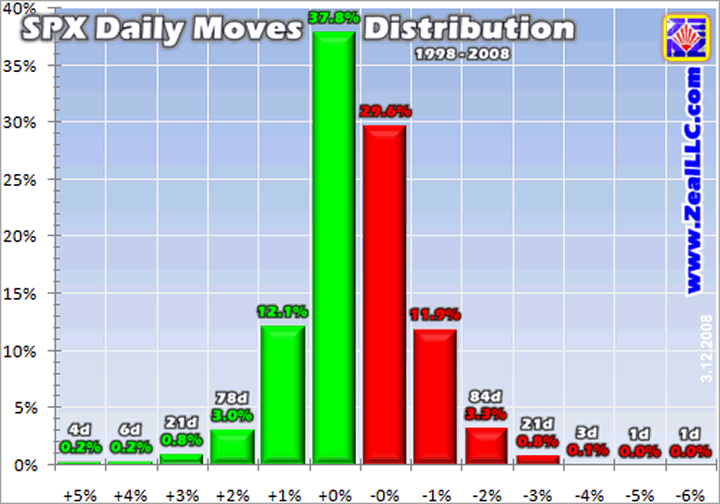
Over the past decade through incredibly volatile markets encompassing major bull and bear alike, our odds of seeing a big move were still exceedingly low. We are talking about a 1.2% cumulative chance of seeing a daily gain greater than 3% and a 1.0% chance of seeing a daily loss greater than 3%. Truly huge moves are even rarer, at just a 0.4% chance of seeing a 4%+ up day and a 0.2% chance of seeing a 4%+ down day.
So gaming big daily moves in the SPX can't be a bread-and-butter strategy for traders. They just don't happen often enough to build a comprehensive trading strategy around. Most of the time, the SPX doesn't do much at all. Fully 67.5% of the days, 2/3rds of all days, run between +1% to -1% on the SPX.
For many years now, I have considered all stock-market days of sub-1% moves in either direction to be essentially “unchanged”. Considered in isolation without their cumulative trend, they are meaningless statistical noise.
But for astute traders carefully watching market technicals and monitoring prevailing sentiment, the rare big SPX daily moves offer fantastic opportunities for large very-short-term profits. The highest-probability-for-success scenario to game is the big up day following a big down day. If the SPX is down 4%ish just before close, buy short-dated at-the-money call options in anticipation of a likely big bounce. This is risky of course, as the bottom you are gaming could be a week or two out yet. Nevertheless, the potential payout is really big.
Applied to today, the recent clustering of big SPX daily moves significantly increases the odds that we are in a new bear market . This may seem troubling, but there are sectors that thrive in such environments. I believe the highest-potential one today is gold stocks. They follow gold on balance regardless of what is happening in the stock markets, as they proved by soaring during the 2000-to-2002 stock bear.
For a broad array of reasons totally unrelated to this research, we have been aggressively buying elite gold and silver stocks at Zeal. Today's stellar gold and silver prices are likely to drive an incredible couple months in precious-metals stocks. Subscribe today to our acclaimed monthly newsletter to mirror our trades to ride this trend! You'll learn how to integrate all kinds of valuable research, like today's SPX explorations, to launch high-potential-for-success trades of your own.
The bottom line is big SPX daily moves are pretty rare. Over the last decade, an incredibly volatile span of time, only about 1 out of every 50 trading days witnessed a 3%+ gain or loss. Both big gains and losses tended to cluster near terminal-stage downlegs and their resulting V-bounces in bear markets. Only bears can consistently generate the extreme volatility necessary to spawn these rare outsized days.
But their very rarity is what makes the big SPX daily moves so darned exciting. They spice up the often dull day-to-day grind in the general stock markets. Not only are they quite fun to experience, in either direction, but they offer great short-term trading opportunities for shrewd speculators.
By Adam Hamilton, CPA
So how can you profit from this information? We publish an acclaimed monthly newsletter, Zeal Intelligence , that details exactly what we are doing in terms of actual stock and options trading based on all the lessons we have learned in our market research. Please consider joining us each month for tactical trading details and more in our premium Zeal Intelligence service at … www.zealllc.com/subscribe.htm
Questions for Adam? I would be more than happy to address them through my private consulting business. Please visit www.zealllc.com/adam.htm for more information.
Thoughts, comments, or flames? Fire away at zelotes@zealllc.com . Due to my staggering and perpetually increasing e-mail load, I regret that I am not able to respond to comments personally. I will read all messages though and really appreciate your feedback!
Copyright 2000 - 2008 Zeal Research ( www.ZealLLC.com )
Zeal_LLC Archive |
© 2005-2022 http://www.MarketOracle.co.uk - The Market Oracle is a FREE Daily Financial Markets Analysis & Forecasting online publication.
