


End of the Financial Crisis, the Great Lie of 2009
Stock-Markets / Credit Crisis 2009 Jul 06, 2009 - 09:17 AM GMT

 Martin Weiss writes: Just as the authorities were touting the “end of the financial crisis,” all heck has broken loose again …
We have a new surge in unemployment, and even without counting those who are excluded from the official numbers, 14.7 million are now jobless, the most since records dating back to 1948. Worse, for the first time since the Great Depression, every single job created after the prior recession has been wiped out.
We have industrial production falling at the same pace as it did in the early 1930s …. and global trade falling at twice the pace of the early 1930s.
We have California — the nation’s most populous state, with the largest GDP and the greatest impact on the entire U.S. economy — collapsing.
We have consumers slashing their spending, small businesses laying off their workers, cities and states forced to gut their budgets.
We see the most radical government countermeasures in a 100 years, the biggest federal deficits in 200 years, plus the swiftest swings — from greed to fear and fear to greed — ever.
Yet, for the past four months, virtually every policymaker in Washington and every pundit on Wall Street has been telling you …
The Great Lie of 2009: “A Recovery Is Around The Corner”
On March 15, Fed Chairman Ben Bernanke told CBS News’ “60 Minutes” that he detected “green shoots” in the economy. And every day since, economic soothsayers have been surveying the landscape, sifting through crops of weeds, trying to find those green shoots.
But from the very outset, editors Claus Vogt, Mike Larson and I have told you this is not a garden-variety recession. It’s merely the first phase of a far longer, deeper depression.
And now, just within the past few days, the myth of “green shoots” has been shattered, the reality of the still-sinking economy revealed.
By late April, famous Wall Street gurus were lining up to declare “the end of the bear market,” and every day since, brokers have been cajoling you to buy the very same stocks they want to sell.
But from the very beginning, we’ve told you this rally was merely the calm before the next big storm, a big selling opportunity.
And now, with the Dow already down 500 points from its June high, it looks like the smarter investors in the world are finally beginning to act on that advice.
In early June, Obama labor officials declared “a big turnaround in nation’s job market,” proudly announcing that “only” 345,000 jobs were eliminated in May.
We immediately issued a report demonstrating these numbers were extremely deceptive. Even if you accepted them at face value, we said, “less bad news” and “slower disasters” are not exactly signs of a turnaround.
And now, with the new government data released Thursday, their thesis is already being proven dead wrong.
One week ago, California officials publicly declared that they would never default on their obligations, directly refuting the forecast of default I made in this column on June 22: According to the BussinessJournal, Tom Dresslar, a spokesman for state Treasurer Bill Lockyer told the press “Mr. Weiss’ analysis and recommendation, to put it kindly, is misinformed.”
Just two days later, California defaulted on its short-term debt obligations to countless vendors and taxpayers, unilaterally issuing millions of dollars in i.o.u.’s that no one wanted and few financial institutions accepted.
These examples barely scratch the surface of the misconceptions, distortions and outright deceptions that are being perpetrated by high authorities, flooded through the media and used to permeate the American psyche — all the while ignoring the elephant in the room …
The Giant Accumulation of High-Risk Debts and Bets Called “Derivatives”
The nation’s mountain of derivatives is not a mirage on the future horizon. Nor is it merely a phenomenon of our distant past.
It’s real. It’s here. And it’s huge.
Just ten months ago, it reared its ugly head and shoved the U.S. and Europe to the brink of a global meltdown.
And just last week, the U.S. Comptroller of the Currency (OCC) issued its latest report showing that, despite all the talk of reducing risk and reforming the financial system, U.S. commercial banks still hold record amounts. The latest tally: $202 TRILLION in notional value derivatives. And even that pales in comparison to the global tally by the Bank of International Settlements, now at $592 trillion.
Yes, there have been some liquidations. But the totals are still massive.
And yes, notional values may overstate the magnitude of the problem. But the OCC’s measure of credit risk does not: Despite some shedding of risk here and there, every single one of the five largest derivatives players is still grossly overexposed to defaults by trading partners:
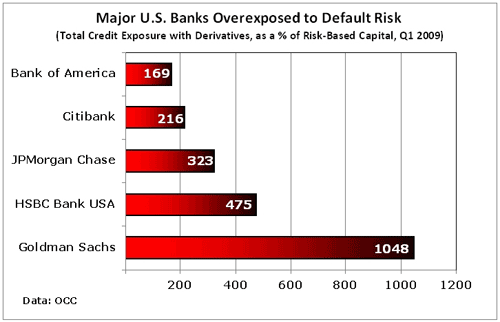
Bank of America has total credit risk in this sector to the tune 169 percent of its capital; Citibank, 216 percent; JPMorgan Chase, 323 percent; HSBC Bank USA, 475 percent; Goldman Sachs, a whopping 1,048 percent, or over TEN times its capital.
If we were back in early 2007 … before the collapse of Bear Stearns, Lehman Brothers and Merrill Lynch … before the implosion of Fannie Mae and Freddie Mac … or before the near-collapse of AIG and Citigroup … then, maybe, folks could get away with ignoring this sword of Damocles hanging over the financial markets.
If we were back in a bygone pre-Bernanke, pre-Geithner era … before TARP (Troubled Asset Relief Program), before PPIP (Public-Private Investment Program), before TALF (Term Asset-Backed Securities Loan Facility), before TLGP (Temporary Liquidity Guarantee Program), before CAP (Capital Assistance Program), before TIP (Targeted Investment Program), before HASP (Homeowners Affordability and Stability Plan), before CPFF (Commercial Paper Funding Facility), before AMLF (Asset-Backed Commercial Paper Money Market Fund Liquidity Facility), before MMIFF (Money Market Investor Funding Facility), or before the alphabet soup of all the other hastily-conceived government efforts to contain the giant elephant in the room … then … maybe we could make believe it’s not there.
Or if all of our nation’s top officials were mute about this monster still in our midst, perhaps that, too, would justify the current aura of bliss that has temporarily shrouded Washington and Wall Street.
But even that is no longer the case. Some officials are finally finding the courage to speak out, issuing some of the same warnings today that we issued years ago.
Global Vesuvius
Nearly three years ago, in our Safe Money Report of November 7, 2006, entitled “Global Vesuvius,” Associate Editor Mike Larson and I wrote:
“Even as the Dow makes new highs, Wall Street and the world’s financial markets sit atop a gigantic mountain of derivatives — high-risk bets and debts that total a mind-boggling $285 trillion. That’s over six times the 2005 output of the entire world economy ($44.4 trillion) … 22 times the total value of the entire Standard & Poor’s 500 Index ($12.7 trillion) … and 25 times the entire U.S. federal and agency debt ($11.3 trillion).
“It’s a global Vesuvius that could erupt at almost any time, instantly throwing the world’s financial markets into turmoil … bankrupting major banks … sinking big-name insurance companies … scrambling the investments of hedge funds … overturning the portfolios of millions of average investors.” (Page 1)
Now, in the thirty months that have ensued, each of these events has come to pass:
The world’s financial markets were thrown into turmoil.
The largest banks in the U.S., the U.K., Germany, and even Switzerland were bankrupted.
The world’s largest insurance company collapsed.
The investments of hedge funds were trashed; the portfolios of average investors, slashed in half.
But it’s not over. And the reasons are quite straightforward: The volcano is now far larger; its tectonic forces, more powerful.
In our 2006 “Global Vesuvius” issue (download the pdf), we identified five major threats:
Major threat #1. The sheer size of the derivatives market. At that time, the global market for derivatives was $285 trillion.
Now it’s $592 trillion. Its six-year compound rate of growth: A shocking 34.5 percent per year!
Major threat #2. The Lack of Transparency. We railed against over-the-counter (OTC) derivatives, representing 96 percent of all derivatives held by U.S. commercial banks. We warned about the lack of disclosure to investors, the lack of standard pricing and the fact that “two financial institutions can trade whatever the heck they want … and no one but the parties involved knows precisely what the contracts are, or what their value really is.” (Page 3)
Now, in Senate Banking Testimony, SEC Chairman Mary Schapiro has admitted that
“OTC derivatives are largely excluded from the securities regulatory framework by the Commodity Futures Modernization Act of 2000. In a recent study on a type of securities-related OTC derivative known as a credit default swap, or CDS, the Government Accountability Office found that ‘comprehensive and consistent data on the overall market have not been readily available,’ that ‘authoritative information about the actual size of the CDS market is generally not available,’ and that regulators currently are unable ‘to monitor activities across the market.’”
Also before the Senate Banking Committee, Henry T.C. Hu, Chair in the Law of Banking and Finance at the University of Texas, has testified that
“Regulator-dealer informational [gaps] can be extraordinary — e.g., regulators may not even be aware of the existence of certain derivatives, much less how they are modeled or used.”
Major threat #3.Too much in the hands of too few. In our 2006 “Global Vesuvius” report, we wrote:
“There are close to 9,000 commercial and savings banks in the U.S. But at midyear … 97% of the bank-held derivatives in the U.S. are concentrated in the hands of just five banks.” (Page 3)
Today, virtually nothing has changed. The five largest commercial banks still hold 95 percent of the total! And if you include the recent shotgun mergers and restructurings, such as Bank of America’s acquisition of Merrill Lynch, the concentration of risk today is even greater.
In her recent testimony, the SEC Chairman puts it this way:
“The markets are concentrated and … one of a small number of major dealers is a party to almost all transactions, whether as a buyer or a seller. The customers of the dealers appear to be almost exclusively institutions. Many of these may be highly sophisticated, such as large hedge funds and other pooled short-term trading vehicles. As you know, many hedge funds have not been subject to direct regulation by the SEC and, accordingly, we have very little ability to obtain information concerning their trading activity … “
Also testifying before the Senate Banking Committee, Christopher Whalen, co-founder of Institutional Risk Analytics, points out that
“Perhaps the most important issue for the Committee to understand is that the structure of the OTC derivatives market today is a function of the flaws in the business models of the largest dealer banks, including JPMorgan Chase [JPM], Bank of America and Goldman Sachs [GS]. These flaws are structural, have been many decades in the making, and have been concealed from the Congress by the Fed and other financial regulators.
“Many cash and other capital markets operations in these banks are marginal in terms of return on invested capital, suggesting that banks beyond a certain size are not only too risky to manage — but are net destroyers of value for shareholders and society even while pretending to be profitable …
“No matter how good an operator of commercial banks JPM CEO Jamie Dimon may be, his bank is doomed without its near-monopoly in OTC derivatives — yet that same OTC business must eventually destroy JPM and the other large dealers. Seen from that perspective, the rescues of Bear Stearns and AIG were meant to protect not investors nor the global markets, but rather to protect JPM, GS and the small group of dealers who benefit from the continuance of their monopoly over the OTC derivatives market.”
Major threat #4.Shenanigans in Credit Default Swaps (CDS). In our 2006 “Global Vesuvius” report, Mike Larson and I also wrote …
“The global market for these credit derivatives is absolutely exploding. It was just $180 billion in 1996. That grew to $893 billion in 2000 … $1.95 trillion in 2002 … and a stunning $20 trillion this year. It’s hard to believe. But that’s a 111-fold expansion in just a decade!
“The problem: Now, hedge funds and other investors are using these derivatives to spin the roulette wheel. In fact, the $1.2 trillion hedge fund industry now holds 32% of the credit default swaps, up from 15% two years ago. Think about that for a minute: Thinly capitalized, gun-slinging hedge funds are now essentially taking on the responsibility for insuring billions of dollars in bonds.” (Page 5)
Now, in his Senate testimony, Institutional Risk Analytics’ Whalen explains it this way:
“In my view, CDS contracts and complex structured assets are deceptive by design and beg the question as to whether a certain level of complexity is so speculative and reckless as to violate US securities and anti-fraud laws. …
“Pretending to price CDS contracts or complex structured securities using ‘models’ is a ridiculous deception that should be rejected by the Congress and by regulators. And members of Congress should remember that federal regulators and the academic economists who populate agencies like the Fed are almost entirely captured by the largest dealer banks. Even today, the Fed and other regulatory agencies raise little or no questions as to the efficacy of OTC derivatives and the absurd quantitative models that Wall Street pretends to use to value these gaming instruments.”
Major threat #5.Outstanding derivatives dwarf the trading in the underlying securities. In our “Global Vesuvius” report, Mike and I wrote:
“The sheer volume of derivatives outstanding … is dwarfing the amount of underlying debt securities. That’s causing major market distortions.
“Take last October. Auto supplier Delphia filed for bankruptcy. At the time, it had just $2 billion in outstanding bonds. But there were a mind-boggling $20 billion of default swaps on its debt!
“To settle those contracts, derivatives players had to scramble to buy underlying bonds. That drove their prices up substantially even as the company was going broke!
“Similar distortions occurred when Delta, Northwest, and Calpine defaulted on their debt.
“End result: The impact of bankruptcies, instead of being minimized by derivatives, can often be multiplied far beyond what you’d normally expect.”
In his testimony, Whalen adds:
“What makes credit default swaps like betting on the temperature is that, in the case of many if not most of these contracts, the volume of swaps outstanding far exceeds the amount of debt the specified company owes.”
And he sums up all the threats nicely with this concluding comment:
“Jefferson said that ‘commerce between master and slave is barbarism.’ All of the Founders were Greek scholars. They knew what made nations great and what pulled them down into ruins. And they knew that, above all else, how we treat ourselves, as individuals, customers, neighbors, traders and fellow citizens, matters more than just making a living. If we as a nation tolerate unfairness in our financial markets in the form of the current market for CDS and other complex derivatives, then how can we expect our financial institutions and markets to be safe and sound?”
Plus, I ask, how can any investor — whether a sophisticated money manager entrusted with billions of the public’s money or an average American seeking a respectable retirement — afford to believe the Great Lie of 2009?
Follow the recommendations we are giving you in our services. Then take all the needed steps to protect your money and convert surging volatility into profit opportunities.
Good luck and God bless!
Martin
This investment news is brought to you by Money and Markets . Money and Markets is a free daily investment newsletter from Martin D. Weiss and Weiss Research analysts offering the latest investing news and financial insights for the stock market, including tips and advice on investing in gold, energy and oil. Dr. Weiss is a leader in the fields of investing, interest rates, financial safety and economic forecasting. To view archives or subscribe, visit http://www.moneyandmarkets.com .
Money and Markets Archive |
© 2005-2022 http://www.MarketOracle.co.uk - The Market Oracle is a FREE Daily Financial Markets Analysis & Forecasting online publication.
