


Which Materials ETF Investing 2010
Companies / Investing 2010 Jan 01, 2010 - 05:20 PM GMTBy: Richard_Shaw

 If you chose to supplement your sector-diversified core US equities stock holdings with a diversified materials stocks ETF, which one is best for you?
There are nine possibilities, of which three, and maybe four, make sense at this time for our purposes and possibly for yours. Those exchange-traded funds are XLB, IYM, VAW and maybe MXI. They have more favorable profiles considering these three attributes:
1. Trading liquidity
2. Expense ratio
3. Yield
Based on those three attributes, the other five materials ETFs do not seem to be great choices at this time. Those less desirable exchange-traded funds are FXZ, RTM, DBN, PYZ and IRV.
Materials funds, or funds within any other category, are likely to exhibit high correlation of returns. That is particularly so for index or index-like funds, but often for active and passive funds alike. Correlation is not going to help too much in fund selection within a closely related group.
Comparison of historical returns, fundamental valuation and underlying portfolio composition is clearly important too, but to initially separate the wheat from the chaff, a good place to start is with liquidity, expenses and yield.
Trading Liquidity:
Trading liquidity is about volume, and is a dominant factor in creating good entries and good exits. You can take your time with good-til-cancelled limit orders for entries, but in the event that you want a rapid exit on good terms, liquidity is a must.
Persistent trailing stop loss orders are an important risk management tool to limit losses while letting profits run. However, since stop loss orders convert to market orders when triggered, you don’t want to be a significant fraction of the daily volume with a market order.
There is likely to be some execution slippage from the stop trigger price to your market order trade, but in a thinly traded stock that slippage could be substantial, particularly if it occurs on a major down draft day – or heaven forbid, on a day like those we say in October 2008.
Simply low Bid-Ask spreads and frequent trades during the day are not sufficient to define liquidity. That may be so for small positions, but what about for large positions? Liquidity is total volume relative to the size of your position.
Here is a view of the average daily Dollar trading volume for the nine materials funds.
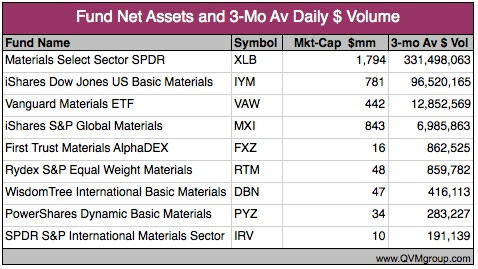
XLB, IYM, VAW and MXI are clearly in a different league than the others, but what about relative to positions of various sizes.
Here is a view of the percentage of average daily Dollar trading volume for each fund for positions that represent 1% of the equity allocation of portfolios with $1 million, $5 million and $25 million in equities.
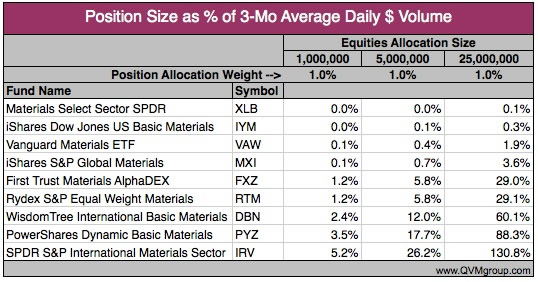
We tend to think that ½% or less of the average daily Dollar volume is a good place to be in any one position. With that guideline, XLB, IYM, VAW and MXI work for all investors with $1 million or less in equities with a 1% allocation of equities to the materials fund.
For the $5 million equities allocation, only XLB, IYM and VAW work – but we might stretch our guideline if we really wanted the global exposure of MXI.
For the $25 million equities allocation, only XLB and IYM work within the guideline. Just imagine the trap that large investor would discover, if that 1% position were in DBN at 60% of a day’s volume. A market order would be savaged, and possibly not completed in a day.
Expense Ratio:
Once you have identified funds within a category with acceptable liquidity, you might be well served by tilting toward those with lower expense ratios – not necessarily the lowest, but generally not the highest either.
Here are the expense ratios for the nine materials funds.
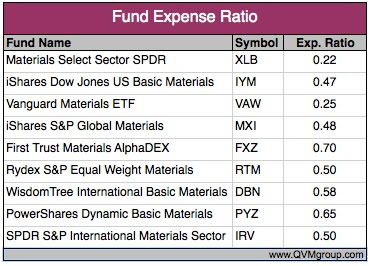
Fortunately, and not entirely surprisingly, the four most liquid funds also have the four lowest expense ratios. OK, that works. Let’s move on to yield.
Dividend Yield:
To the extent that you want total return to come from dividend yield, it’s a good idea to see how yields compare. Of course, all things being equal, lower expense ratios result in higher fund dividends and higher total returns. Then too, differences in portfolio composition can result in material differences in dividends. As conservative investors who like to receive a share of the cash flow within our portfolio holdings, we think yield inspection is an important part of fund selection within a group or category.
Here is the trailing 12-month yield for the nine materials funds.
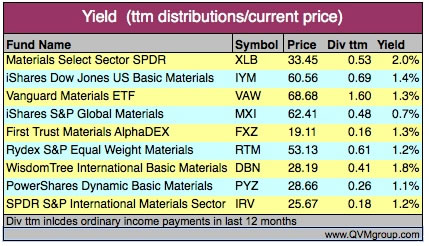
XLB, IYM and VAW show up as on a par with or better than most of the other funds. No give up there. MXI, however, is the lowball yield in the group.
As we have reported before, yield is a slippery concept. Data sources that purport to provide yield data on the same basis often have significantly varying numbers (perhaps due to “as of” date), and not all data sources use the yield definition (e.g. trailing, SEC, current, or annualized last payment as examples). Then some sources simply don’t give clear information about their method or “as of” date. So let us not be guilty of those terrible data offenses.
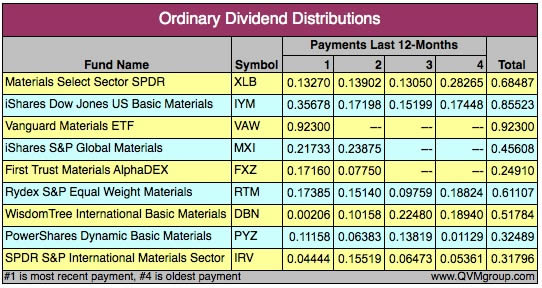
This table details our method and data. We went to the sponsor site for each fund and tabulated all of the actual per share ordinary income distributions for each fund over the most recent 12-month period working backward from the date of the last distribution. The yield in the table above is the result of dividing the total 12-month dividends from the table below by the most recent price (12/30/09) for the each fund.
Yield Trend:
As well as yield, it can be helpful to inspect the yield trend. This may be particularly important after a turbulent year or two, such as the ones we have just been through.
In this table, we show the 2009 and 2008 distribution amounts for each distribution period (the periods vary in length and number by fund). We then computed the year-over-year change for the most recent dividend payment and for the two most recent calendar years.
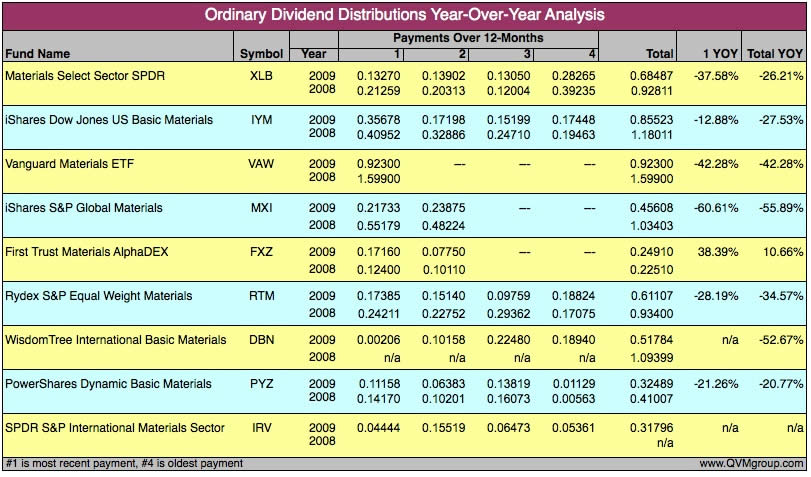
Of the four funds that made it through our filter here, all paid substantially less in dividends in 2009 than in 2008. If the world economy continues to improve, they would probably increase their dividends, with the prospect of going forward yields substantially higher than the trailing 12-month level.
MXI experienced the greatest decrease in dividend payments, and could possibly represent the greatest potential increase. XLB and MXI are continuing to reduce payments through the last payment period. VAM may or may not be experiencing falling dividend receipts, but we can’t tell by these data, because the fund pays dividends only one time per year. IYM is an interesting case, in that it experienced less decrease YOY in the last payment than for 12-months overall – signs of improvement?
Portfolio Holdings:
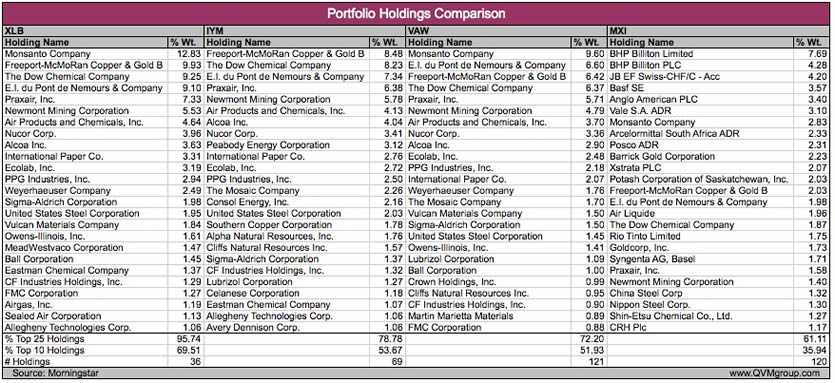
Given the differences in dividend distribution patterns, let’s take an overview look at the top holdings in each of the four “qualified” funds.
A few basic observations are that XLB is the most concentrated and least diversified, with IYM and VAM successively less concentrated and more diversified. MXI is the least concentrated.
XLB is limited to materials companies within the large-cap S&P 500, whereas IYM and VAW are not limited in that way. MXI includes non-US holdings, whereas the XLB, IYM and VAW hold only US positions.
There is high overlap among top positions between XLB, IYM and VAW.
Unless you are particularly oriented toward large-cap or toward the particular top companies in XLB, the holdings data would tend to favor owning IYM or VAW rather than XLB (if the liquidity works for your position size).
Here is a table of the top 25 holdings for each fund.
Fundamental Valuation Ratios:
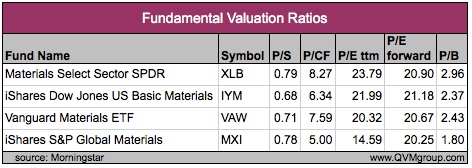
The funds look quite similar in terms of traditional fundamental valuation ratios, with MXI possibly looking a bit better.
Here is a table of price-to-sales, price-to-cash flow, price-to-trailing earnings, price-to-forward earnings, and price-to-book for the four funds that passed the earlier screens.
Price Return:
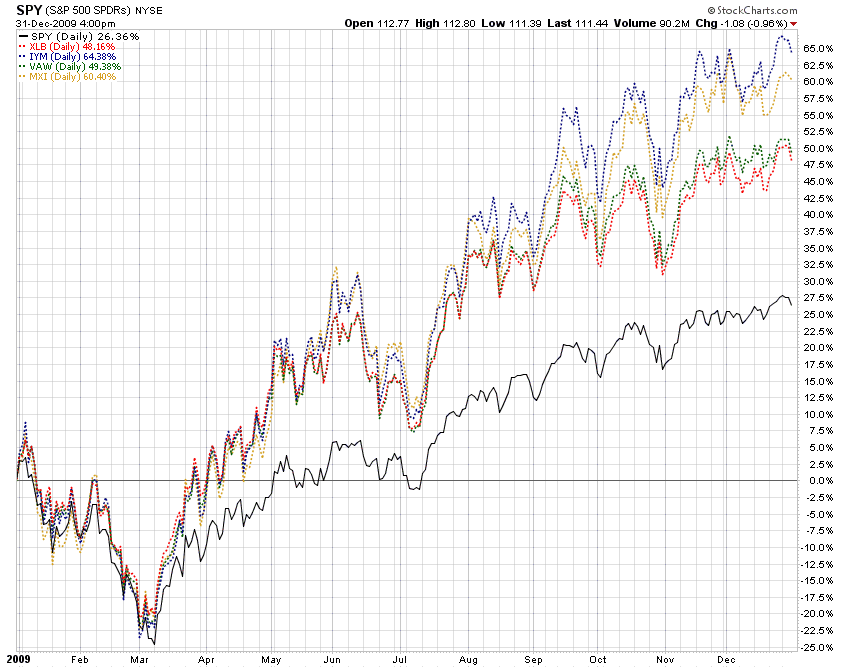
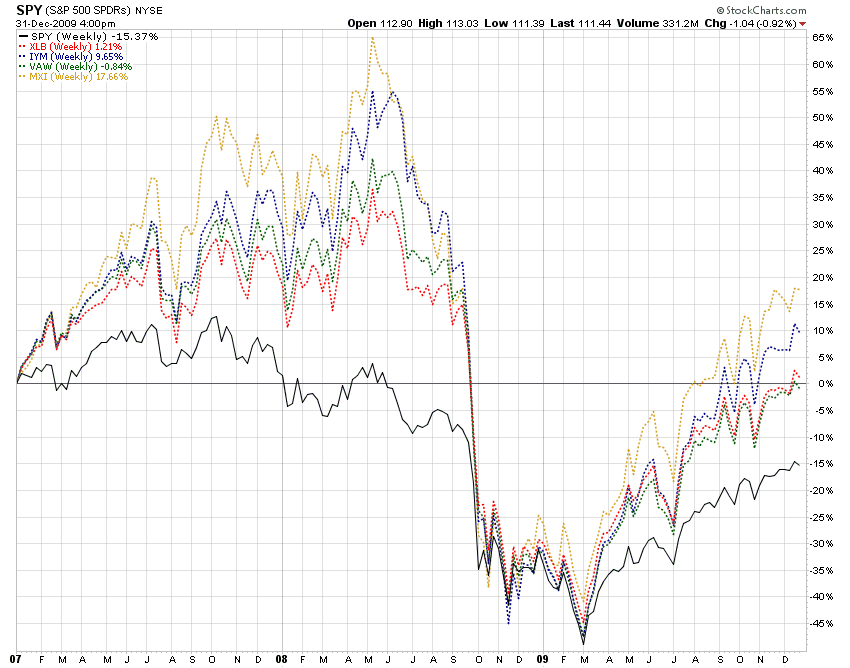
The price charts show IYM and MXI has turning in stronger price returns over 1 and 3 years, compared to XLB and VAW.
1 Year
3 Years
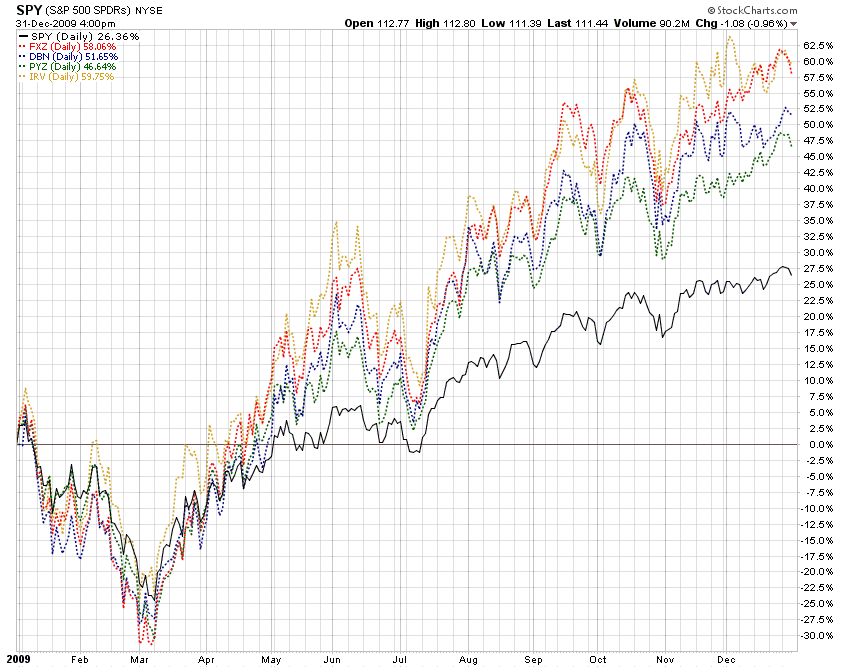
The price return charts for the other five funds is approximately the same as for the four more liquid funds. There was no price return give-up by avoiding these funds.
1 Year
Conclusion:
For very large accounts, we would own XLB, and supplement with positions in some individual non-US materials stocks for international exposure. For accounts sizes that work from a liquidity perspective, we would own IYM and MXI for global exposure, and if the account were small enough we might own MXI alone.
Final Thought:
Assuming you make reasonable selections of individual stocks and/or funds, the primary driver of your long-term returns (perhaps 90% according to some studies) may be your allocation among key asset categories, while security selection among choices within asset categories may generate only 10% or less your total return.
Certainly, strive to make the best security choices, but do not overlook the overwhelming importance of allocation among asset categories — and don’t sacrifice critical liquidity in security selection.
Compliance Disclosure:
We do not currently own any of the funds discussed in this article. We are a fee-only investment advisor, and are compensated only by our clients. We do not sell securities, and do not receive any form of revenue or incentive from any source other than directly from clients. We are not affiliated with any securities dealer, any fund, any fund sponsor or any company issuer of any security. This report is for informational purposes only, and is not personal investment advice to any specific person for any particular purpose. We utilize information sources that we believe to be reliable, but do not warrant the accuracy of those sources or our analysis. Past performance is no guarantee of future performance. Do not rely solely on this research report when making an investment decision. Other factors may be important too. Consider seeking professional advice before implementing your portfolio ideas.
By Richard Shaw
http://www.qvmgroup.com
Richard Shaw leads the QVM team as President of QVM Group. Richard has extensive investment industry experience including serving on the board of directors of two large investment management companies, including Aberdeen Asset Management (listed London Stock Exchange) and as a charter investor and director of Lending Tree ( download short professional profile ). He provides portfolio design and management services to individual and corporate clients. He also edits the QVM investment blog. His writings are generally republished by SeekingAlpha and Reuters and are linked to sites such as Kiplinger and Yahoo Finance and other sites. He is a 1970 graduate of Dartmouth College.
Copyright 2006-2010 by QVM Group LLC All rights reserved.
Disclaimer: The above is a matter of opinion and is not intended as investment advice. Information and analysis above are derived from sources and utilizing methods believed reliable, but we cannot accept responsibility for any trading losses you may incur as a result of this analysis. Do your own due diligence.
Richard Shaw Archive |
© 2005-2022 http://www.MarketOracle.co.uk - The Market Oracle is a FREE Daily Financial Markets Analysis & Forecasting online publication.

