


Long-end Treasuries Drives Valuation Of Stocks And Real Estate: Where Are They Going?
Interest-Rates / US Bonds Mar 03, 2010 - 10:34 AM GMTBy: Andrew_Butter

 Not many people say this, but recently I noticed one of the guys at Minyanville saying…out of the blue, that the “fundamental” value of a stock is the best estimate of what the earnings will be discounted using the best estimate of what the 30 Year will be.
I almost had a heart attack!
Not many people say that; Tobin’s “q” says the “fundamental” is all about book value, that’s what you paid depreciated to now, but the way accountants do valuations of assets these days, (particularly toxic assets), that’s not particularly reliable; and good-luck working out the book-value of brand equity!
But then everyone has a right to his own opinion, that’s what markets are about, and fundamentally the price today is always what someone “dumber than you” will pay.
Likewise trailing (or whatever) P/E ratios just give you an estimate of half of the equation, remember when the DOW was 6600 and the P/E pundits were saying it was going down more and it was never going to bounce up to 10,000? And well, they had a right to their opinions.
I remember when I wrote in early May 2009 that it would go to 10,000 without any problem, one comment I got was “This is the dumbest article I have ever read on Seeking Alpha” (one place where I posted it), like I said, everyone is entitled to their opinions.
Sure, estimating what will happen in the future is an imprecise art. If you buy a cow the price you pay is based on your estimate (and the estimates of anyone else who is competing to buy the critter), of how much milk it will produce (and how many babies), and you know that’s not precise. For example the cow could fall down a well, it could be eaten by a lion, or someone could steal it. Nothing in the future is certain.
And when you buy anything you know that in the words of Keynes, “the market can remain irrational for longer than you can remain solvent”, which is where George Soros and the technical traders make their money.
In Wall Street-Speak what some people call the “fundamental” value (and what International Valuation Standards Calls “Other Than Market Value”), is what the value could reliably be expected to be if the market was not in disequilibrium (or whatever you want to call it). In layman’s language a measure of what someone “smarter than you” might reliably be expected to pay at some unspecified time in the future, discounted using the 30-Year.
The test of whether or not the market is “irrational” or in the words of George Soros and International Valuation Standards “in disequilibrium”, is whether that number is equal to “what someone dumber than you will pay, today”, which is sometimes called “mark-to-market”.
Of course, one of the problems with relying on what the dumbest person in the room thinks, is that sometimes they get it wrong (by definition), for example in the Dot.com, the housing bubble, etc. Particularly when you find out that you were the dumbest person in the room.
As a point of interest, for example, the reason the “inflation targeting” aficionados sat on the sidelines whilst the housing bubble grew like a cancer, was that they got their valuations wrong.
They thought that the “cost” here and now of what an owner-occupier paid to live in a house he owned (that’s for the house-keys leaving aside utilities and municipal taxes), was how much he might have paid if he didn’t live in the house but lived in rental accommodation (owner’s equivalent of rent).
It wasn’t (and it isn’t), the cost was what he paid for living in the house, as opposed to not living in the house (whether he “might” have lived in his car, or “might” have chosen to walk across America is irrelevant, what matters is not what he “might” have done, it’s what he “did” do).
And the cost to him of financing that purchase of one year’s “shelter” is irrelevant also, if gas costs $3 a gallon, that’s what it costs, whether you financed that purchase using a credit card that charges 27% a year, or paid cash, doesn’t change the amount of money you paid the petrol pump attendant.
So the cost to the owner was how much he could have sold the house for (to someone dumber than him or smarter than him - regardless), at the beginning of the year, multiplied by the yield on the 30-Year. If Allan Greenspan and the Bureau of Labour had figured that out, there would not have been a housing bubble. They didn’t, the rest is history.
Reflecting on that for a moment, one can’t help wondering that if the “Inflation Targeting” crowd can’t even figure that out all on their own, what hope is there for America?
There again, like Keynes said, irrationality can last a lifetime; but if you want to understand where is the “fundamental “, you need to understand where the 30-Year will be.
So where is the 30-Year going?
There used to be a time when you could just look that up, it was pretty stable. If you wanted to be really “scientific” you could draw a line through the trend and if you wanted to be really-really scientific you could work out where two standard deviations went and do a Monte Carlo, but that didn’t make much difference.
Nowadays it’s not so simple, talk about that and you are in a conversation about what China will do next, which is not something you can work out on a slide-rule.
One thing about the 30-Year is that although the Fed can play around with the short-end as long as it’s “inflation targeting” heart desires, it can’t do anything about the long end, even the “magician” Alan Greenspan acknowledged that.
Sure they can print money; that helps. And they do, and sure one of the nice things about owning the world’s reserve currency is that you can set it up so you can pay back you debts to the world, using deflated money (and make it so the shadow bankers who own all those toxic assets can do that too).
Suicide is of course always an option, and you can do that slowly if you like, like smoking.
As a young man, Larry Summers (yes THE Larry Summers) thought you could control the long-end by controlling the price of gold. Who knows, perhaps he still thinks that, although perhaps his experiences betting a billion dollars of Harvard’s money on a lame donkey, might have tempered his belief in the invincibility of his intellect?
The logic there was the (fundamental) price of gold ought (theoretically) to be driven by the difference between trend-line inflation and the yield you can get on a 10-Year or 30-Year note. That makes sense, if inflation approaches or exceeds the yield on Treasuries you might as well park your money in gold (which long-term is widely regarded to be inflation proof), and live with the 1% to 2% a year it costs to hold it.
Of course Larry, being a good little Machiavellian, figured that if you can manipulate the price of gold (down) you can (theoretically) push the long-term yield down (so you pay less on your debt), which might explain all the allegations (so far unproven), about how central banks have been relentlessly manipulating the price of gold since as long as anyone can remember.
It’s not clear if he was right. I looked at the history of gold since 1970 and compared it to the “real” return on Treasuries, it takes a bit of imagination to see a correlation, but I guess that just illustrates the pesky long-end is not as easy to play games with as the short-end, or perhaps that “proves” that the gold price was manipulated?
Interestingly the best predictor anyone has found (that I know of – I twigged that reading a report by Societe Generale ) for the 30-Year, at least since all those new-fangled economic ideas started to become popular after the Second World War, is trend-line nominal GDP (5 year Moving Average).
Plot that against annual average for the 30–Year and you can explain 80% of the change over those fifty or so points of data, that’s better than CPI either lagged or projected forwards, the best you can do with that is explain 62% of the changes.
That suggests also it’s the direction of the economy that drives yields rather than the other way around since yields lag – which in “quant-speak” means that nominal GDP is probably a “driver” of the 30-Year yield, and more so than CPI.
That’s a relief, because CPI is a number that can easily be manipulated and there are plenty of reasons for wanting to manipulate it as I’m sure Mr. Larry Summers, the master-manipulator can explain.
For example if you can squeeze it down you pay less on your index-linked pensions and your TIP’s, also you can justify putting the base-rate right down to create bubbles which is always good for politics (in the short-term, and thanks to the political system in USA you can leave the fall-out to the next guy), plus you can tell everyone what a great job you are doing “inflation targeting” (and for that it helps enormously if you can move the target).
Anyway, this is how that looks:
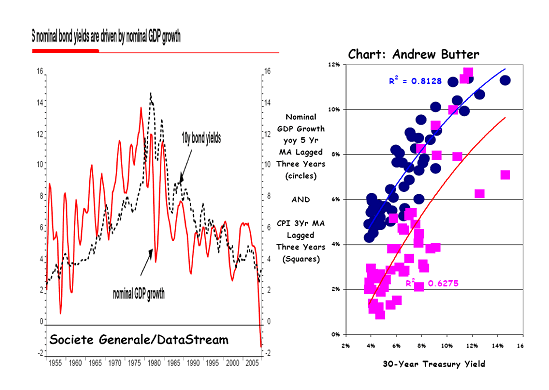
OK…OK…I know the dependent variable should be on the “Y” axis but I put it like that to compare the two lines. Seems to work pretty good; like I said, I couldn’t find anything that works better.
Why should that work? Well to tell the truth I don’t really have a clue, although I’m sure Societe Generale has an idea, and if you don’t speak French you can ask three economists and they will lay out six different explanations for you in Technicolor.
What that says is that if Mr. Helicopter want to make it so that Slim Timmy pays less interest on the two, three…four (?) trillion dollars of debt that he wants to issue in the not too distant future, all he has to do is make sure nominal GDP doesn’t grow, and he should have it cracked.
Two other interesting points, the first is that if China wants to maintain the value of those $870 billion plus perhaps what they bought secretly US Treasuries, plus the $500 billion or more of toxic assets they bought, then they need to help Helicopter and Larry keep the yield on the long-end down. So their best interests would be served if US Nominal GDP did NOT grow too fast in the immediate future.
The best way to do that of course is to keep protecting the scumbags who manufactured all that “melamine tainted milk” and shovelling “stimulus” money into the public sector to add one layer of unsustainable debt on another, which as far as I can see is the current plan.
It’s nice to know Timmy and the Chinese are on the same side for a change, although if I was American I would be concerned that they might not be on the SAME side as me.
The other thing is that the best predictor of the S&P 500 “fundamental” is nominal GDP divided by the 30 year (that works better than any accumulation of Earnings worked out under US-GAAP (or “Voodoo Valuation Standards” (VVS) for short), or for any prediction of those).
That’s pretty robust once you add in the dynamics of bubbles and busts, for example in January 2009 that model said the S&P 500 would turn at 675, and you can’t get much closer than that (666 was intra-day).
http://www.marketoracle.co.uk/Article9131.html
Anyway, it looks like the fundamental is in fact a function of nominal DGP divided by a function of the direction of change in nominal GDP (slow-hand i.e. lagged).
So for any enquiring minds thinking about where the S&P 500 is headed, it’s worth keeping a close eye on where nominal GDP is headed.
By Andrew Butter
Twenty years doing market analysis and valuations for investors in the Middle East, USA, and Europe; currently writing a book about BubbleOmics. Andrew Butter is managing partner of ABMC, an investment advisory firm, based in Dubai ( hbutter@eim.ae ), that he setup in 1999, and is has been involved advising on large scale real estate investments, mainly in Dubai.
© 2010 Copyright Andrew Butter- All Rights Reserved
Disclaimer: The above is a matter of opinion provided for general information purposes only and is not intended as investment advice. Information and analysis above are derived from sources and utilising methods believed to be reliable, but we cannot accept responsibility for any losses you may incur as a result of this analysis. Individuals should consult with their personal financial advisors.
Andrew Butter Archive |
© 2005-2022 http://www.MarketOracle.co.uk - The Market Oracle is a FREE Daily Financial Markets Analysis & Forecasting online publication.
