
Best of the Week
Most Popular
1.Four Shocking Economic Bombshells Bernanke Did NOT Tell Congress About Last Week - Martin_D_Weiss
2.Obama Preparing to Attack Iran - Webster G. Tarpley
3.U.S. House Price Forecast 2010 to 2015 - Andrew_Butter
4.The Illuson of Economic Recovery, Major Indicators Point Towards Further Collapse - Bob_Chapman
5.Unusually Uncertain Outlook Shows The Fed is Killing the Economy - Washingtons_Blog
6.Economic Warnings From Niall Ferguson and Nassim Taleb - Gary_North
7.Gold Market Spooked by Deflationary Double-Dip Recession Fears - David_Galland
8.Stocks, Commodities and Financial Markets, The Shape of Things to Come - Steve_Betts
9.Elements of Deflation and the Super-Trend Puzzle - John_Mauldin
10.Wages and Subsistence - 24th July 10 - Ludwig von Mises
Last 5 Days Analysis
The Fed Flashes the Nuclear Quantitative Easing Trump Card - 29th July 10
You’ll Hate Your Gold So Much You’ll Want to Spit On It - 29th July 10
Austrian Business Cycle Theory Vs Keynesians - 29th July 10
Gold Promises and Currency Lies - 29th July 10
Investing for Deflation Part 2: More Reader Questions - 29th July 10
An Corporate Earnings Feast to Digest - 29th July 10
The Number of ETFs Exploding to Over 1,000 - 29th July 10
Stock Market Balancing on a Knife Edge... - 29th July 10
Escalating Violence From the Animal Liberation Front - 29th July 10
How to Pick Stocks in the ‘New Normal’ Economy - 29th July 10
Did BP Accidentally Tap Into the Rigel Gas Field? - 29th July 10
How Think Tanks, Foundations, Big Oil and the CIA Undermine Democracy - 29th July 10
Is WikiLeaks Release Anti-war Whistleblowing or Obama War Propaganda? - 29th July 10
Price Stability Not a Fed Priority - 29th July 10
Bill Gross Ponders "Deep Demographic Doo-Doo" - 29th July 10
Financials, Oil and Gold on the Move - 29th July 10
Kindergarten Double Dip Recession Economics - 28th July 10
Putting Money on the Junior Gold Miners - 28th July 10
Economists Miss Durable Goods Orders Slump - 28th July 10
2011: The Year Of The Tax Increase - 28th July 10
Banks Find A Bid After Basel Watered Down - 28th July 10
Profit From the Global Thirst for Clean Water - 28th July 10
Evolving Global Financial Crisis, U.S. Dollar Heading Down Again - 28th July 10
Investors Beware of Municipal Bonds as Defaults Soar - 28th July 10
Government Economic Lies, The Grossly Problematic Gross Domestic Product - 28th July 10
Economic Warnings From Niall Ferguson and Nassim Taleb - 28th July 10
Will U.S. House Prices Drive The 4.8% “Consensus” Nominal GDP Growth Forecast? - 28th July 10
Gold Counting Down to Assault on $1300 - 28th July 10
America's Vision: National Capitalism - 28th July 10
European Sovereign Debt Crisis, Running Through a Minefield Backwards - 27th July 10
Gold, Hoping for a Break - 27th July 10
Stock Market Take-Off Tuesday Already? - 27th July 10
The Unlimited Power of Suppressing the Interest Rate - 27th July 10
Should the Fed Pump Even More Money? - 27th July 10
Is the Star in Starbucks Fading? - 27th July 10
Nasty MLP ETF Indicator Flashing Investor Warning Signal Again - 27th July 10
NAFTA Has Resulted in Increased U.S. Unemployment - 27th July 10
WikiLeaks Exposes Imperialist War in Afghanistan - 27th July 10
A Decade of Falling House Prices - 27th July 10
The Continuing Crisis in the New World Order - 27th July 10
WikiLeaks and the Afghan War - 27th July 10
BP Hopes for a CEO Savior in American Robert Dudley - 27th July 10
Will China Grab the Credit-Rating Business? - 27th July 10
Unemployment is Worse Than We Know, Economic Recovery Challenge Harder Than We Think - 27th July 10
Plausible Gulf Oil Spill Scenario: Underground Blowout and Mudflow - 27th July 10
The 'I's' of the Illuminati - 27th July 10
Good Potential in Junior Gold Miners - 27th July 10
Three Emerging Economies Bucking the Depression Downtrend - 26th July 10
U.S. Financial Reform Bill is 2300 Pages of Gobbledygook - 26th July 10
Crude Oil and Natural Gas Trading Using Technical's or Fundamentals, Which is Better? - 26th July 10
The Deflationary Cycle Full Monty, Eight Risks That Will Cause Deflation - 26th July 10
Stocks Search for Direction Post Bank Stress Tests - 26th July 10
Crude Oil Headed Unimaginably Higher! - 26th July 10
Four Shocking Economic Bombshells Bernanke Did NOT Tell Congress About Last Week - 26th July 10
China Stock Market Ready to Surge 50%: Part II - 26th July 10
Why Second Quarter Corporate Earnings Haven’t Spurred a Stock Market Rally - 26th July 10
Stocks Stuck in Trading Range Despite Positive Corporate Earnings Reports - 26th July 10
The Illuson of Economic Recovery, Major Indicators Point Towards Further Collapse - 26th July 10
Money Supply Divergence TMS1 vs. TMS2 vs. M2, What does it Mean? - 26th July 10
The Breakup of the United States - 26th July 10
Inflation, The Coming Rice in Prices - 26th July 10
Stocks, Commodities and Financial Markets, The Shape of Things to Come - 25th July 10
Yes, You Can Time the Market – Here’s How! - 25th July 10
Mid 2010 Investment and Economic Thought - 25th July 10
SP-500, GLD and GDX Investor Sentiment Trumps Everything - 25th July 10
Charting the Stock Market is Similar to Tracking a Squirrel Crossing a Busy Street - 25th July 10
Stocks Bull Markets Generate Economic Growth - 25th July 10
Metals Investing in Burkina Faso, The Land of Upright People - 25th July 10
U.S. is Insolvent and Faces Bankruptcy as a Pure Debtor Nation - 25th July 10
Obama Preparing to Attack Iran - 25th July 10
U.S. Taxpayers the Largest Source of Taliban Revenue - 25th July 10
Credit Based on Consumption Not Savings, Real Bills Revisted - 25th July 10
Thoughts on the Economy - 25th July 10
Positive European Bank Stress Tests Sending Markets Higher - 25th July 10
The Golden Chalice and Gold’s Greatest Correction Since 1980 - 25th July 10
Wages and Subsistence - 24th July 10
Why Currencies Play an Important Role in Corporate Earnings - 24th July 10
Elements of Deflation and the Super-Trend Puzzle - 24th July 10
Making Sense of the Economic Puzzle - 24th July 10
Statistical View of Price Ranges for U.S. and China Stock Markets - 24th July 10
NATO Pulls Pakistan Into Its Global Network - 24th July 10
U.S. Jobless Claims and Housing Market Data Point to Worsening Economy - 24th July 10
U.S. Need Not Fear Sovereign Debt Crisis, Unlike Greece, It Actually Is Sovereign - 24th July 10
Shadow Banking Makes A Comeback - 24th July 10
U.S. Economy Never Came Out of Recession, Pray and Hold onto Gold - 24th July 10
Gold BubbleOmics Revisited - 23rd July 10
Gold Market Spooked by Deflationary Double-Dip Recession Fears - 23rd July 10
U.S. Dollar's Never-Ending Plunge and Its Gold Consequences - 23rd July 10
Gold and Silver For Investor Profit and Protection - 23rd July 10
Credit Deflation Lands in Britain - 23rd July 10
Gold Diverging Trend From Weak U.S. Monetary Inflation - 23rd July 10
Markets Stressful Finish To The Week - 23rd July 10
Oil Stocks XOI Undervalued - 23rd July 10
The Strategic Ramifications of a US-Led Withdrawal from Afghanistan - 23rd July 10
A Battle Royal in the S&P 500 Stocks Index - 23rd July 10
Gold Market Manipulation, Swaps Signal the Roadmap Ahead, BIS The Super SIV Solution - 23rd July 10
UK Stealth Economic Boom, GDP 1.1% Growth Catches Press and Academic Economists By Surprise - 23rd July 10
Three Dividend Stealth Stocks - 23rd July 10
Mortgage Debt … Credit Card Debt … Corporate Debt — It’s all Shrinking! - 23rd July 10
U.S. House Price Forecast 2010 to 2015 - 23rd July 10
Hungary Could Trigger Next Sovereign Debt and Credit Crisis Event - 23rd July 10
How to Buy Gold - 23rd July 10
Signing Financial Reform Is Signing Up For A New Struggle To Make It Real - 23rd July 10
Plan For America To Control Federal Deficit Spending - 23rd July 10

Free Instant Analysis

Free Instant Technical Analysis


Market Oracle FREE Newsletter

Robert Prechter's Stock Market Forecast to 2016

Germany, The “Must-Invest” Economy

Economics / Investing 2010 Mar 10, 2010 - 07:49 AM

By: Money_Morning

Economics

Best Financial Markets Analysis ArticleMartin Hutchinson writes: If you're a U.S. investor, you can't be happy about the prospects for your portfolio. After all, you're mostly trapped in an economy with a gigantic and dangerous financial-services sector, a central bank that can't stop itself from printing money and a government that overspends wildly.


But there is an answer: You should consider allocating some of that "at-risk" capital to a country that has none of those problems - Germany.

Germany has a banking system, of course, but that banking system is not the overgrown financial-services monster that we have here in the United States (or, for that matter, in Great Britain). It's impossible to get a subprime mortgage in Germany: Even now - and even after mortgage levels have crept up in recent years - the average down payment for the purchase of a new home in this key Eurozone nation is 50%. As a result, the homeownership rate in Germany is only 43%, the lowest rate in the European Union.

That's actually healthy; far less of Germany's capital is tied up in unproductive housing and the savings rate is correspondingly higher. (Let's face it, most Americans don't accumulate 50% of the cost of a house in savings over their lifetimes - unless forced to do so in a company pension scheme).

What's more, this more-modest home-ownership rate lessens the impact of speculative bubbles, since the wealth of most folks isn't tied up in rapidly escalating house prices. So while the German banking system had its own real estate problems in the late 1990s, the only parts of it that got in trouble in 2008 were those banks that had rashly ventured overseas and got caught up in the U.S. disaster.

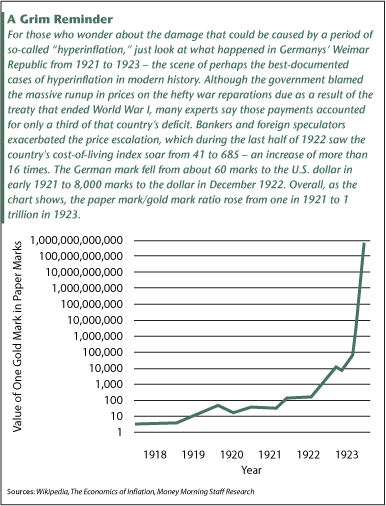
Up until 1999, Germany had the most admirable central bank in the world - the Bundesbank. This was a much better set up than the U.S. Federal Reserve. It was owned by the states instead of by the national government, so political interference was much more difficult. It was a single institution, instead of a collection of regional banks, so it was much easier to manage. And it had the single objective of avoiding inflation (Germany having bad memories of the Weimar hyperinflation of the 1920s) so did not get sidetracked into attempting Keynesian management of employment. As a result, Germany's currency - the Deutsche Mark - was a beacon of stability during the inflation-ridden 1970s.
In 1999, control of Germany's monetary policy passed to the European Central Bank (ECB). The ECB is not as solid as the Bundesbank, but it still beats the Fed. The ECB expanded the money supply much less than did the Fed from 2002-07, and it has issued much less monetary stimulus since the crash. Consequently, there is far less danger of inflation in Germany and the Eurozone in general than there is in the United States. Yes, there's the possibility that German taxpayers might have to bail out Greece, but the same possibility exists in the United States with respect to California, which is much larger.

However, the most important advantage for Germany over the United States - in fact, over all the other major industrial economies - is its superior fiscal policy. When the talk of "stimulus" first appeared in late 2008, Peer Steinbruck - a Social Democrat who was then serving as Germany's finance minister - rudely described it as "crass Keynesianism." As a result, Germany did very little stimulus, and so still has a budget deficit of less than 5% of gross domestic product (GDP), in spite of the recession.

Last September, the German electorate decided that even Steinbruck was too socialist, and so elected a coalition between Angela Merkel's Christian Democrats and the Free Democrats, a free-market party that is even more opposed to public spending than Merkel. The effect of this has been to push Germany even more firmly into the fiscal-retrenchment camp - the German parliament lopped an extra 5.8 billion euros ($8 billion) off public spending before finalizing the 2010 budget - no pork barrel waste there!

The result has been a very brisk economic recovery, with no inflation and no significant risk of "crowding out" the private sector. Manufacturing orders were up a strong 4.3% in January, far more than had been expected, and are now 19.6% ahead of where they were a year ago. Unemployment is 8.2%, well below the U.S. level, while Germany's current-account surplus is a massive 5.2% of GDP.

With competitive manufacturing, a business-friendly government and plenty of domestic capital, Germany is about as healthy an economy as there is in the world today and is thoroughly underrated by U.S. and British analysts. Its stock market is trading at a fairly demanding 19.7 times earnings, according to The Financial Times database. But that's lower than the U.S. market multiple of 20.0 times earnings. And Germany has better near-term prospects.

You should think about owning some of Germany's promise, even if it's only through the iShares MSCI Germany Index Fund ETF (NYSE: EWG).

Source: http://moneymorning.com/2010/03/10/investing-in-germany/

Money Morning/The Money Map Report

©2010 Monument Street Publishing. All Rights Reserved. Protected by copyright laws of the United States and international treaties. Any reproduction, copying, or redistribution (electronic or otherwise, including on the world wide web), of content from this website, in whole or in part, is strictly prohibited without the express written permission of Monument Street Publishing. 105 West Monument Street, Baltimore MD 21201, Email: customerservice@moneymorning.com

Disclaimer: Nothing published by Money Morning should be considered personalized investment advice. Although our employees may answer your general customer service questions, they are not licensed under securities laws to address your particular investment situation. No communication by our employees to you should be deemed as personalized investment advice. We expressly forbid our writers from having a financial interest in any security recommended to our readers. All of our employees and agents must wait 24 hours after on-line publication, or 72 hours after the mailing of printed-only publication prior to following an initial recommendation. Any investments recommended by Money Morning should be made only after consulting with your investment advisor and only after reviewing the prospectus or financial statements of the company.

Money Morning Archive

© 2005-2010 http://www.MarketOracle.co.uk - The Market Oracle is a FREE Daily Financial Markets Analysis & Forecasting online publication.


Comments


Post Comment (Moderated)


(Note Commenting Issue: If after Submitting you are returned to the Main Index Page then due to site caching your comment has not been accepted. Solution - Click the Browser Back Button to the article page and Press PAGE REFRESH (you should see the message "You are not authorized to carry out this operation") Now re-enter your comment (ignoring the notice) - If all's well then you will remain on the article page after submitting, a moderator will check and authorise the comment. Alternatively EMAIL to comments @ marketoracle.co.uk , quoting the article number.

FREE Deflation Survival GuideFREE Updated 118 Page Independant Investor E-book