


Liquidity Problems and the Stock Market
Stock-Markets / Credit Crunch Aug 14, 2007 - 12:16 AM GMTBy: Hans_Wagner

In the last weeks we have seen problems in the mortgage market spill over and negatively affect commercial and investment banks. Volatility in the stock market has increased with the U.S. markets experiencing dramatic swings in price, especially in the last hour. So what can investors do to deal with this situation?
What is a Liquidity Crisis
We all have heard that the world is awash with liquidity. And now there is a liquidity crisis that has required central banks in Europe, the United States and Asia to inject funds to help resolve the problem. So what is liquidity? Simply put liquidity is a measure of how fast an asset can be converted into cash. Some assets can be quickly converted into cash, such as stocks. Others take time and effort before the become cash, such as the sale of a house.
A liquidity crisis exists when someone needs cash and cannot quickly sell assets to generate the cash. For example, if you own real estate and need to quickly sell your property to generate cash, it will take some, time, weeks to months before you see the cash. In the mean time you are unable to convert your real estate asset to cash. This is a liquidity crisis.
Well in the last few weeks we have seen the trappings of a liquidity crisis form due to the melt down of the sub-prime mortgage markets that is now affecting much of the credit markets
How Sub-prime Mortgage Problems Cause Liquidity CrisisBut how can problems in sub-prime mortgages cause the worlds largest banks, investment houses and hedge funds problems? Well, it is a complicated process that was put together by some of the leading financial minds on Wall Street.
First, the sub-prime loans were made without properly pricing in the risk of repayment. Loans were made without any collateral to borrowers who did not have to provide normal loan qualification information, such as income sufficient to cover the future loan payments. Many of these loans were adjustable rate with little or no money down. These are more risky loans, yet they were priced as though there was not risk associated with repayment and default.
Then various financial institutions “packaged” these loans together to create financial instruments that could be sold to various investors such as pension funds, hedge funds, etc. The packaging of these loans hid the risk inherent in the original loans. Also the packaged loans could include high risk sub-prime loans as well as high quality credits. The investors buying the packages were unaware of the details. The concept was that the packages were put together so that statistically the package of loans would meet an acceptable loss rate based on the past. Unfortunately, most of these sophisticated investors had no idea what they were buying, or did not fully appreciate the risk they were assuming.
When the repayment problems with these loans become more wide spread, they impacted the value of these packages, negatively. They did not know the value of these asset holdings. Also many were bought with credit to enhance the leverage and as a result the returns. However leverage works both ways.
As defaults in the loans grew beyond expectations, the investors sought sell their positions. The institutions holding these packages of loans had to sell some of their assets to meet cash demands from their investors. However, there wasn't anyone to buy these securities, except as very low prices (pennies on the dollar). This started the liquidity crisis. It expanded when the same intuitions then sold their more solid assets to help meet the cash demand from their investors. This included stocks with solid fundamentals, causing the stock markets to fall.
The banks that had lent money to these funds got concerned that their loans were in jeopardy and issued margin calls. This caused the funds to sell more assets, especially the ones that that they could sell easily, the better assets. This further caused the selling in the markets that lead to the liquidity crisis we saw recently. To help overcome this problem central banks in Europe, the United States and Asia temporarily bought securities from the banks to help provide sufficient cash to help them meet the demand. The banks will have to buy back these securities at a later date.
As a result rates for new loans rose in price to better reflect the realities of the market. New borrowers were faced with rates that were substantially higher than just a few weeks ago. Even well qualified borrowers encountered difficulties borrowing money as the lending institutions “over reacted” to the credit problems.
This is how we experienced the latest liquidity crisis which has caused much of the increase in volatility we have been seeing the stock markets.
Markets Highly VolatileAs the liquidity problems spread beyond mortgages they impacted the ability of private equity firms and hedge funds to borrow money to fund their purchases of stocks and to take companies private. Investors then become fearful that they owned assets that were losing value, so they sold stocks to generate the cash to meet their investor's demands. This caused the prices of stocks to fall. At times there were few buyers willing to buy stock, so the price of shares fell further. As a result “When you can't sell what you want, you sell what you can.” This caused the increase in volatility we have experienced in the stock markets.
The VIX is known as the volatility indicator. It is a weighted blend of prices for a range of options on the S&P 500 index. When the VIX rises it is a sign of higher volatility which implies greater fear that the market will fall. Notice how the VIX has risen dramatically.
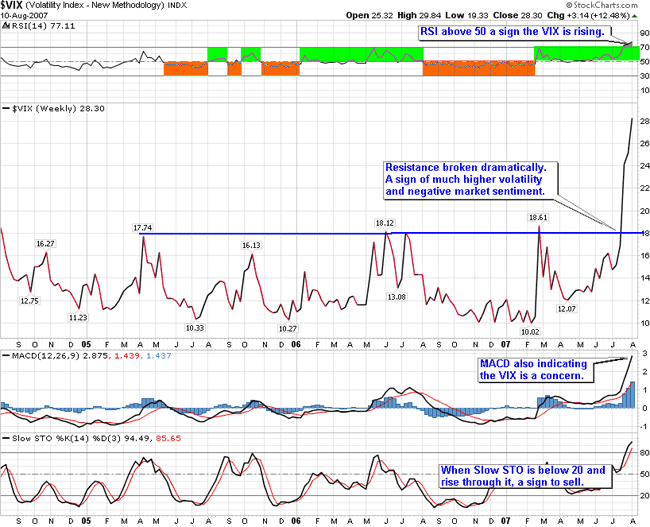
First of all this is a very difficult trading environment. As a result it is very important to make any buys, sells or shorts very carefully. The key is to find sectors and sectors that are doing well now and will continue to do so once these liquidity problems are over. For example the technology sector has bee outperforming the market recently. Also companies that continue to benefit from the strength of the global economy are also doing well.
Now is the time to look for bargains or good valuations (companies with good earnings and cash flows) and be ready to buy once we see the bulk of these problems are contained. The problem is usually it takes longer than most investors expect for all the “cockroaches” to be found. Most of the investment banks and hedge funds still do not know the value of the mortgage assets they have on the books. As a result there can be further surprises that cause more problems.
Don't be in a hurry to buy as volatility can last for a while. Also be ready to buy quality on dips in price.
By Hans Wagner
tradingonlinemarkets.com
My Name is Hans Wagner and as a long time investor, I was fortunate to retire at 55. I believe you can employ simple investment principles to find and evaluate companies before committing one's hard earned money. Recently, after my children and their friends graduated from college, I found my self helping them to learn about the stock market and investing in stocks. As a result I created a website that provides a growing set of information on many investing topics along with sample portfolios that consistently beat the market at http://www.tradingonlinemarkets.com/
Hans Wagner Archive |
© 2005-2022 http://www.MarketOracle.co.uk - The Market Oracle is a FREE Daily Financial Markets Analysis & Forecasting online publication.
