


The U.S. Economy Really is in Trouble
Economics / US Economy May 25, 2010 - 12:37 PM GMTBy: Gerard_Jackson

 Although industrial production has continued to grow manufacturing has started to slow. There were mass layoffs in April with manufacturing taking the lead. The Fed reported that that its index of manufacturing activity for New York, New Jersey and Connecticut had slowed significantly while the Philadelphia Fed reported that manufacturing growth had decelerated and that in May there was a significant drop in orders for manufactured goods. Adding to the woe was a report by The Conference Board that its index of leading economic indicators dropped in April, the first fall in about twelve months. What the devil is going on? Without a doubt this is the worst 'recovery' in post-war history.
Now it was believed by many that Bernanke's massive monetary injection would send production and prices zooming, Neither happened. This is because the money largely ended up as idle reserves. Nevertheless, the money supply did expand. Adopting what some call "a narrow view of the Austrian definition of the money" the following chart shows a rapid monetary expansion from September 2008 to June 2009 of about 25 per cent. (Although money supply figures are subject to revision there can be no doubting -- irrespective of one's monetary measure -- that there has been massive growth in the monetary base.)
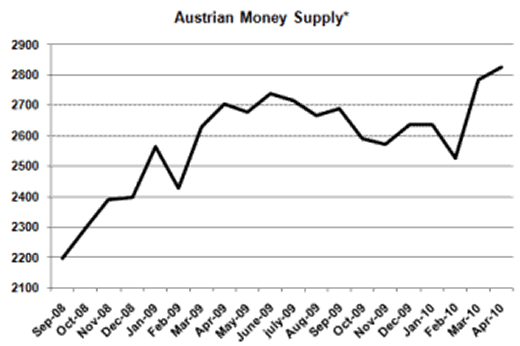
I have no doubt that this expansion stimulated production and manufacturing. However, from June 2009 to the following February a contraction set in and the money supply fell by about 8 per cent. This, in my opinion, is responsible for the current slowdown in manufacturing. We now find that from February to April that the money supply once again accelerated, growing by about 12 per cent.
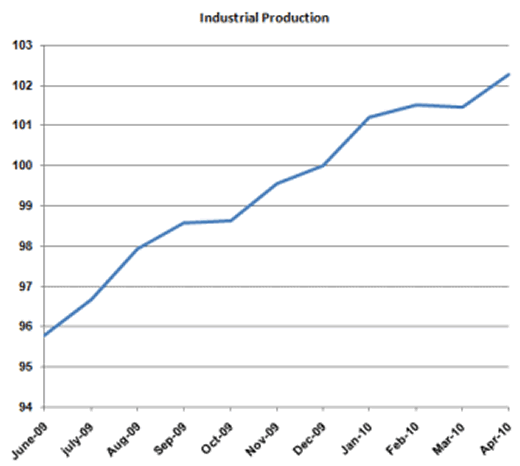
So why was industrial production unaffected? It wasn't. The following chart shows that from June 2009 to January 2010 industrial production steadily rose, apart from a temporary flattening in September. It was in January and February that the expansion slowed, with production declining slightly in March and then accelerating in April. These changes suggest that industrial production could be particularly sensitive to large and sudden changes in the money supply
Readers are well aware of my belief that manufacturing is a vital economic indicator. (The reason for this belief has to do with the role time plays in production.) Right now the US economy is suffering from a frightful monetary policy that would make a roller-coaster ride feel like a stroll through the park. Destabilising doesn't describe the present situation. If the monetary acceleration continues then the US will eventually face a severe surge in inflation followed by another steep slump. Should the money supply continue its erratic course then I doubt if any kind of recovery is possible.
Aggravating the situation is Obama's impending tidal wave of taxes and a permanent avalanche of form-filling, not to mention the rest of the his agenda -- just the things a flagging economy needs. This is like trying to save a drowning man by throwing bricks at him, regardless of what Reuters and the rest of the lefty media assert. Then again, maybe he doesn't really want to save the economy. Perhaps what he really wants to do is transform it.
As if determined to prove that he has no understanding of the country's economic plight he appointed Janet Yellen, president of the San Francisco Fed, Peter Diamond of MIT and Sarah Bloom Raskin to the Federal Reserve Board. All three are Keynesians and all three believe in big-spending government. Any so-called economist who can still call himself a Keynesian should not be allowed near sharp instruments let alone a central bank.
It is largely Keynesianism that brought about the present mess. Now we have Janet Yellen who believes in the absurd Philips curve and the silly idea that excessive employment can cause inflation. Then there is Sarah Bloom Raskin who thinks greed caused the financial crisis. And this woman's Amherst College thesis was on monetary policy.
These people are -- as are most economists -- clueless on genuine monetary theory. No wonder the US is going down the gurgler. (The best stuff I ever read on monetary theory was written by the early economists. Their insights and grasp of monetary theory puts this lot to shame.)
*There are some differences among Austrians as to what ought to be included in a definition of the money supply. I try adhere to Walter Boyd's view who in his open letter to Prime Minister Pitt in 1801 defined money in the following terms:
By the words 'Means of Circulation', 'Circulating Medium', and 'Currency', which are used almost as synonymous terms in this letter, I understand always ready money, whether consisting of Bank Notes or specie, in contradistinction to Bills of Exchange, Navy Bills, Exchequer Bills, or any other negotiable paper, which form no part of the circulating medium, as I have always understood that term. The latter is the Circulator; the former are merely objects of circulation. (Walter Boyd, A Letter to the Right Honourable William Pitt on the Influence of the Stoppage of Issues in Specie at the Bank of England, on the Prices of Provisions, and other Commodities, 2nd edition, T. Gillet, London, 1801, p. 2).
In simple terms, money is the medium of exchange. Nevertheless, difficulties do arise. Are savings deposits money? This presents the problem of double-counting. If I take $10,000 in cash and deposit it in my savings account it cannot be seriously I argued that I have now expanded the money supply by $10,000. It therefore follows that if the bank lends out that $10,000 the money supply still remains unchanged. We now deduce that credit transactions do not alter the money supply. Whether we include savings deposits in our definition depends on whether or not it involves double-counting.
By Gerard Jackson
BrookesNews.Com
Gerard Jackson is Brookes' economics editor.
Copyright © 2010 Gerard Jackson
Gerard Jackson Archive |
© 2005-2022 http://www.MarketOracle.co.uk - The Market Oracle is a FREE Daily Financial Markets Analysis & Forecasting online publication.
