


Six Ways to Invest in South Korea, Asia’s Can’t-Miss Stock Market
Stock-Markets / South Korea Jul 07, 2010 - 06:09 AM GMTBy: Money_Morning

 Martin Hutchinson writes: With the U.S recovery looking a bit iffy after last week's unemployment report, Japan and Britain battling huge budget problems and Europe in trouble because of the Greek debt crisis, investors have quite naturally shifted their focus to Asia.
But even there the pickings seem a bit slim. Asian stalwarts China and India show signs of overheating (India more so than China). Taiwan and Singapore - both excellent markets - seem pretty fully valued right now.
That leaves us with one Asian market whose economy is enjoying well-balanced growth, whose government is a model of competence and efficiency and whose stock market is surprisingly reasonably valued.
I'm talking about South Korea.
The Upbeat Outlook for South Korea
In any conversation about a Korea investing strategy, one question always comes up: What about the potential for war with North Korea? Well, to say the least, the odds of such a confrontation are relatively low. Given that, some investors may be able to look to Korea for as much as 20% of their portfolio, if other conditions are right.
At the moment, economic conditions in Korea are about the best in the world. The country suffered a sharp - but temporary - recession in late 2008. However, the new center-right government of Lee Myung-bak did not panic, nor did it engage in more than minor stimulus. Instead, it allowed the won exchange rate to depreciate, making life very difficult for banks and other large foreign borrowers, but producing a rapid industrial recovery. In the first quarter of 2010, South Korea's gross domestic product (GDP) was 8.2% above the first quarter of 2009, while April industrial production was up 19.9% from the year before.
There are no signs of overheating: Consumer prices in May were 2.7% above the previous year, most of which was due to price increases in imported oil and other commodities.
A panel of forecasters for The Economist expects South Korea's growth to slow - to 5.9% in 2010 and 4.2% in 2011. But those projections appear somewhat conservative to me. The balance of payments is positive, with a surplus of 3.1% of GDP, while the budget deficit is small at 2.1% of GDP and will presumably decline as expansion continues.
Just yesterday, in fact, the International Monetary Fund (IMF) boosted its growth forecast for South Korea for this year to 5.75%, a big jump from its earlier forecast of 4.5%, Radio Korea International reported. The IMF cited government-led stimulus measures and improving global trade conditions as the basis for its upgrade. It expects the Korean economy to grow 5.0% in 2011.
Both of these forecast upgrades were made more than a week after I made my projections.
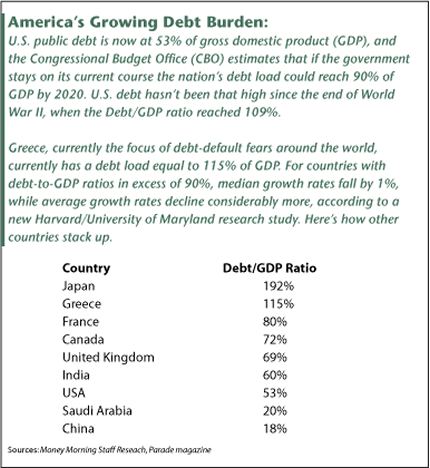
Korea's success is easily explained. The country is rich, but retains a significant wage/cost advantage over Japan. But Korea's government sector remains small: Public spending was only 27% of GDP in 2009, by far the lowest in the Organization for Economic Cooperation and Development (OECD) group of mainly rich economies. With less government, and a smaller public debt load, there is more room for the private sector to flourish. [As the accompanying graphic demonstrates, countries that amass high levels of debt experience measurable declines in their economic growth rates. Korea has avoided this miscue.]
 Lee's government is strongly pro-business, moderately free-market and safely in power until 2013. Recent local elections last week were mildly adverse to the government, but still would have given it a small majority if repeated at the national level (the ruling Grand National Party retained the mayorship of Seoul, for example).
My only complaint is that Lee, himself, tends to favor the kind of giant infrastructure projects that have helped drive Japan towards bankruptcy during its 20-year recession. However, he did not indulge this urge significantly during the recession, when a strict Keynesian might have done so. So I can only conclude that he appears to have it under control.
The Korean economy is well-balanced and enjoying strong growth. The country also enjoys important - and even dominant - positions in a number of major global industries, including transportation, nuclear power, consumer electronics and biotechnology. And it has set goals to become a major player in several other areas, including so-called "smart-grid" technology and robotics (Korea intends to become the world's No. 3 player in robotics - up from roughly No. 13 now - within the next few years, according to a recent Radio Korea International documentary. It has a national strategy and the financing and R&D programs in place to pursue that goal, Korea's national shortwave-radio broadcaster reported in that documentary).
Korea: The "Essential" Investment Ingredient
For global investors, some Korean exposure is an essential part of the portfolio.
Korea's stock market is currently very reasonably valued, trading at only about 14.5 times earnings. However, Korean companies mostly eliminated their dividends in the crisis of 2008/2009 and haven't restored them, so dividend investors will find little to attract them here.
Since I don't trust corporate managements in companies without dividends not to go on mad expansion schemes or to attempt to enrich themselves at shareholder expense, this is typically a fairly major negative. But given Korea's excellent growth prospects - especially when compared to other global investment opportunities available at the moment - Korea remains a top-tier investment opportunity. Investors just need to be selective.
Shares with full American-Depository Receipt (ADR) listings that you might consider, include the following (my own ratings are included):
•KB Financial Group Inc. (NYSE ADR: KB): The financial group that owns the largest bank in Korea, KB was hit badly by loan losses and problems in its Kazakhstan subsidiary, as well as its badly timed (October 2008) conversion to a holding company. It did a $900 million rights issue in 2009 and recently traded at a Price/Earnings (P/E) ratio of only 11.2 times projected earnings for 2010. However, earnings fell sharply in both 2008 and 2009, and in my view it has ham-fisted management, with a poorly designed strategy. AVOID.
•Korea Electric Power Corp. (NYSE ADR: KEP): The company that serves as the country's main power provider, Korea Electric Power notched a loss in both 2008 and 2009 because of fixed tariffs. KEP's steady growth should benefit from any acceleration in Korea's economic growth rate, but it is forced to buy coal from overseas, which gives it a downside risk. In December 2009, it signed a contract to build four nuclear reactors in United Arab Emirates (UAE). It trades at only 53% of its net asset value (NAV), but even so I prefer companies that are making money - old fashioned, I know. AVOID.
•KT Corp. (NYSE ADR: KTC): Formerly Korea Telecom, KT is Korea's leading fixed-line telecom-services provider, which was privatized in 2002. It carries a P/E ratio on trailing earnings of 22, and it eliminated its dividend last year. However, KT recently merged with its mobile supplier KT Freetel Corp., a key reason that first-quarter earnings doubled. The stock now trades at 8.5 times projected earnings for 2010. BUY.
•LG Display Co. Ltd. (NYSE ADR: LPL): A leading manufacturer of thin film liquid crystal displays, LG Display shares were recently trading at 7.6 times 2009 earnings and 4.5 times prospective 2011 earnings. Given the importance of its products to the global consumer electronics sector, this rates a STRONG BUY.
•Posco (NYSE ADR: PKX): Korea's largest steel company, Posco was recently trading at a P/E of 11 times trailing earnings and 9.4 times prospective 2011 earnings. Posco is Korea's leading steel company, with large export operations to China, making it a big beneficiary of China's explosive growth. Posco is the world's third-largest steelmaker, and its most efficient in terms of output per man-hour. Like KEP, Posco suffers from rising prices of raw materials - in its case, iron ore - which have risen sharply in price. The shares are in the low end of their recent range. BUY.
•SK Telecom Co. Ltd. (NYSE ADR: SKM): Korea's largest mobile phone company, with operations in Vietnam, the shares of SK Telecom were recently trading at 10.2 times trailing earnings and 8.0 times prospective 2011 earnings. Ought to pay a decent dividend, given the sector, but it doesn't. HOLD/BUY.
•Woori Finance Holdings Co. Ltd. (NYSE ADR: WF): Korea's second-largest finance group, Woori has suffered bad debt losses like all Korean banks, but has avoided some of the strategic blunders of KB. Currently trades at 89% of net asset value, at a P/E of 12.2 times trailing 2009 earnings and 7.9 times prospective 2011 earnings. BUY.
•Finally, you could look at the Korean exchange-traded index fund, the iShares South Korea ETF (AMEX: EWY), which invests in the Morgan Stanley Capital International Korea index, with a P/E ratio of 10.0, but a yield after expenses of only 0.7%. BUY.
[Editor's Note: Money Morning readers are often amazed by Martin Hutchinson's profit-focused instincts - as evidenced by his unerring ability to paint a picture of what's to come. He's able to show us the big profit opportunities that are still over the horizon - while also warning us about the potentially ruinous pitfalls hidden just around the corner.
So it's no surprise that Hutchinson has pulled off a string of forecasting successes in the face of the worst financial crisis since the Great Depression - a financial crisis that, not surprisingly, Hutchinson is widely credited for having predicted and warned about well ahead of time.
With his "Alpha Bulldog" investing strategy - the crux of his Permanent Wealth Investor advisory service - Hutchinson has managed to combine dividends, gold and growth into a winning, but low-risk formula that has developed eye-popping returns for subscribers.
To take a moment to find out more about the opportunities related to dividends, gold, "Alpha-Bulldog" stocks and The Permanent Wealth Investor, please click here. You'll the time well spent.]
Source : http://moneymorning.com/2010/07/07/invest-in-korea-2/
Money Morning/The Money Map Report
©2010 Monument Street Publishing. All Rights Reserved. Protected by copyright laws of the United States and international treaties. Any reproduction, copying, or redistribution (electronic or otherwise, including on the world wide web), of content from this website, in whole or in part, is strictly prohibited without the express written permission of Monument Street Publishing. 105 West Monument Street, Baltimore MD 21201, Email: customerservice@moneymorning.com
Disclaimer: Nothing published by Money Morning should be considered personalized investment advice. Although our employees may answer your general customer service questions, they are not licensed under securities laws to address your particular investment situation. No communication by our employees to you should be deemed as personalized investent advice. We expressly forbid our writers from having a financial interest in any security recommended to our readers. All of our employees and agents must wait 24 hours after on-line publication, or 72 hours after the mailing of printed-only publication prior to following an initial recommendation. Any investments recommended by Money Morning should be made only after consulting with your investment advisor and only after reviewing the prospectus or financial statements of the company.
Money Morning Archive |
© 2005-2022 http://www.MarketOracle.co.uk - The Market Oracle is a FREE Daily Financial Markets Analysis & Forecasting online publication.
