


Stock Market Balancing on a Knife Edge...
Stock-Markets / Stock Markets 2010 Jul 29, 2010 - 08:48 AM GMTBy: Mark_McMillan

 Trade Recommendations: Take no action.
Daily Trend Indications:
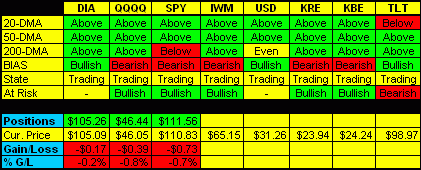
- Positions indicated as Green are Long positions and those indicated as Red are short positions.
- The State of the Market is used to determine how you should trade. A trending market can ignore support and resistance levels and maintain its direction longer than most traders think it will.
- The BIAS is used to determine how aggressive or defensive you should be with a position. If the BIAS is Bullish but the market is in a Trading state, you might enter a short trade to take advantage of a reversal off of resistance. The BIAS tells you to exit that trade on "weaker" signals than you might otherwise trade on as the market is predisposed to move in the direction of BIAS.
- At Risk is generally neutral represented by "-". When it is "Bullish" or "Bearish" it warns of a potential change in the BIAS.
- The Moving Averages are noted as they are important signposts used by the Chartists community in determining the relative health of the markets.
Current ETF positions are:
DIA: Long at $105.26
QQQQ: Long at $46.44
SPY: Long at $111.56
Daily Trading Action
The major index ETFs opened lower and then moved back into positive territory in the first half hour before rolling over and moving lower in stages with the first stage complete by late morning. A rally from late morning through the noon hour brought the Dow above and S&P-500 to the unchanged mark. The NASDAQ-100 was never able to fight its way back to positive territory before all three major indexes began to move lower once again. This time, the move would last into the final hour of trading and push the NASDAQ-100 to a better than one percent intraday loss before a recovery in the final forty-five minutes left the major indexes with fractional losses on the day. The Dow continues to show relative strength versus the other major indexes. The Russell-2000 (IWM 65.15 -1.07) continues to show relative underperformance to the major indexes. The Semiconductor Index (SOX 359.47 -6.61) also continues to underperform the major indexes. The Bank Index (KBE 24.24 -0.28) lost about one percent and the Regional Bank Index (KRE 23.94 -0.35) lost a bit more than one percent. The 20+ Yr Bonds (TLT 98.97 +0.32) gained about one third of one percent and has maintained its position above its 50-DMA in a trading state. NYSE volume was quite light with just 1.004B shares traded on the NYSE. NASDAQ share volume was also quite light with just 1.843B shares traded.
In addition to crude oil inventories and the Fed's Beige Book, there were two economic reports of interest released:
- Durables Goods Orders (Jun) fell -1.0% versus an expected rise of +1.0%
- Durable Orders excluding Transportation (Jun) fell -0.6% versus an expected rise of 0.6%
Both reports were released an hour before the open. The U.S. Government reported crude oil inventories rose by 7.31M barrels.
The Fed's beige book provided details where two districts reported stalled growth, two reported the pace of growth had slowed recently. The other eight districts reported growth, but several of those reported that increases were modest. All of this is consistent with the Fed's previous guidance for slower growth in Q2 and Fed Chairman Ben Bernanke's recent Congressional testimony.
Market participants have been reacting to better than expected earnings reports and individual company guidance. That must be measured against recent worse than expected economic reports. Which should they believe? With public companies sitting on around $1.8T in cash that they can put to work, we think that these companies can actually drive future growth and help the economy to move forward. With that said, the terrible durable goods orders reports suggest that there has been a recent slowing in business investment as companies hoard even more cash.
Health Care (-1.4%) led losing sectors downward while Telecom (+0.4%) was able to notch a gain. The managed care sector (part of Health Care) dropped -2.5% even as Aetna (AET 27.56-0.80) and WellPoint (WLP 50.82 -1.98) reported better than expected earnings.
Implied volatility for the S&P-500 (VIX 24.25 +1.06) popped up four percent while implied volatility for the NASDAQ-100 (VXN 25.03 +0.70) rose less than three percent. Both had closed on their 200-Day Moving Averages (DMAs) on Tuesday. Market participants caused both to rise above that level as the prolonged sell-off began in late April/Early May.
The yield for the 10-year note fell five basis points to close at 3.00. The price of the near term futures contract for a barrel of crude oil fell fifty-one cents to close at $76.99.
Market internals were negative with decliners leading advancers 2:1 on both the NYSE and the NASDAQ. Down volume led up volume by more than 2:1 on both the NYSE and the NASDAQ. The index put/call ratio fell 0.04 to close at 1.49. The equity put/call ratio rose sixteen basis points to close at 0.71.
Commentary:
Wednesday's trading action appears to be a light volume pull-back. As we reiterate, we have been expecting a pull-back to the 200-DMAs at some point, thinking this would occur in August at some point. The major indexes are balanced on a knife's edge at this time with short term indicators suggesting a move lower is imminent while longer term indicators suggest a move higher is more likely. The nascent uptrend states that the Dow and S&P-500 had transitioned to have evaporates such that all the equity indexes and the long bond index are all in trading states at this time.
It is important to note that the Dow and Semiconductor Index have moved to a BULLISH BIAS. This suggests that the intermediate to longer term direction of the market is to the upside. We will be comfortable with proclaiming this in a loud voice when the leading indexes (NASDAQ-100, Russell-2000, Semiconductor Index) all share the same BIAS instead of only the semiconductor index.
We believe that by next week, all the major indexes and the leading indexes will likely be in uptrend states, but this may not come about. A BULLISH BIAS and an uptrend state suggests that more strength could be seen in the markets than pundits have, thus far, espoused. If it turns out that the markets don't make this transition in the near term, we would want to exit our long trades and move to short positions, but we believe the bulls have the edge here.
We hope you have enjoyed this edition of the McMillan portfolio. You may send comments to mark@stockbarometer.com.
If you are receiving these alerts on a free trial, you have access to all of our previous articles and recommendations by clicking here. If you do not recall your username and/or password, please email us at customersupport@stockbarometer.com.
By Mark McMillan
Important Disclosure
Futures, Options, Mutual Fund, ETF and Equity trading have large potential rewards, but also large potential risk. You must be aware of the risks and be willing to accept them in order to invest in these markets. Don't trade with money you can't afford to lose. This is neither a solicitation nor an offer to buy/sell Futures, Options, Mutual Funds or Equities. No representation is being made that any account will or is likely to achieve profits or losses similar to those discussed on this Web site. The past performance of any trading system or methodology is not necessarily indicative of future results.
Performance results are hypothetical. Hypothetical or simulated performance results have certain inherent limitations. Unlike an actual performance record, simulated results do not represent actual trading. Also, since the trades have not actually been executed, the results may have under- or over-compensated for the impact, if any, of certain market factors, such as a lack of liquidity. Simulated trading programs in general are also subject to the fact that they are designed with the benefit of hindsight. No representation is being made that any account will or is likely to achieve profits or losses similar to those shown.
Investment Research Group and all individuals affiliated with Investment Research Group assume no responsibilities for your trading and investment results.
Investment Research Group (IRG), as a publisher of a financial newsletter of general and regular circulation, cannot tender individual investment advice. Only a registered broker or investment adviser may advise you individually on the suitability and performance of your portfolio or specific investments.
In making any investment decision, you will rely solely on your own review and examination of the fact and records relating to such investments. Past performance of our recommendations is not an indication of future performance. The publisher shall have no liability of whatever nature in respect of any claims, damages, loss, or expense arising out of or in connection with the reliance by you on the contents of our Web site, any promotion, published material, alert, or update.
For a complete understanding of the risks associated with trading, see our Risk Disclosure.
© 2010 Copyright Mark McMillan - All Rights Reserved
Disclaimer: The above is a matter of opinion provided for general information purposes only and is not intended as investment advice. Information and analysis above are derived from sources and utilising methods believed to be reliable, but we cannot accept responsibility for any losses you may incur as a result of this analysis. Individuals should consult with their personal financial advisors.
© 2005-2022 http://www.MarketOracle.co.uk - The Market Oracle is a FREE Daily Financial Markets Analysis & Forecasting online publication.
