


Federal Government's Trillion Dollar Deficits Crowding Out Our Future Wealth
Economics / Economic Theory Jul 31, 2010 - 07:11 AM GMTBy: Gary_North

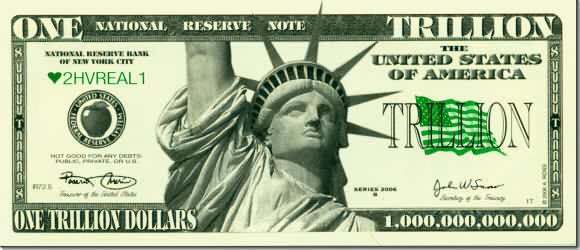
 The standard justification for the Federal government's trillion-dollar-plus deficits for the next decade is this: "Without this stimulus, the economy will fall into another Great Depression." This is the Keynesian Party Line, all over the West. It is promoted by almost everyone. Even normally free market economists have gotten on board.
 Standing at the side of the deficit road, unwilling to climb on board the bandwagon, are Austrian School economists. Hardly anyone pays any attention to them. This has been true for approximately a century, when Ludwig von Mises published The Theory of Money and Credit (1912).
When you are surrounded by the media, which are all pitching the Keynesian version of economic causation, you would be wise to think through what is being said. To do this, start at the beginning. "There are no free lunches."
SCARCITY
At the heart of modern economic analysis is the doctrine of scarcity. This doctrine teaches that, at zero price, there is greater demand than supply.
Most mistakes in economic thinking are based on the assumption that scarcity does not apply to some sector of the economy. Goods really are free by nature, but inappropriate institutional arrangements have led to scarcity. Nature is assumed to be abundant. But, somehow, society has adopted certain traditional ways of doing things – especially private ownership of resources – which have led to a condition of scarcity.
This outlook dominates many forms of utopianism. The promoters argue that a reform of this or that legal arrangement will lead to greater wealth for all.
When you hear about a proposed reform that is supposed to add to our wealth, ask this: "Why will this reform encourage people to work more efficiently, save more aggressively, or offer something for sale less expensively?" There had better be a cogent reason for this change in people's behavior, because it is easier to work less efficiently, save less aggressively, or sell at a higher price. To change someone's behavior, it is necessary to answer his question plausibly: "What's in it for me?"
If the answer is, "My badge and this gun, which is pointed at you," then the worker will find ways to avoid both efficiency and thrift in the future. One of the easiest behavioral changes he can make is to sit around instead of working.
When workers in the Soviet Union refused to work hard, the government sent out more people with badges and guns, who told people to work. But the badge does not enable the badge-holder to determine what form of work is most efficient. The old Russian worker's saying holds up: "The government pretends to pay us, and we pretend to work."
TRADING THIS FOR THAT
When we come to a stranger with an offer to buy, we are offering to trade this for that. The stranger is not going to give us what we want for free.
If you persuade someone to sell you something, your offer has crowded someone else who wanted to buy it.
Think of the world as a gigantic auction, because that is what the economic world is. You make a bid on an item. You hear the glorious words: "Going once. Going Twice. Sold!" Or you hear the other words. "Going once. Going twice. I have a new bid for. . . ." Depressing.
This applies to production goods as well as consumption goods. When someone is selling a promise to pay 5% per annum for 5 years, and another person offers to pay 6%, and the creditor accepts this higher offer, the first would-be borrower has been crowded out of the capital market. He must find someone else to lend him the money. If he can't, he has these choices: (1) pay a higher rate of interest; (2) skip the project he was going to finance with the money; (3) raise the money by selling ownership in the company: (4) Sell a percentage of the future income from the completed project.
The would-be borrower must accept a second-best solution to his problem. That is what crowding out means. He has been crowded out from the best solution by a more aggressive borrower.
The funds used to finance a borrower's project can be used for only one project at a time. The winning bidder for the funds is now able to bring his project to completion. All other would-be borrowers must find other low-cost sources of the funding. They did not have such low-cost alternative sources prior to the winner's bid.
THE WORLD OF KEYNES
This sounds elementary. Anyone should be able to understand it. But Keynesian economists do not understand it. When the government does the borrowing, they insist, there is no crowding-out effect. We read this on a site that provides definitions of economic terms. This is the definition for "crowding out."
Theory that heavy borrowing by a government (which can pay any interest rate) soaks up the available credit, leaving little for the private sector at affordable interest rates. Opponents of this theory point out that new sources of credit emerge at every stage of an interest rate increase.
Got that? The opponents argue that when Joe cannot borrow money from Fred, because Fred lends the money to their Uncle Sam, Bill will lend Joe the money, but at a higher interest rate. "But," you say, "that is what crowding out means: Joe is crowded out at the low rate that Uncle Sam agreed to pay." You are beginning to get a sense of the level of sophistication of this dictionary.
"But this cannot be representative of common economic opinion," you respond. "This is some sort of oddity." So, I direct you to the definition provided by The Economist, generally regarded as the most sophisticated of all general audience economics magazines.
When the state does something it may discourage, or crowd out, private-sector attempts to do the same thing. At times, excessive GOVERNMENT borrowing has been blamed for low private-sector borrowing and, consequently, low INVESTMENT and (because the economic returns on public borrowing are typically lower than those on private DEBT, especially corporate debt) slower economic GROWTH. This has become less of a concern in recent years as government indebtedness has declined and, because of GLOBALISATION, FIRMS have become more able to raise CAPITAL outside their home country.
"Government indebtedness has declined." When was this entry written? In Grover Cleveland's Administration? Second, firms can supposedly borrow from abroad. But so can Uncle Sam . . . which he has done incessantly, to the tune of about half of the debt he owes to the public.
The definition assumes that by appealing to foreign lenders, the definition changes. "You see, Joe can now borrow what he wants from foreigners, which he was unaware of before Fred lent Uncle Sam that money." In literary terminology, this is a Deus ex machina, which is a source of causation that was outside the original plot's presentation of the facts. The solution to the plot's otherwise unsolvable problem is delivered from the realm of the gods. Thank Deus!
How can this sort of intellectual subterfuge go on? Because of this:
- Most intellectuals are Keynesians.
- Keynesians do not think straight.
- Intellectuals assume that the general public is as intellectually hampered as intellectuals.
- Keynesians do not want the public to believe that government debt is destructive.
WEALTH TRANSFER
When any civil government borrows money, it increases its ability to bid for scarce resources in the various markets for resources. Those who previously owned the money thereby forfeit the use of the money. That was why the government had to offer a rate of interest. Otherwise, the lender would have used the money to lend to some other borrower at the same rate of interest, plus a risk-of-default premium.
Because the government claims that it is less likely to default than a private borrower, investors lend the government money. The government has crowded out private borrowers by a claim: "Your money is safer with us," Lenders who believe this claim turn over their money to the government. Where did the lenders get this money? From their bank accounts or similar short-term accounts.
What happens next? The government puts the money in whatever accounts it prefers. If it deposits it with the Federal Reserve, the FED draws down the money. The banks or money market funds must then sell assets in order to pay the money to the new owner of money, the government. The very act of cashing the check, or depositing the digital money, crowds out the former borrowers.
The government soon spends the money. This money is deposited in the accounts of the recipients. The beneficiaries are the borrowers who get loans from the bank or money-market funds of the recipients.
The process of exchanging digits called money is a process of "this for that." It is a process of asset sales and asset purchases. There are winners and losers. This is always a process of crowding out and pushing in.
When a government borrows money to spend, it is always spending in order to buy. What is it buying? Continued political support. Support is usually in the form of votes. The money may go to welfare recipients, or weapons producers, or any of tens of thousands of organizations that are paid by the government. It does not matter who gets the payments. The recipients will be in a position to bid for scarce resources in the various markets. Assets will move from one sector to another sector, from one person's bank account to another person's.
The basis of this wealth transfer is a badge and a gun. Never forget this. The badge and the gun are the government's collateral. "Your money is safe with us when you lend to us, because your money is not safe from us when tax day comes." Your money is not safe from government on tax day, no matter who you lend to. So, people lend to the government because they believe that taxpayers will fork over the money on tax day. Their money is said to be safe with the agency that makes everyone's money unsafe. This is the logic of all government debt.
SAVE NOW, CONSUME MORE LATER
When a person lends money to a corporation or other producer, he is enabling the borrower to increase production. The goal is to sell something of value to a customer. The customer will part with his money in order to buy the item offered for sale.
As the supply of loanable funds increases as a result of thrift, the market process increases the supply of customer goods. The wealth of customers increases, according to their demonstrated preferences: purchases. So, lenders defer consumption in the present in order to increase consumption in the future. The market responds to their expected future increase in demand by increasing output.
The person who wants to consume more later at the cost of consuming less today is in a position to do this. There are bidders for his money. They tell him this: "We have ways of increasing our profits by increasing future customers' satisfaction. If you will lend us money today, we will pay you more later." The collateral is a contract, but the contract is collateralized by hope: the hope of profitability. Lenders do not lend to companies who they suspect will not pay back the loans, for whatever reason.
The money lent, meaning assets transferred, is part of a process that makes possible increased future output. It is a system of "save now, consume more later." The lender will consume more, later, because he receives greater money in return. Customers consume more, later, because of greater output by producers. It is a win-win arrangement.
But there are losers: the borrowers who were crowded out by the successful borrowers.
SAVE NOW, CONSUME LESS LATER
When a person lends money to government, he is enabling the borrower to increase its purchase of votes. The goal is to deliver something of perceived value to a voter. Future taxpayers will part with their money in order to avoid dealing with someone with a badge and a gun.
As the supply of loanable funds increases as a result of thrift, the taxation process increases the supply of promises and payoffs. The wealth of non-recipient voters decreases, according to their demonstrated preference: submission. Then they reduce their production because they know they will keep a smaller portion of the fruits of their labor. The supply of goods and services does not reach the output level that would have prevailed apart from government debt and vote-buying.
So, lenders to the government defer consumption in the present. Result: a decrease in the society's consumption in the future. The lenders may or may not get paid off, but the society as a whole will be poorer. The lenders may get paid off in depreciated money. This has been the dominant pattern for a century.
When governments crowd out private borrowers, this reduces future consumption. The government spends the money as fast as it collects it. The government does not invest in projects that entrepreneurs would have begun, based on their expectations of success in a private market. Governments launch projects that can be sustained only by badges and guns.
So, the loans' collateral – badges and guns – is the same as the authorization of the projects. The public's demonstrated preference for not getting shot is the basis of both the loans and the projected increased output, if any.
The Keynesian argues that the free market for capital misallocates capital. These markets are said to reduce the output of goods and services. He recommends that the government borrow more money in order for the recipients to spend. This will increase future demand, thereby making most people in the society richer.
He argues that the goal of saving now in order to increase consumption later will be thwarted by the market process of allocation. What is needed is collateral: badges and guns.
With badges and guns, officials can increase production.
With badges and guns, officials can persuade lenders to get their money into circulation, because money deposited in a bank account and lent out by the bank is not really in circulation, whereas money spent to buy votes is in circulation.
With badges and guns, there is no crowding out.
With badges and guns, stones become bread.
CONCLUSION
The Keynesian tells the voting public that if the government does not offer a stimulus, meaning a budget deficit, the economy will revert into recession.
The Keynesian tells the public that projects that are shovel-ready will put men back to work.
I say that this is squishy Keynesianism. If shovel-ready projects will put men back to work, then teaspoon-ready projects will put far more men back to work.
This is the logic of Keynesianism. It is the logic of the much-heralded worldwide economic recovery. It rests on faith: faith in the productivity of badges and guns.
These people are in charge of every major financial institution. They have crowded out everyone with common sense. This is the crowding-out process that is going to produce a fiscal disaster, all over the West.
Gary North [send him mail ] is the author of Mises on Money . Visit http://www.garynorth.com . He is also the author of a free 20-volume series, An Economic Commentary on the Bible .
© 2010 Copyright Gary North - All Rights Reserved
Disclaimer: The above is a matter of opinion provided for general information purposes only and is not intended as investment advice. Information and analysis above are derived from sources and utilising methods believed to be reliable, but we cannot accept responsibility for any losses you may incur as a result of this analysis. Individuals should consult with their personal financial advisors.,
© 2005-2022 http://www.MarketOracle.co.uk - The Market Oracle is a FREE Daily Financial Markets Analysis & Forecasting online publication.
