


The Shock Doctrine: Surviving Democracy - Part 3
Politics / Global Financial System Sep 26, 2007 - 12:15 AM GMTBy: Stephen_Lendman
 Chicago School dogma became known as Thatcherism in Britain, but its prime minister wasn't an early adherent. Margaret Thatcher thought Chilean shock therapy wasn't possible in a democracy like the UK because voters wouldn't buy it. Three years into her first term, her approval rating was lower than George Bush's. She was in danger of not being reelected and didn't dare risk imposing bitter economic medicine that would sink her chances. That is, until destiny intervened on April 2, 1982 when Argentina invaded the British-held Falkland Islands off its coast that was unimportant to either country except for the political hay to gain from war.
 Thatcher jumped at the chance to regain her footing and "went into Churchillian battle mode," even though Argentina's president, General Leopoldo Galtieri, wasn't Adolph Hitler. But defending the British empire was almost as good, and it paid off. Thatcher's political future was at stake. She revived it, more than doubled her approval rating and henceforth was known as the "Iron Lady" that for her was high praise, and she made the most of it.
She launched a "corporatist revolution" based on Chicago School economics she thought impossible earlier. She parlayed her new popularity to a victory against striking coal miners in 1984 with tactics like unleashing 8000 "truncheon-wielding" riot police in a single confrontation. Before the strike ended, thousands of workers were injured, but Thatcher stood firm with a clear message to other unionists. Take what you're offered or get the same medicine.
She didn't stop there, and what followed was a radical economic agenda in a wave of state enterprise privatizations including British Telecom, British Gas, British Airways, British Steel and others in what Klein called "the first mass privatization auction in a Western democracy." It proved Chicago School fundamentalism didn't need repressive dictatorships to advance as long as "Iron Ladies" like Thatcher were around to match the best of them, short of all out tanks in the streets shock therapy, that is. Her eleven and a half years in power proved it, and Britain hasn't been the same since with Labor as committed now as the Tories.
Bolivia was soon targeted as well, but in 1985 was part a democratic wave sweeping the world. It was an election year with two familiar figures facing off for the presidency - former dictator Hugo Banzar and former elected president, Victor Paz Estenssoro. It was close and Banzar thought he won so before final returns were in he named 30 year old Harvard economist Jeffrey Sachs to help develop an anti-inflation economic plan for the country.
Sachs was part Keynsian but larger part Chicago School adherent that made for a bad combination. He bought its orthodoxy in softer form by supporting debt relief and generous aid along with the shock therapy he advised Banzar to adopt as the only solution to hyperinflation.
As it turned out, Banzar lost and Paz won, and while no socialist, he was no Chicago School adherent either, or so voters thought. Four days into his term, he charged his emergency economic team to radically restructure the economy using shock therapy with a twist. It was much harsher than Sachs proposed with the entire state-centered structure Paz erected decades earlier dismantled in the first 100 days before the public could react. In its place, food subsidies were ended, price controls lifted, wages frozen, oil prices hiked 300%, deep government spending cuts imposed, unrestricted imports allowed, and state-owned companies downsized as a first step to privatizing them. It cost hundreds of thousands of full-time jobs, pensions and safety net protections. Friedman continued to roll.
The results were predictable. The minimum wage never regained its value, and two years later real wages were down 40% and average per capita income dropped from $845 in 1985 to $789 in 1987. As in other shock therapy countries, a small elite got richer while the great majority of Bolivians lost out with campesinos faring worst. In 1987, they earned on average $140 a year, or less than one-fifth the nation's declining average income.
Bolivian misery gave Sachs star status for the country's "Miracle." It launched his new career and brought him to Argentina, Peru, Brazil, Ecuador, Venezuela and Russia later on plus a best-selling book and three-part PBS "success story" series. The only problem was it wasn't true. President Paz had no mandate for shock therapy, and many workers were predictably furious at his betrayal. They went on strike and Paz's response made Margaret Thatcher's earlier action against striking coal miners seem tame by comparison. Tanks rolled in the streets, and riot police raided union halls, a university and factories. Hundreds of arrests followed, including the top 200 union leaders, and oppositional politics was banned. The siege lasted three months during the decisive shock therapy period with more repression and Chicago School medicine later.
It showed shock therapy needs harsh authoritarian rule backing with Bolivia's pin-stripped politicians, economists and bureaucrats administering it, not uniformed soldiers as in Chile. Paz's democratic victory was illusory like others when leaders renege on promises and sacrifice them on the alter of Chicago School orthodoxy.
Argentina was another "textbook case." In the post-Falklands War period, it was burdened with billions in odious debt Washington insisted be serviced and paid. It was far more onerous after the (Paul) "Volker Shock" when the US Federal Reserve Chairman hiked interest rates up to 21% in the early-mid 1980s to fight inflation, so he said. It was painful in the US and disastrous for developing countries turning their debt burdens into crises. New loans were needed to pay off old ones, and the debt spiral was born afflicting nations then and still today. That was the whole idea, or at least one of them.
Argentina, Brazil and other countries had another option they didn't take - defaulting on debt so great it was unrepayable. As Klein put it: "Understandably (new democracies were) unwilling to go to war with Washington (and the international lending agencies it controls so they) had little choice but to play by Washington's rules (and) in the early eighties (they) got a great deal stricter....It was the dawn of the era of 'structural adjustment' - otherwise known as the dictatorship of debt."
In the 1980s, Chicago School economists colonized the IMF and World Bank to advance their corporatist crusade. Economist John Williamson named it "the Washington Consensus" that stuck ever since. It consisted of core economic policies both institutions consider essential for economic health according to their orthodoxy. We know them well: all "state enterprises ....privatized (and) barriers impeding entry of foreign firms....abolished." There was more that together was classic Friedman dogma: privatization, deregulation, unrestricted free trade (never called fair), and deep cuts in government spending except for security.
Indebted developing countries learned shock doctrine 101 the hard way. Getting aid meant accepting Washington Consensus rules - the whole package. So to save their countries, they had to "sell (them) off." Klein calls Argentina the "model student" in the 1990s under leaders like Carlos Menem. Appointing Domingo Cavallo economy minister signaled he bought the corporatist package. But as Klein points out: "Argentina was not unique (and by 1999) Chicago School alumni included more than twenty-five government ministers and more than a dozen central bank presidents from Israel to Costa Rica."
Shock therapy was on a role that in Argentina turned into a textbook case of therapeutically induced disaster. What Time magazine in 1992 called "Menem's Miracle" became Menem's Mirage when the economy collapsed in 2001, and Argentina did the unthinkable with Menem gone and a new president in power. It defaulted on an $805 million debt to the World Bank. It should have ended the neoliberal experiment, but instead it spread. Economic crises fueled it, and when old ones ebbed "even more cataclysmic ones appear(ed): tsunamis, hurricanes, wars and terrorist attacks. Disaster capitalism was taking shape" with shock therapy its tool of choice.
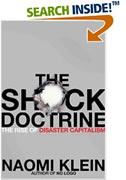
Reviewing Naomi Klein's "The Shock Doctrine: The Rise of Disaster Capitalism" - Introduction ,
Part 1 - Two Doctor Shocks - Torture and Chicago School Fundamentalism
Part 2 - Chile The First Test - The Bloody Birth of the Counterrevolution
By Stephen Lendman
Stephen Lendman lives in Chicago and can be reached in Chicago at lendmanstephen@sbcglobal.net.
Also visit his blog site at sjlendman.blogspot.com and listen to The Steve Lendman News and Information Hour on TheMicroEffect.com Saturdays at noon US central time.
Stephen Lendman Archive |
© 2005-2022 http://www.MarketOracle.co.uk - The Market Oracle is a FREE Daily Financial Markets Analysis & Forecasting online publication.
