


China's Rare Earth Metals Revenge, U.S. Military Vulnerable
Commodities / Metals & Mining Oct 26, 2010 - 03:06 AM GMTBy: Jennifer_Barry

 While China has slowly increased their market share in rare earth metals for decades, this year marks a quiet crisis in these elements. As James Dines reported in a recent interview, the Chinese now produce 97% of rare earth oxides and have cut back sharply on exports, slashing them 72% for the second half of 2010. These quotas are causing price spikes from panic buying.
I decided to research why China would slash their rare earth exports. One major factor in China’s decision is surging domestic demand. The nation needs to reserve these key metals for their own future. With more than 1.3 billion citizens and a rapidly expanding economy, the Chinese consume 60% of world demand.
While China is the dominant producer of REEs, the nation only holds 36% of known global reserves according to energy analyst Marc Humphries. The rate of mineral exploitation is unsustainable, and it makes sense for Beijing to assure they retain enough REEs to carry out their plans for development. As an anonymous Chinese expert put it, “It's unwise to drain the pond to catch all the fish."
Just as China moved from a major exporter of crude oil to one of the biggest importers, some pundits believe that China will even have to import certain rare earths by 2015 for certain high tech products like super magnets for wind turbines. To back up this theory, China attempted to purchase Australian REE miner Lynas Corporation last year.
China is not just interested in hoarding a depleting store of rare earths. According to the People’s Daily, much of the government’s concern is environmental. The area around Baitou - where the majority of production occurs - was polluted by toxic chemicals used to process this ore. Much of the damage was caused by illegal, uncontrolled mining operations. Even worse, the contamination happened while much of these valuable resources were wasted due to the use of outdated technology.
While many analysts doubt that Beijing cares about ecological damage, I believe this is truly a motive for Chinese leaders. Up to 5% of China’s economic output is lost due to environmental destruction each year, as well as 400,000 excess deaths. Over the past decade, the nation has made great strides in improving the environment. China increased its forest cover and lessened both air and water pollution. It’s also making huge investments in green energy like solar and wind power to wean itself away from coal.
Decades of Planning
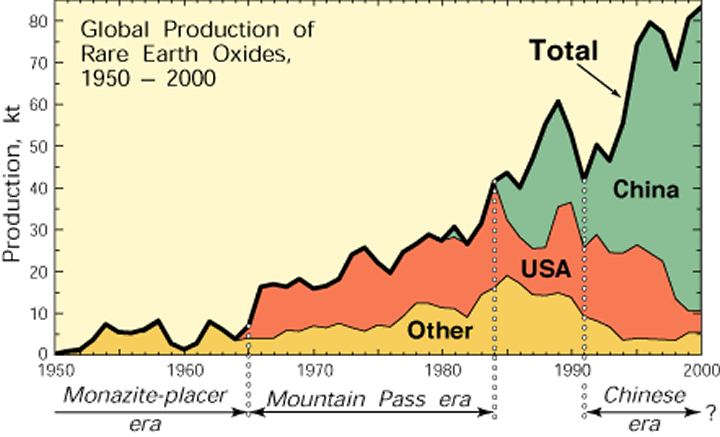
China did not reach 97% of rare earth oxide production by accident. The nation has always been a long term planner. In the 1960’s, leaders realized the significance of REE deposits. Deng Xiaoping stated, “The Middle East has oil, and China has rare earths.” However, the country wasn’t a major player in the rare earth market until 1985.
In that year, China significantly increased production at their Bayan Obo mine. These elements could be mined very cheaply as they are a by-product of iron ore production. In addition, the elements are relatively easy to extract, with low radioactivity.
At the same time, electronics manufacturing was outsourced to Asia, and it made sense to source raw materials like REEs locally as well. With lower costs for labor and fewer regulations, China was able to outcompete other countries like Australia easily. Foreign mines were shuttered due to unprofitability or environmental concerns.
By 1996, the Chinese had totally dominated the market, and most of the technical expertise had been transferred to the East. China funds continue research in REEs in order to develop new applications and keep their lead in this field.
Now that the Chinese control the rare earth market, the government has decided to reorganize the entire industry. Smuggling and illegal mining will no longer be tolerated. Ninety mining companies will be consolidated into 20 by 2015 to improve efficiency. In Inner Mongolia, the Baotou Steel Rare-Earth company will be the only legal miner, and 9% of annual production will be saved in stockpiles. Chinese leaders are also considering creating official state reserves.
China’s Revenge
These decisive moves from China have upset countries that manufacture items containing REEs, most notably Japan. In August, Japan begged the Chinese to ease restrictions on exports as surging prices are hurting corporations. The Japanese argued that these cuts were harming Chinese companies that depend on finished parts from Japan containing these elements. The Japanese government was so concerned about the impact on its manufacturing base that it sent 160 business leaders to China for economic talks.
Despite these entreaties, China was not very flexible, citing WTO rules that allow quotas for environmental protection. In fact, Chinese leaders suggested that Japan implore other countries to produce more rare earths rather than depend on their output. The Japanese realized they had little bargaining power, so they agreed to transfer technology on purifying REEs. In fact, China is in the position to demand territorial concessions in exchange for access to these metals.
I’m sure that the Chinese are enjoying turning the tables on the Japanese, even if only economically. These two nations have been rivals for centuries, with the first recorded battle occurring in 663 AD. Japan has borrowed many aspects of Chinese culture from its writing system to philosophy, but these contributions are rarely credited by the Japanese.
Most of the source of Chinese anger is directed at Japan’s aggressive military history. Japan has repeatedly invaded and occupied Chinese territory, most recently from 1931 to 1945. Hundreds of thousands of civilians were massacred in Nanking, and other atrocities like medical experiments were perpetrated on the public. This rage simmers below the surface today, as massive anti-Japanese demonstrations occurred as late as 2005. While Japan seems unwilling to make formal reparations or an apology for the occupation, the nation has quietly been China’s largest financial aid donor for years.
To cope with supply disruption, Japanese corporations are are reformulating products so they no longer require rare earth elements to work. Hitachi has developed a motor that uses an iron alloy instead of dysprosium, but the prototype is not large enough yet for production. The Teijin Group has also successfully produced a new magnet out of iron and nitrogen, replacing one using REEs. However, I doubt that these elements can be replaced everywhere in the supply chain, as they have unique qualities which prompted their use in the first place.
US Military Vulnerable
Although the US is not a major manufacturer of high tech consumer products containing REEs, the military is dependent on them. As modern weapons from smart bombs to tanks require these metals, the ability of America to wage war depends on a steady supply of rare earths.
The US was not always dependent on the continued goodwill of foreign countries for critical materials. The National Stockpile was established after World War II to assure that essential elements would be available in case of an emergency. In the 1990s, the US Department of Defense (DOD) decided that 99% of the stockpile was “surplus” and the vast majority was sold.
Although China has dominated the rare earth market since the mid-1990s, the US government was unconcerned about Chinese control of these elements for many years. Only in April 2009, did the DOD and Congress finally place a freeze on the sale of some materials, and decide to conserve a minimum of a one year supply for others.
While the US House of Representatives has passed a bill to promote locating and exploiting rare earth resources, I wonder if this action is too little too late. Not only are these metals necessary for weapons, but for “green” technology that attempts to lessen dependence on foreign oil, supplied mostly by countries unfriendly to the US. While Mountain Pass mine in California was allowed to reopen and Congress may subsidize more rare earth resource development, it takes seven to 15 years to move from a promising deposit to a producing ore body. With inadequate domestic stockpiles, China could shut down America’s military offensives in a matter of months.
Uncommon Profits
Now that other countries are dependent on these elements for high technology, the game has changed. While conserving the environment and rare earth resources for internal use are legitimate needs, China’s dominance of the supply chain gives it enormous leverage. The nation can demand higher prices and special concessions to allow access to foreigners. International corporations can’t even purchase their own mining claims, as the government prohibits foreigners from mining these minerals on its soil.
The Chinese government knows that other countries will eventually adapt, but in the meantime, it can force companies to produce in China in exchange for access to these key elements. In addition, domestic workers trained by foreigners can open up their own companies to supply Western corporations with products. The Chinese have all the expertise in refining, making alloys and finished goods and they want it done in their country.
While companies are developing alternatives to REEs, this is a slow process. I believe most high tech products will not be feasible without a small percentage of rare earth metals. At the same time, demand is increasing as new applications for these elements are developed, with another 50% increase projected over the next four years. The use of REEs has tripled over the past decade while supply has dropped more than 35%. Now that China is threatening to cut off exports as early as 2012, prices are skyrocketing as panic sets in with some REEs selling for more than $1,000 a pound.
As China owns 97% of the REE market, no other supplier can take its place. Miners are scrambling to start new projects, but it will take at least seven years to go into production. This means that prices must go higher over the next few years.
by Jennifer Barry
Global Asset Strategist
http://www.globalassetstrategist.com
Copyright 2010 Jennifer Barry
In 2003, Jennifer started an online bullion dealership, becoming part of a select group in the new generation of bullion dealers. She ran the business successfully until 2007, closing it to focus on writing Global Asset Strategist, which grew out of her customer newsletter for the coin dealership. She takes pride in having guided her customers into silver near the bottom of the market. Those early customers have almost tripled their investment.
Jennifer was originally trained as a therapist, receiving a Bachelor of Arts in Psychology from Connecticut College, and a Master of Social Work from Simmons College in Boston. She worked as a licensed professional in human services for several years, until reading Ayn Rand's Atlas Shrugged, which motivated her to reject working to support the State. She left the field and taught herself Austrian Economics while working a series of positions in industry.
Disclaimer: Precious metals, commodity stocks, futures, and associated investments can be very volatile. Prices may rise and fall quickly and unpredictably. It may take months or years to see a significant profit. The owners and employees of Global Asset Strategist own some or all of the investments profiled in the newsletter, and will benefit from a price increase. We will disclose our ownership position when we recommend an asset and if we sell any investments previously recommended. We don't receive any compensation from companies for profiling any stock. Information published on this website and/or in the newsletter comes from sources thought to be reliable. This information may not be complete or correct. Global Asset Strategist does not employ licensed financial advisors, and does not give investment advice. Suggestions to buy or sell any asset listed are based on the opinions of Jennifer Barry only. Please conduct your own research before making any purchases, and don't spend more than you can afford. We recommend that you consult a trusted financial advisor who understands your individual situation before committing any capital.
Jennifer Barry Archive |
© 2005-2022 http://www.MarketOracle.co.uk - The Market Oracle is a FREE Daily Financial Markets Analysis & Forecasting online publication.
