


Investment Shock and Awe - Opportunities from growing risk of world conflict
Commodities / Investing Jan 29, 2007 - 08:59 PM GMT

5 new shockwaves, 5 big dangers and 6 opportunities
A new world war is unfolding with untold consequences for investors. But Wall Street remains largely oblivious. This war is not confined strictly to Afghanistan and Iraq. It is already spreading to Pakistan, Iran, Gaza, Lebanon and beyond. Nor are its protagonists limited to the few countries regularly mentioned in news reports. To the contrary, even considering only those countries that are directly involved with troops or weapons, I count over forty — the U.S., Britain, Germany, and nearly all the members of NATO ... plus Iran, Syria, Pakistan and many other Muslim nations from Morocco to Malaysia.
Stop and think for a moment:
How many times have you heard someone admit that the situation in Iraq is “dire” recently?
How many times have you wished that all those with the wisdom to recognize the severity of the crisis could be equally wise in proposing the pathways to its resolution?
How often have you been frustrated by the futility? Or discouraged by the dissonance?
My advice: No matter how you may feel about what's happening on the battle front, you must not let that hamper your response on the investment front.
This morning, I will show you the economic consequences as I see them. I will demonstrate why there's still hope for the eventual outcome. And I will point you to the actions we recommend.
First, though, please understand the full implications of the new shockwaves that have erupted just in the past few days ...

Shockwave #1 : Beirut, Lebanon
Riots are raging to topple the government, with four people killed and 150 wounded just in the last few days. The most recent outburst began with a scuffle in the student cafeteria at Beirut Arab University. Then it spilled into the street. And soon it escalated regionally with vanloads of reinforcements that suddenly appeared on the scene.
Right now, the Lebanese Army has restored some calm with a heavy presence in tense neighborhoods. But the only optimism expressed is of the kind that rarely pans out — the feeling that things have gotten so bad that, maybe, just maybe, they won't get any worse.
The danger: Lebanon is torn by the same Shiite-Sunni schism that is already tearing apart Iraq. Now, if Lebanon erupts into civil war, it implies that parallel conflicts could also explode in virtually any other Muslim nation with a Shiite majority or large minority. That includes Azerbaijan and Afghanistan ... India , Pakistan and Turkey ... Yemen , Bahrain, Qatar , and Saudi Arabia.
Shockwave #2 : Islamabad, Pakistan

On Friday, a suicide bomber blew himself up outside the Marriott hotel in an upscale neighborhood of the country's capital. It was supposed to be a “high-security zone” — where foreign visitors stay, where important government functions are held, and where ministers, members of Parliament and diplomats live. But it's obviously not secure any more.
My brother lived there with his family in the early 1980s. Back then, in terms of scenery and security, it was almost like Switzerland. Now, however, it looks like it could turn into a scenario more reminiscent of Beirut or even Baghdad.
The danger: Militarily, Pakistan is easily America's most critical ally in the region. But politically, it also happens to be one of the most fragile.
The president, General Pervez Musharraf, has been unable to root out widespread popular support for the Taliban in Afghanistan, even among his own secret service. He is despised by the country's devout Muslims, the majority among the country's 167 million people. He has been the target of at least four assassination attempts in recent years. And his regime could easily fall to extremists, upending the balance of power in the War on Terror.
Shockwave #3 :
Gaza Strip, Palestinian Territories
Just this weekend, escalating battles between Hamas and Fatah killed 25 Palestinians and wounded 76, dashing hopes that the two rival factions might form a coalition government. Major roads in Gaza City are blocked by concrete barriers put up by security personnel loyal to both factions. Large security details from each side are deployed at major street corners and outside potential targets.
And there's every indication that the Palestinian territories could soon follow Iraq and Lebanon down the wayward path of civil war.
The danger: Without a resolution of the factional fighting among Palestinians, talks between Israelis and Palestinians, including an upcoming U.S.-sponsored summit, are next to meaningless.
And without an improvement in the 60-year Israeli-Palestinian dispute, there is unlikely to be any reconciliation with Syria, Iran or the world's estimated one billion Muslims worldwide that are now aligned against the West.
Shockwaves #4 and #5
Afghanistan and Iraq
NATO forces in Afghanistan are bracing for a massive spring offensive by the Taliban, likely to be the bloodiest and most dangerous since the hard-line Islamists were ousted by US-led forces in 2001. And already, American officials are reporting increasingly brazen cross-border attacks from Pakistan.
Ironically, however, at a special meeting convened by Secretary of State Condoleezza Rice in Brussels this past Friday, America's European allies refused to commit to sending additional troops. France and Germany are adamantly opposed to deploying their troops in the south of Afghanistan, where the spring offensive will be the most intense. Prime Minister Romano Prodi of Italy is battling allies in his own government who oppose the Afghan mission and want the government to set a deadline for withdrawing the country's 1,800 troops. Other, smaller NATO allies are also on the verge of pulling out.
Not coincidentally, in Iraq, we see a similar dilemma, but on a much larger scale. Indeed ...
Just as most Americans now agree that the “situation is dire,” they also must recognize that the broad commitment to war is rapidly waning.
Most of America's allies are about to throw in the towel. Most of America's population is withdrawing its support. And even America's President is warning that his patience is limited.
The twin dangers:
In both Afghanistan and Iraq, the West's will to win seems contingent on its pace of success — the more political and strategic ground the allies lose, the more they want to withdraw.
But among our enemies, we see precisely the opposite pattern — the more they're beaten down, the greater their zeal to bounce back.
This is not exactly a winning formula. Nor is it likely to change.
Shockwave #6 : Iran and Weapons of Mass Destruction
Over a decade ago, I was tracking and analyzing another Gulf war. And in its final days, I saw a heated debate raging in the White House:
Should we march on to Baghdad and depose Saddam Hussein?
Or ...
Should we make a pact with the devil and keep him in power?
Surprisingly, the first President Bush opted to make the pact. He decided that a united Iraq under Saddam was a necessary evil, a buffer against a far greater, longer term threat — Iran. Today, the fury of that fateful debate — and the reasoning behind that fearful decision — are echoing from the White House walls and reverberating through the halls of Congress. Slowly at first, but with gathering momentum in the last few weeks, U.S. policymakers are waking up to ...
The truly dire danger:
* Iran, not Iraq, was — and is — the greater menace to the West and to world peace.
* The war in Iraq has opened a Pandora's box that Iran is leveraging virtually without restraint ... reinvigorating long-term alliances with Iraq's leading political parties ... pouring in its operatives ... and laying the groundwork for a de-facto takeover of the Shiite south or even the entire country.
* But now, the U.S. government may have exhausted its power — and its credibility — to effectively counter the Iranian threat.
Just look at how things are panning out ...
Whenever Iran's president denies the holocaust or cries for the destruction of Israel, the West does little more than utter a sigh of frustration.
Whenever U.S. officials accuse Iranian operatives of fomenting violence in Iraq, everyone remembers the earlier intelligence fiascos in Iraq ... they roll their eyeballs ... and they think only of the boy who cried “wolf.” Worst of all, even when Iran announces new steps in their development of weapons of mass destruction, the West's response is muted.
Just this past Friday, for example, the head of the UN's nuclear inspection agency, Dr. Mohamed ElBaradei, announced that Iranian engineers will begin installing new equipment next month in an industrial-scale nuclear plant to enrich uranium. This will set into motion a new escalation between the West and Iran, which ElBaradei says could be irreversible: Stronger UN sanctions against Iran, followed by more counter-actions by Iran against the West. And it could lead to war. In fact, ElBaradei himself said on Friday that the next logical outcome could be a military strike by the U.S. or Israel on the nuclear plant.
Why All Hope Is Not Lost
Despite the dire outlook, there's still a basis for hope:
- There's a substantial minority in the Muslim world that, under the right circumstances, would rally to the support of the United States.
- In Iran in particular, a large segment of the population, much like those living behind the iron curtain in 1980s, are quietly waiting for the opportunity to embrace modern Western culture.
- Even the hard-line leadership in Iran seems to be losing faith in the nuclear confrontation pursued by its president.
- Overall, the silent majority in the Arab world abhors confrontation and prefers reconciliation.
But before they can find their voice, become more vocal, and exert influence, much will have to change. And until then, the outlook is bound to worsen in the shape of a new world war that's difficult to avoid.
The Economic Consequences: Worse Than “Dire”
There is no resource more essential to the world than energy ...
And ...
There is no greater threat to energy supplies than the Middle East and Persian Gulf conflicts that are now spreading.
This is both undeniable and inescapable.
Anyone who makes financial decisions, structures their portfolio or plans their life without serious consideration to these realities is sleepwalking through a minefield.
Don't be among them! And if you are, wake up now!
The declines you've seen in oil and energy prices in recent weeks are like a tempting mirage in a waterless dessert. They give you — and all of the world's energy consumers — a fleeting sense of security and a false sense of relief.
That's too bad. Because it can only make the subsequent energy shortages and price surges that much worse.
What other outcome is likely when virtually every major economy on the planet, especially in Asia, is still ramping up its consumption of energy?
What other scenario is reasonable, when the ability to produce and ship that energy can be hampered, cut back, cut off or even destroyed by wars?
This points straight to:
- Crude oil prices at new all-time highs ..
- Huge investment flows to alternate energy suppliers, such as uranium miners and ethanol producers ...
- Massive flights of capital into safe havens, including gold, silver and the world's strongest currencies ...
- A major worldwide build-up of defense capabilities, with hundreds of billions spent on new weapons ...
- Huge risks for investors that have most of their money tied up in nations heavily involved in war, such as the U.S., and ...
- Equally large opportunities for those with money invested far from war's reach, such as East Asia and Latin America.
All this helps explain why our Money and Markets editors have been relentless in their advocacy of alternative investment opportunities for you. It helps explain ...
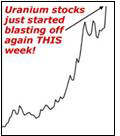
1. Why Sean Brodrick, our small cap specialist, has been so adamantly recommending uranium producers and his favorite small mining companies.
Click here for his current article on uranium .
And visit this page for his current info on 6 white-hot small cap stocks .
2. Why Tony Sagami, our Asia specialist, has been so consistently recommending his favorite stocks in China, Taiwan, Singapore and Japan. Click here for his favorite ways to invest in Asia .

3. Why Larry Edelson, our gold and natural resource expert, has been so diligently telling you about the very best natural resource investments he can dig up.
Click here for his latest on global stocks and gold .
4. Why John Burke, our defense specialist, has been advocating some of the most wildly successful weapons and homeland security companies.
5. Why our separate money management division has been using global strategies to help some of its clients achieve returns of up to 63% from 8-6-04 through 12-31-06 (22.53% annualized).
6. Plus, it helps explain why Mike Larson and I have given you multiple ways to safeguard your retirement (such as with a Treasury-only money market fund ), and to build your wealth with solid global investments .
Take a moment to use the links I've given you above. Read our current articles carefully. Act on the ideas that fit your goals. Come back to Money and Markets each morning for urgent new updates as a new world war unfolds. Then pray for the best and prepare for the worst.
Good luck and God bless!
Martin Weiss
This investment news is brought to you by Money and Markets. Money and Markets is a free daily investment newsletter from Martin D. Weiss and Weiss Research analysts offering the latest investing news and financial insights for the stock market, including tips and advice on investing in gold, energy and oil. Dr. Weiss is a leader in the fields of investing, interest rates, financial safety and economic forecasting. To view archives or subscribe, visit http://www.MoneyandMarkets.com NOTE - From time to time, The Market Oracle publishes articles from third parties. These articles do not necessarily express the viewpoints of The Market Oracle or its editorial team.© 2005-2022 http://www.MarketOracle.co.uk - The Market Oracle is a FREE Daily Financial Markets Analysis & Forecasting online publication.
