


Commercial Banks Heading for Huge Derivatives Losses- Credit Crisis Turning into Credit Armageddon
Stock-Markets / Credit Crisis 2008 Apr 21, 2008 - 11:38 AM GMT

 While most investors are focused on the latest stock market rally, hidden from view is a monumental change that few recognize and fewer understand: Unprecedented amounts of old debts are coming due in America, and many are not getting refinanced.
Even worse, borrowers are going into default, lenders are taking huge losses, and outstanding loans are turning to dust.
The numbers are large; the government's response is equally massive. So before you look at one more stock quote or any other news item, I think it behooves you to understand what this means and what to do about it ...
New Evidence of A Credit Crack-Up
Until recently, economists have had only anecdotal evidence of credit troubles.
They knew that individual banks were taking losses. They knew that many banks were tightening their lending standards. And they realized that there were hiccups in the credit markets.
So they called it the “credit crunch” — essentially a slowdown in the pace of new credit growth.
But we didn't buy that. Earlier this year, we warned that America's credit woes involved much more than just a slowdown. We wrote that it was actually a credit crack-up — an outright contraction of credit the likes of which had never been witnessed in our lifetime.
Wall Street scoffed. No one had seen anything like this happen before, and almost everyone assumed that it would not happen now.
They were wrong.
Indeed, three new official reports are now telling us, point blank, that the credit crack-up is already beginning!
First, the Federal Reserve is reporting a big contraction in short-term debts.
The specifics: Based on its Flow of Funds Report (pdf page 18), we can clearly see that ...
- Just in the third quarter of last year, “open market paper” (mostly short-term commercial loans) was slashed at the annual rate of $682 billion ...
- In the fourth quarter, it shrunk again — at the rate of $337 billion per year, and ...
- This shrinkage doesn't even begin to reflect the impact of the Bear Stearns failure or the huge additional bank losses announced so far this year.
I repeat: This is not a mere “slowdown” in new lending, which would be relatively routine. This is an actual reduction in the short-term loans outstanding, which is anything but routine ... which implies a rupture in the nation's credit spigots ... and which could deliver a new shock to the U.S. economy.
If this represented a planned and voluntary effort by lenders to begin trimming America's debt excesses, it might actually be a good thing.
But that's not the case here, not even close. Rather, this debt reduction is almost exclusively forced on lenders by the pressure of events — the plunging value of mortgages, the surging defaults by debtors, and the huge losses that have caught both banks and regulators off guard.
Second, the Comptroller of the Currency (OCC) is reporting havoc in the derivatives market.
Derivatives are bets and debts placed by banks and others.
In recent decades, derivatives have grown far beyond any semblance of reason. But in its latest report , the OCC reveals that in the fourth quarter of 2007 ...
- For the first time in history, the notional value of derivatives held by U.S. commercial banks plunged dramatically — by $8 trillion ...
- For the first time in history, U.S. banks suffered a massive overall loss on their derivatives — $9.97 billion, and, again ...
- These numbers do not yet reflect this year's disasters at Bear Sterns and other institutions.
The OCC's chart below illustrates the magnitude and drama of the decline:
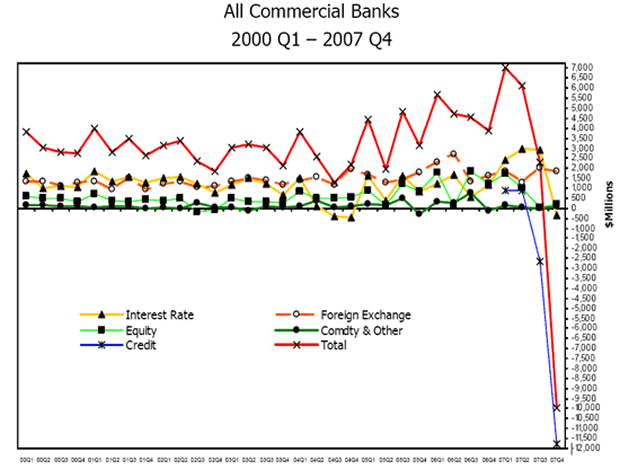
The chart shows that, until the third quarter of last year, U.S. commercial banks had been making consistent profits from their derivatives quarter after quarter.
Their total revenue from these and related transactions (red line) never dipped into negative territory ... rarely suffered a significant decline ... and was even making brand new highs through the first half of 2007.
Then, suddenly, in the fourth quarter of last year, we witnessed a landmark game-changing event: For the first time ever, U.S. commercial banks lost big money in derivatives in the aggregate ( as you can plainly see by the sharp nosedive of the red line).
Again, if this were part of a planned retreat by the banks to more prudent trading approaches, it would be a positive. But it's anything but!
Indeed, the OCC specifically states in its report that the sudden and unusual reduction in derivatives was due entirely to the turmoil in the credit markets.
And ironically, nearly all of that turmoil was concentrated in “credit swaps” (blue line in the chart) — the one sector that was designed to protect investors from this precise situation.
These credit swaps were supposed to act as insurance policies that big banks and others bought to help cover their risk in the event of defaults and failures. But they're not working out as planned: Just in the fourth quarter, U.S. banks had a net loss (after all profitable trades) of $11.8 billion on credit swaps alone, according to the OCC.
Those losses helped wipe out all the profits they made in other derivatives, leaving a net overall loss of $9.97 billion.
Third, the International Monetary Fund (IMF) predicts that this crisis is barely ONE-THIRD over!
In its Global Financial Stability Report(see Executive Summary ), the IMF predicts that the total losses from the subprime and related credit crises could reach $945 billion, or more than triple the already-huge losses that have been announced so far.
The IMF further warns that ...
- “There has been a collective failure to appreciate the extent of the leverage taken on by a wide range of institutions — including banks, monoline insurers, government-sponsored entities, and hedge funds — and the associated risks of a disorderly unwinding.” Now, both the OCC and the Fed reports confirm that this “disorderly unwinding” is already beginning.
- “The transfer of risks off bank balance sheets was overestimated. As risks have materialized, this has placed enormous pressures back on the balance sheets of banks.” Now, the OCC report confirms that “the transfer of risk” (with credit swaps) has often failed.
- “Notwithstanding unprecedented intervention by major central banks, financial markets remain under considerable strain, now compounded by a more worrisome macroeconomic environment, weakly capitalized institutions, and broad-based deleveraging.” This is precisely what we have been warning you about. Now, it's happening!
Looking ahead, the IMF also warns about...
- “Deep-seated balance-sheet fragilities and weak capital bases, which mean the effects [of the crisis] are likely to be broader, deeper and more protracted.”
- “A serious funding and confidence crisis that threatens to continue for a significant period.”
The U.S. Government's Response
You've seen what the Fed has already done — six rate cuts since August of last year ... unprecedented broker bailouts ... and massive new amounts of liquidity pumped into the banking system.
You've seen where a lot of that money has gone — into foreign currencies, gold and oil.
And you've seen the dramatic market surges which that money can generate. Case in point: The latest jump in crude oil to $117 per barrel.
Now, get ready for more of the same:
- More rate cuts, with the next expected as soon as April 30 ...
- More Fed bailouts ...
- Even wilder money printing, and ...
- Larger surges in foreign currencies and commodities, despite intermediate setbacks.
But also start preparing for the day when the credit crack-up temporarily overwhelms the Fed, driving the U.S. economy into a far deeper recession than most people expect.
The Bottom Line for You Right Now
The three official reports support several related conclusions:
First, whether the stock market goes up or down in the near term, this crisis is far from over — and it's likely to get a lot worse.
Bottom line: It's far too soon to waver from a path of safety.
Second, credit is already scarcer and is probably going to be even harder to get as this crisis progresses.
Bottom line: If you're looking forward to a future day when you can buy properties at bargain prices, don't count on doing so with a lot of borrowed money. Instead, be prepared to put up substantial amounts of cash.
Third, some banks won't survive this crisis.
Bottom line: Be sure to keep your bank accounts — including principal, accrued interest and checks outstanding — under the FDIC's $100,000 insurance limit. (Amounts that run above the limit could be at risk.) Plus, for maximum safety, use U.S. Treasury bills or money market funds invested exclusively in short-term Treasuries.
Fourth, for protection and profit from a falling dollar, invest in the strongest foreign currencies plus other assets that naturally rise with the falling dollar.
Fifth, right now, for specific steps to take as this crisis unfolds, register for our upcoming emergency briefing titled ...
“AMERICAN ARMAGEDDON:
How to Win the Epic Battle for Your Wealth”
It's free. And it's taking place online this coming Thursday (April 24) at 12 Noon Eastern Time. Click here to register .
Good luck and God bless!
Martin
This investment news is brought to you by Money and Markets . Money and Markets is a free daily investment newsletter from Martin D. Weiss and Weiss Research analysts offering the latest investing news and financial insights for the stock market, including tips and advice on investing in gold, energy and oil. Dr. Weiss is a leader in the fields of investing, interest rates, financial safety and economic forecasting. To view archives or subscribe, visit http://www.moneyandmarkets.com .
Money and Markets Archive |
© 2005-2022 http://www.MarketOracle.co.uk - The Market Oracle is a FREE Daily Financial Markets Analysis & Forecasting online publication.
