


Manipulated, Corrupted and Unreliable Government Data Points to Hyperinflation
Economics / Stagflation Jun 11, 2008 - 02:52 AM GMTBy: Stephen_Lendman

 Walter "John" Williams thinks out of the box. He makes disquieting reading, but you won't find him in the mainstream. At least not often. He runs a "Shadow Government Statistics" site with an electronic by-subscription newsletter. Anyone can access some of his data and occasional special reports. They can also assess his reasoning. In his judgment, government data are manipulated, corrupted and unreliable. He's not alone thinking that.
First, through technical changes over time in how data are collected and/or interpreted. The intent is to portray a more rosy scenario and ignore real world experiences of ordinary people. Calculating the CPI is an example:
 -- in the 1980s, the Bureau of Labor Statistics (BLS) switched from using house prices to their rental equivalent;
 -- then a decade ago, BLS made a spurious assumption for reasons other than it stated; it was that consumers substitute cheaper products for ones that have risen in price - such as hamburger for steak or chicken for meat; the idea wasn't to reflect their buying habits; it was to artificially lower inflation and distort its calculation; and
-- BLS has long adjusted prices for quality improvements; it's called "hedonic adjustment" that, in fact, cooks the books; so if computer speed increases, its cost is lowered proportionally even if its price rises; the same is true for autos with better brakes or other assorted innovations; again the result is distortion, and it affects all sorts of products; as a result, inflation is artificially and fraudulently lowered.
 Another example is how federal deficits are calculated. Beginning with Nixon in 1969, a "unified budget" was adopted to artificially lower them by offsetting expenditures with "off-budget" Social Security revenues. The idea was to hide government's true cost at a time wartime and Great Society spending was high and would later factor into the 1970s and 1980s inflation. If deficits were calculated then and now by GAAP methodology (required of all publicly-traded corporations), they'd be much higher than annually reported - since the 1970s, in multiple trillions of dollars; fiscal alchemy sweeps them under the rug.
 A further example was Nixon's "core inflation" idea. More artificial rigging - to exclude volatile food and energy prices to produce a lower figure. No matter that these items account for a large portion of consumer spending, especially for lower income households.
Others like this are numerous. They all amount to manipulative rigging for political or financial market purposes, and the practice goes back decades. A recent Bush administration one is switching to monthly instead of semi-annual jobs data seasonal adjustments to make the number friendlier. Later on (too late for markets to react) they're matched against payroll figures for a once a year adjustment and more accurate jobs created or lost reading.
 The Clinton administration was also manipulative. In calculating employment, it lowered its monthly household sample from 60,000 to 50,000, reducing it mainly in inner cities. The effect is to artificially lower jobless numbers among blacks, Latinos and the poor overall. The calculation is also rigged by keeping out the 2.3 million prison population. The overall effect is illusion, not reality - to erase "free market" capitalism's defects and make it look wondrous and beneficial to mankind.
 Williams reverse-engineers the GDP, employment and inflation data for more accurate readings. He backs out manipulative changes to produce more valid figures. Take the 5.5% May unemployment rate for example. BLS calculates it on persons who looked for work in the last 30 days. Williams adds those who want to work but gave up in frustration plus people working part-time who want (but can't find) full-time jobs. Result: real unemployment of over 12%.
The same methodology works for economic growth. The real value of all goods and services produced is lower than official GDP numbers when adjusted for higher inflation. More of it means higher prices, not increased output. It's how Williams makes his calculation, and he's worried. He sees inflation rising and a threat of hyperinflation ahead. He highlighted his concern in a recent April 2008 report called "Hyperinflation Special Report" with three dramatic sub-headings:
-- "Inflationary Recession Is in Place;
-- Banking Solvency Crisis Has Opened First Phase Monetary Inflation;" and
-- "Hyperinflationary Depression Remains Likely As Early as 2010."
Time alone will prove him right or wrong. But given current economic conditions, the financial malpractice that precipitated them, continued mismanagement since then, and resultant dangers they created, it pays to examine his analysis. It's not for the faint-hearted and hopefully won't bear out. But it's happened before at other times in other countries, and when it hits it ruins lives and savings. Is America now headed for that type future? Williams thinks so, and here's his argument.
He sees the US economy in an "intensifying inflationary recession" heading for "a hyperinflationary great depression." He expects it as soon as 2010, maybe sooner, and "likely" no later than in a decade. Blame it on reckless monetary and fiscal policy - creating torrents of money, borrowing outsized amounts, and spending ourselves into bankruptcy by supporting short-term "big-monied special interests."
Things are so out of hand, Williams sees "no way of avoiding a financial Armageddon." We're nearly or already bankrupt; are creating money to cover our obligations; the more we print, the more we need; it's fiat currency unbacked by gold; and every new dollar created dilutes the value of all others in circulation. Double the money supply, and presto - every dollar is worth 50 cents. Double it again, and you get the point. We've been doing it for decades, especially since Nixon closed the gold window in 1971.
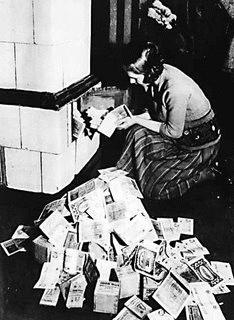 At some point, the music stops, the dollar collapses, it becomes worthless paper, and related dollar-demoninated paper assets go down with it. Williams quotes a law professor who experienced Weimar Germany's hyperinflation first hand. It was the worst by far ever recorded. "It was horrible. Horrible! Like lightening it struck. No one was prepared." Shelves in grocery stores emptied. "You could buy nothing with your paper money." At the trough in 1923, the mark plunged to an astonishing 4,200,000,000,000 to the dollar.
 Can it happen here? It might, and rising world inflation is worrisome. Analyst Bob Chapman's International Forecaster reports current US inflation at 12.5%; China's 8.5%; Russia's 14%; Gulf oil producers on average 12%; India 8%; Indonesia 12%; Brazil 5%; Chile 8.3%; Venezuela 29.3% and Argentina 23%. This likely plays into the European Central Bank's (ECB) reluctance to cut rates and the Bank of England's holding off on further ones. It's also a factor affecting dollar weakness and rising gold prices that hedge against depreciating currencies and geopolitical uncertainties.
Williams is justifiably concerned as inflationary pressures build. First some definitions. Inflation results from a money supply increase that causes prices to rise. Williams refers only to goods and services, not financial assets like stocks and bonds. He also leaves out speculation and market manipulation that's key to understanding high oil and food prices. Markets don't move randomly. Big-monied speculators move them, but that's a separate topic from what Williams addresses.
He mentions various types of hyperinflation. They range from the double or triple-digit kind, several-fold that level, to what happened in Weimar Germany when it went to infinity. Once the genie is unleashed, there's no telling how bad things may get. Williams sees them getting pretty bad. So much so that dollars get dumped, holders flee to safety, and a downward spiral intensifies with no idea of a bottom.
In his view and others, the culprit is fiat currency, without gold backing. Its worth depends solely on the full faith and credit of the issuing government. Absent that and currencies crash. Print too much of it, and that's its future. Examine Fed policy under Greenspan and Bernanke, and draw your own conclusions.
They've been virtual money-creation machines unmindful of the history they should know. By issuing too much of a good thing for too many years, they fueled asset bubbles. When they burst, they made things worse and may now have headed the economy for collapse. In Williams judgment, America today is no different from other nations in other eras that followed similar policies. They all met the same fate, and today this country has already "obligated itself to liabilities well beyond its ability ever to pay off." Not a cheery assessment, and he's not alone believing it.
More definitions:
-- Deflation - a decrease in goods and services prices, generally from a money supply contraction;
-- Inflation - the reverse of the above;
-- Hyperinflation - extreme inflation, as explained above, to a level where money becomes worthless or nearly so; according to Williams, the coming hyperinflation is because of a "lack of monetary discipline formerly imposed....by the gold standard, and a (Fed) dedicated to preventing a collapse in the money supply (and preventing) the implosion of the (ongoing) extremely over-leveraged domestic financial system;"
-- Recession - officially defined as two or more consecutive (inflation-adjusted) GDP contracting quarters; many economists don't agree on this, and some gauge conditions by the relative strength or weakness of industrial production, payroll employment, retail sales, and so forth; add it up and clearly the US is in recession; how bad and for how long will only be known in time;
-- Depression - a recession "where (inflation-adjusted) peak-to-trough contraction exceeds 10%; and a
-- Great depression - one where the peak-to-trough exceeds 25%. It happened only once so far in US history in the 1930s.
Williams believes the current US contraction is about halfway to becoming a "depression," but before it ends it may become "Great Depression II" to distinguish it from the earlier one. We're now in an "inflationary recession," and available data confirm it - soaring food and oil prices, a weakened dollar, true unemployment over 12%, real inflation nearly as high, weak industrial production, and more. In his judgment, expect worse ahead when added "inflationary effects of soaring broad money growth....start" surfacing later in the year. In his judgment, by year-end 2008, "official CPI" figures should begin showing it.
Current computations cook the books, and not just for inflation. According to Williams, the economy has been in recession since late 2006 when it entered the "second down-leg" of a multiple dip contraction. It began in 1999, then showed up officially in 2001. His current outlook takes account of "further bounces and dips in economic activity." We may now be in an upward swing before reheading down. It happened during the Great Depression, only to fall to new lows.
Conditions today are hazardous. A major financial crisis precipitated them. Reckless policies caused it. It threatens the solvency of major banks and other financial institutions. It also hurts the greater economy. Solutions - massive liquidity injections, interest rate cuts and reckless deficit spending. Result - financial malpractice for a short-term fix. Consequences - "financial Armageddon" according to Williams.
M3 (the broadest money supply measure) growth is so high that the Fed no longer reports it. Economists like Williams do because it's crucial to know, and the data he reveals are disturbing - record M3 growth at a near 18% annual pace. Hyperinflationary seeds are now sown. Dollar valuation is falling, and at some point may accelerate when investors flee it for safer havens. The Fed again will respond. More debt will be monetized. It will build over time. Things will get worse and then be exacerbated when the government is less able to meet its obligations. "Therein lies the ultimate basis for the pending hyperinflation," in Williams' judgment.
He believes it will morph into a hyperinflationary depression, then a "great depression." And when it hits, it will be with "surprising speed." Already disposable income is falling in a weakened economy in crisis. As things worsen, politicians get blamed, and Williams raises an interesting possibility. If conditions get bad enough, voters may respond with their feet, declare a pox on both major parties, and turn to a third alternative around 2010 or 2012. It happened before in our history. The Republican Party is Exhibit A. It was created in 1854 at a time Democrats and Whigs were the two dominant parties. Exit Whigs, and enter Republicans with Abraham Lincoln its first elected president in 1860.
Williams shows US inflation data going back to 1665. It was fairly stable up to the Fed's 1913 creation. It then began rising and accelerated post-WW II. Government calculations mask it. Alternative ones are more revealing and accurate. Except for minor price declines in 1944 and 1955, the US hasn't had a deflationary period since the 1930s. Abandoning the gold standard is why. It imposed monetary discipline. Roosevelt went off it in 1933. He had to. The banking system collapsed, money supply imploded, and economic stimulus was needed. It released the Fed to create money freely. Therein lies the problem, and it shows up in the numbers.

Current Fed Chairman Bernanke and Alan Greenspan are students of the Great Depression. "Helicopter Ben" especially vowed never again, and his actions prove it to a fault. He knows the risks and stated them in an earlier speech. He said:
"Like gold, US dollars have value only to the extent that they are strictly limited in supply. But the US government has a technology called a printing press (now its electronic equivalent), that allows it to produce as many US dollars as it wishes." By doing so, it "reduce(s) the value of a dollar in terms of goods and services" which raises their prices...."under a paper-money system, a determined government can always generate higher spending and hence positive inflation."
So it has, according to Williams, and it caused a "slow-motion destruction of the US dollar's purchasing power" since 1933. It shows up in GAAP-based 2007 federal deficit figures - $4 trillion for the fiscal year, not the official $163 fiction reported. Williams estimates total outstanding federal obligations at $62.6 trillion. At least one other economist puts it over $80 trillion. There's no way to honor this debt level, so the "government effectively is bankrupt." At that point, it has three choices - default, declare a moratorium, or repudiate the entire amount.
Sooner or later, markets will react. Holders of US debt already are balking, but so far modestly and quietly. Ahead, that may change if dollar valuations plunge. It will force the Fed's hand. Greater debt monetization will follow. Dollar valuations will sink further, and so forth in a progressive downward cycle to oblivion if Williams is right.
If conditions get severe enough, the Fed can create huge amounts of currency in a few days or weeks - enough to match the dollar's lost purchasing power in the last 75 years. Combine it with fiscal irresponsibility and imagine the consequences.
Official data alone today are reason for concern - soaring food and oil prices, the dollar near historic lows, money growth at an all-time high, and off-the-charts federal deficits and debt. The trend continues, and it shows up in gold prices - topping $1000, then retreating, but nearly certain to soar way above previous highs on its way to numbers not discussed in the mainstream - $2000 an ounce, $3000? Who knows. Williams sees it "setting new historic highs."
In 1980, its price hit $850 an ounce. In CPI inflation-adjusted terms, around $2300 an ounce would match it today. But if the government hadn't cooked the CPI calculation, the number would be about $6250 an ounce. By that standard, gold today is cheap. It's way below its real 1980 top, and if inflation accelerates as Williams predicts, expect much higher prices as dollars keep deflating.
Under this scenario, the "US government cannot cover (its) existing obligations." Annual federal deficits are "careening wildly out of control, averaging $4.6 trillion per year for the six years through 2007." That's with all unfunded liabilities included like Social Security, Medicare, Medicaid, other social services, debt service and more.
Williams says things are so out of control that "if the government (raised taxes) to seize 100% of all wages, salaries and corporate profits, it still would (show) an annual deficit using GAAP accounting" methods. At the same time, "given current revenues, if it stopped (all) spending (including defense and homeland security) other than Social Security and Medicare obligations, the government still would (show) an annual deficit." The hole is so deep, it's impossible to dig out, according to Williams.
But given political realities, officials spend whatever it takes to get elected and keep their jobs. That's besides foreign wars, limitless corporate subsidies and more. Things, however, won't improve. They'll worsen, and that for Williams spells hyperinflation ahead. It's happening "with the full knowledge of political Washington and the Federal Reserve." It it weren't for the US's "special position," our debt would likely be rated "below investment grade instead of triple-A." Longer term bonds are especially risky. At some point, they'll lose their full value. They also risk default, and that's besides their loss in dollar terms.
It's just a matter of time before foreign investors get worried enough to act - buying fewer Treasuries down to none, then followed by redemptions. The Fed will have to compensate. Print more currency, and the problem deepens. Its value declines and inflation accelerates.
Trade policies worsen things. We're in a global race to the bottom. The once bedrock manufacturing base eroded. It's now 10% of the economy and falling. Services currently account for around 84% of it and rising. Jobs in all categories are being offshored to low-wage countries. Average inflation-adjusted wages keep declining. Real earnings are below their early 1970s peak. Living standards are falling. Consumer debt is rising to make up the shortfall. Savings are liquidated. Before the housing decline, mortgage refinancing helped when valuations rose. It meant taking on more debt. Fed policy encouraged it. Today's dilemma "is payback" for unsustainable bubble-creation policies. Recalling a relevant quote: "Things that can't go on forever won't."
Bad policy caused enormous structural change, and trade deficits are part of it. They've "risen to the highest level for any country in history." They're one more problem for a seriously over-extended economy. It places "the federal government and Federal Reserve in untenable positions, where they cannot easily or rapidly address the underlying problems, even if standard economic stimuli were available."
Given the federal deficit and out-of-control spending, fiscal policy limits have been reached. The Fed's in the same bind. It can neither stimulate the economy or contain inflation. Rate cuts have done little. Saving the dollar may require raising them, but that won't "contain non-demand driven inflation." It shows up in high food, energy, health care, and companies like Dow Chemical announcing on May 28 that it will raise prices across the board up to 20% to offset increased costs.
More cause for worry, and Williams anticipates depression. Hyperinflation will follow, and it will sink "the economy into a great depression." It will halt commercial activity. The greater disparity in income, the more negative its consequences. "Extremes in income variance usually are followed by financial panics and economic depressions. US income variance today is higher" than in 1929 and "nearly double that of any other 'advanced' economy."
Federal bailouts have worsened things. Dollar creation exploded. Crisis has been pushed into the future. Its enormity will be far greater, and foreign investors will get stuck with a lot of it. When it arrives in strength, capital outflow will follow, and dollar valuation will plunge with it. Williams believes that "both central bank and major private investors know that the dollar is going to be a losing proposition. They either expect and/or hope that they can get of (it) in time to lock in their profits (or for central bankers) that they can forestall the ultimate global economic crisis" as long as possible.
Dollars are very vulnerable in this environment. If Treasuries are dumped, the Fed will monetize debt to make up the difference. Inflation will then accelerate, multi-trillion dollar deficits will worsen things, and a "self-feeding cycle of currency debasement and hyperinflation" will follow.
Cash as we know it will disappear. A barter system and black market will replace it or possible introduction of a new currency. Since most money today is electronic, not physical, chances of it adapting "are practically nil." With hyperinflation, electronic commerce would completely shut down and economic collapse would follow. Gold and silver will be invaluable. Holders could exchange them for goods and services.
Physical goods will also be precious for survival and as a medium of exchange. Anything with a long shelf life may be stocked in advance, and providers of essential services could barter them for goods and other services. Forewarned is forearmed. Safety and liquidity are crucial. Anything retaining value is essential. Real estate, other currencies for example. Foreign equities and debt to a small degree because US financial assets hammering will spill everywhere.
With all that to deal with, consider another dilemma - the likelihood of painful political change, civil unrest, disruptive violence, and utter chaos. If Williams is right and hyperinflation arrives, Katie bar the door on what may follow. Revolutions are possible with three notable last century ones to consider - in Russia, Weimer Germany and Nationalist China. In each case, the old order ended, everything changed, but not for the good. How does Williams advise? Evaluate one's own circumstances, use common sense, and forewarned is forearmed. That will help, but hard times hurt everyone.
Hopefully they won't arrive, at least not full-blown as Williams predicts. But make no mistake. Excess has a price. The more of it the greater. America has an ocean of it. Sooner or later comes payback. "Things that can't go on forever won't."
By Stephen Lendman
Stephen Lendman lives in Chicago and can be reached in Chicago at lendmanstephen@sbcglobal.net.
Also visit his blog site at sjlendman.blogspot.com and listen to The Global Research News Hour on RepublicBroadcasting.org Mondays from 11AM to 1PM US Central time for cutting-edge discussions of major world and national topics with distinguished guests.
http://www.globalresearch.ca/index.php?context=va&aid=
9229
Stephen Lendman Archive |
© 2005-2022 http://www.MarketOracle.co.uk - The Market Oracle is a FREE Daily Financial Markets Analysis & Forecasting online publication.
