


New Investment Era, Contracting Earnings and PE Reversion Below the Mean
Stock-Markets / Stock Market Valuations Aug 02, 2008 - 12:55 AM GMTBy: John_Mauldin

 This week I am in Maine on vacation with my son, and next week is my daughter Tiffani's wedding, so for the next two weeks I am going to send an updated version of a speech I have been giving the past few months on what I think is the likely potential for the rise of a brand new asset class. It is too long to be sent as one letter, so we will start with the first part today and finish with the second part next week. This first part can be read as a standalone letter.
I think we're at a watershed moment, what Peter Bernstein defines as an "epochal event," with the very order of the investment world changing as it did in 1929, in '50, in 1981, where a number of things came together - it wasn't just one thing but a number of events happening that conspired to change the nature of what worked in the investment world for the next period of time.
It took most people a decade after 1981-2 to recognize that we were in a different period, because we make our future expectations out of past experience. It's very hard for us to recognize a watershed moment in the process. We're going to look back in five or ten years and go, "Wow, things changed." As we will see, it's going to be a change that's going to cost people in their portfolios and in their retirement habits.
We're going to look at a number of different concepts and separate ideas that in and of themselves don't make that much difference. But I think their confluence in the present moment is going to change things.
Now, some of this is new, some of it is old. The old stuff we're going to fly through. Most of you have been reading me for a while now, and you've got the concepts down. So let's start.
The first thing to note is that we're in a Muddle Through Economy. We're in a recession that's fueled by the bursting of two bubbles: the housing bubble and the credit crisis. The real question is: when do we come out of the recession? At what time do we come back to trend growth, which is 3 to 3.5 percent a year?
I believe that over the next 20 years the US economy will grow at roughly a rate of 3 percent compounded, in real terms. But I believe that we have some headwinds for the next year or two. So I think the real bottom of this economic cycle will be later this year, during the fourth quarter and possibly into the first quarter of next year. But it will take two years, for some reasons we are going to get into, to get back to long-term trend growth. It will take much longer than normal because the things that created the problem – the housing bubble and the credit crisis – aren't things that can respond to Fed policy, and they aren't things that can respond to the normal cycles. It's going to take a long time to work through these.
First, we had an investor-driven transaction bubble in housing. There were 48% more houses built since 2005 than should have been built, if you were simply looking at trends.
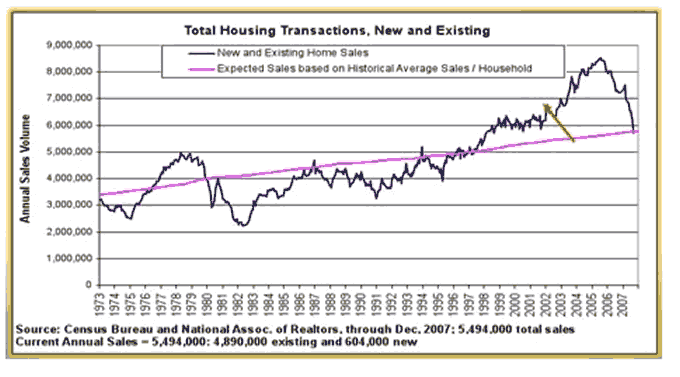
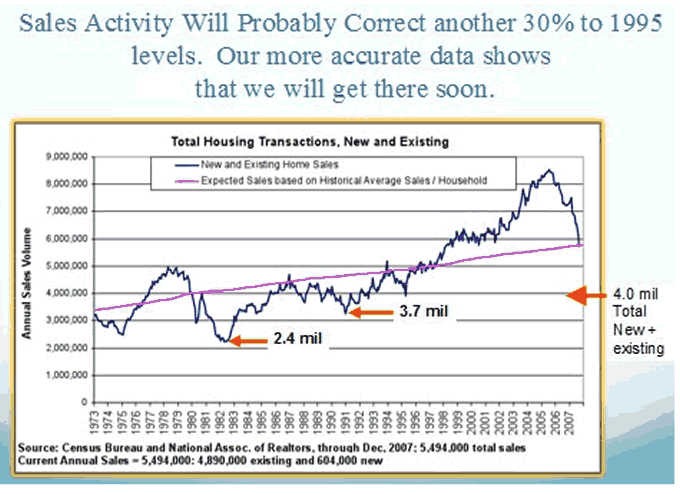
What that means is there are 3.5 million homes we have to work through. Now, that means that the 8 or 9 hundred thousand homes that we're now down to building a year, is going to end up going down to 400,000. It's going to take some time to work through those excess homes – for the prices to drop enough that people can go in and buy them or rent them. We are probably talking 2011 before we finally work through this housing crisis and get back to a normal market where housing contributes significantly to GDP growth.
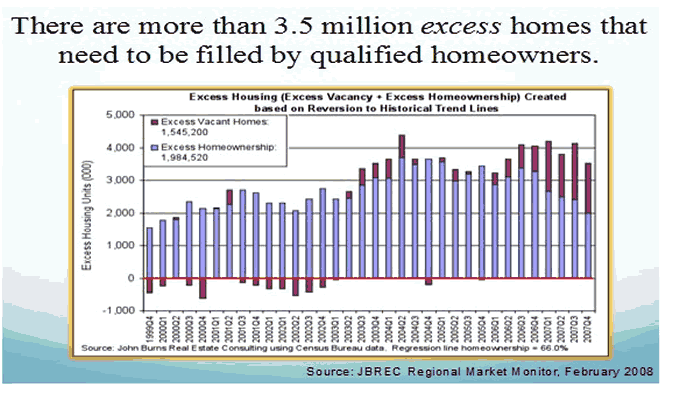
Sales activity is probably going to correct another 30 percent. That's not fun. By the middle to the end of this year, sales are going to be really low. As a side issue, those of you who like to invest in real estate and actually want to own a home to rent are going to have some good opportunities.
Let's look at the credit crisis very quickly. We vaporized 60 percent to the shadow banking system, the SIVs and CDOs, the people who actually bought US mortgages, who bought student loans, who bought credit cards, who bought car loans. That's gone and it's never coming back. As we'll see, it's going to take well into the next decade for us to create a completely new infrastructure to replace the broken one. It took decades to get to where we were last year. I don't think it will take decades to recover, but it's going to take five, six, seven years. That means things are going to be difficult if you want to borrow money. Credit spreads are going to be wider; it's going to affect you more. By the way, if you're in business, if you're paying more, it's going to put pressure on your profits.
Let's look at GDP growth for the last ten years, with and without mortgage equity withdrawal.
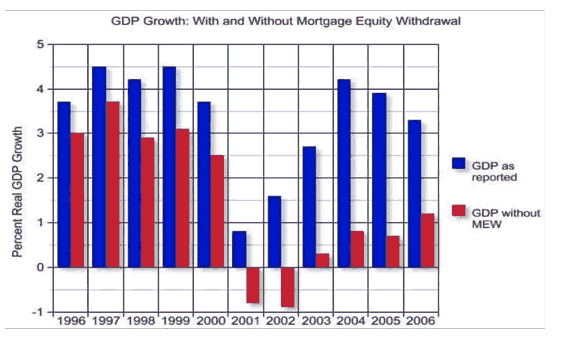
Without MEW, we would have had two years, in 2001 and 2002, with negative GDP growth. We're not going to go get those levels of mortgage equity withdrawals today, not in this environment. We're still seeing some cash-out borrowing, but it's getting more and more difficult; and as home values drop, there are going to be fewer and fewer people pulling less and less money out of the "home ATMs." As Paul McCulley says, your home ATM is starting to spit out negative twenty-dollar bills.
That means consumer spending is going to continue to slow. We haven't had a consumer recession since 1990-91. There are a lot of people today who have kind of forgotten that consumer spending can actually slow down. That's going to happen from lower mortgage equity withdrawals, and it's going to happen because of higher gas and energy costs that are displacing normal spending. You've got to fill up your Ford F-150 to be able to get to work. I saw $4 a gallon gasoline when we arrived in La Jolla. I mean, I guess around here people don't really pay attention, but that means it would cost a hundred bucks to fill up my big SUV. That's just a lot of money. That's a hundred bucks I can't spend on something else – on clothes or kids or education. It means I'm going to be consuming less.
We're in a recession. Recessions by definition mean that we're going to be seeing rising unemployment. We're already up past 5.5 percent. We'll probably see 6 percent and maybe higher. We're not going to see the 9 and 10 percents like we did in the '70s or '80s, because we're not as subject to the manufacturing cycle as we were back then. That's both good and bad. We don't have that boom-bust in the manufacturing world. We're seeing a bust in the construction world and we're starting to see commercial lending and commercial building go down. But I don't think we're going to see the large 8 and 9 percent unemployment rates that we typically see in a recession. But still, if you see rising unemployment – and unemployment rises by 20 percent, from 5 to 6 — that means those people are going to have less money and they're not going to be spending it.
We're seeing inflation in an environment of low real-income growth. Inflation is running over 4 percent now. And real-income growth is running a little bit less. While we may see some nominal growth in consumer spending, real spending is going to be dropping over the next year. That has some consequences that we'll talk about later. Also, consumer spending is going to drop because we have less availability of easy credit. Now, it probably hasn't hit this room. But there is a wave of letters going out from credit card companies, cutting people's credit lines, cutting people's home mortgage lines. There are a lot of people actually hitting their home equity credit lines and putting it in a savings account because they're afraid that it's going away. They're afraid that they may not be able to get the cash when they need it. "What happens if I lose my job? I better get the cash, and I'll pay the difference in interest costs just to make sure that I'm OK." That's happening a lot.
In summary, lower mortgage equity withdrawals, higher gas and energy costs, rising unemployment, inflation in an environment of low real-income growth, and less availability of cheap and easy credit are all contributing factors to slowing consumer spending.
This has three major effects. First, lower corporate earnings. We're in a period where earnings disappointments are going to be the rule and not the exception. We're going to go into this in detail in just a little bit. But GE wasn't a one-off announcement. Yes, it was their financial system. But we're going to see a lot of earnings disappointments from all sorts of retailers, from all sorts of companies, for a variety of reasons. We're going to look at the documentation for a minute to demonstrate that. Second, lower corporate profits put pressure on the stock market. There's a relationship between earnings, valuations, and stock prices. And third, that also means we're going to see lower than expected long-term returns. That's going to be a problem for people who are looking for traditional assets to be the bulk of the growth for their retirement portfolios.
Now, I think we're still in a bear market. Remember that in 2000 and 2001, we had three corrections of over plus 20% percent and one in the plus 30% range. It's not unusual to see large corrections inside an overall bear market.
Why do I think we're in a bear market? Long-term markets – and we're going to talk long term for a second and then come to the shorter term – long-term markets in bear cycles have several characteristics. Number one, they all start with high P/E ratios. Now, Vitaliy Katsenelson, who wrote my e-letter this week so that I could be here, lays out what he calls "cowardly lion markets," as distinct from bear markets, because stocks tend to go sideways for a long period of time. We'll talk about why that is in a minute, but I think he's right on that.
You are told that you should invest for the long run. Twenty years for a lot of people is the long run. However, what they do not tell you is that you can see negative real stock market returns over 20 years. It's happened four or five times. So when you're reading in somebody's book that says, "Hey stocks are going to compound at 11 percent a year" or whatever la-la number can be seduced from the data, think twice.
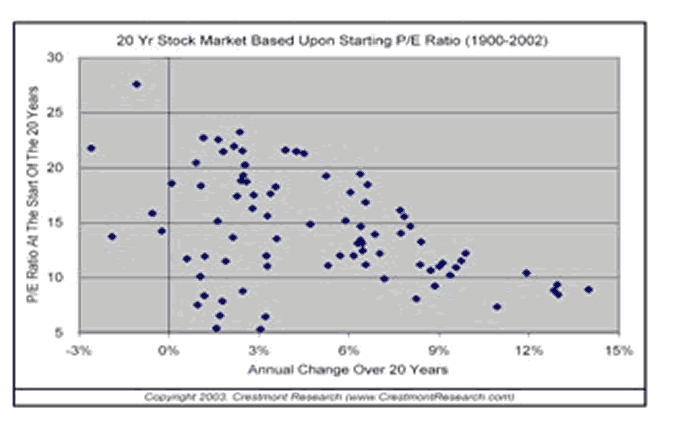
In secular bear markets, you can have returns for long periods of time from zero to 3 percent, every 15 to 30 years. We're kind of starting one here again. If you went to Standard and Poor's website in March of 2007 and you asked what the earnings were going to be for 2008, their analysts said that earnings would be $92 for 2008. Two months later, at the end of the year in December 2007 – this is four months ago – they were projecting $84. In February, it was $71.20. Today Merrill Lynch estimates that earnings could drop to as low as $45 next year. Notice a trend here?
When you go into a recession, analysts begin to project lower earnings. They keep ratcheting them down. What do they use to project future earnings? Past performance. There are very few analysts who actually go out and say, "OK, how is this company going to perform in a recession?" They all say, "The company that I cover is an exception." This is how they're going to cover it, because they're talking to management.
And when's the last time management said, "Oh man, we're really going to get clobbered; there's a recession coming." Not if they want to keep their jobs. John Chambers will be telling us that Cisco's going to be doing wonderfully, just like he did all of '99, all of 2000 and all of 2001.
Now, what does this mean for P/E ratios? About 30 days ago, it was estimated, based on prices, that the P/E ratio for the end of the last quarter would be 20.5. Today, as companies mark their earnings down, the P/E ratio is 22.5. For the end of September, third quarter, a month ago, they were saying the P/E ratio would be 21. Today they're projecting that if the market stayed at the same price, it would be 28. Now, does anyone think we're going to see a P/E ratio of 28 at the end of the third quarter? People are going to be projecting positive earnings forward – and we're going to see one earnings surprise after another.
Remember, it takes three to four really good earnings disappointments to reach a point where investors really begin to understand that things are different, because we project future performance from past performance. When past performance disappoints us three or four times, then we begin to project negative performance, and that's when the stock market drops. It's not that the stock market is telling us that things are going to be better. It's that we have expectations of things getting better because that's what our past experience has been – so we need those disappointments.
This is from Vitaliy Katsenelson's book: If you take 10-year trailing P/Es – you average them together so you don't have the effect of just one year – you find that valuations go from high to low from where bull markets start, in what he calls a range-bound market or what I would call a secular bear.
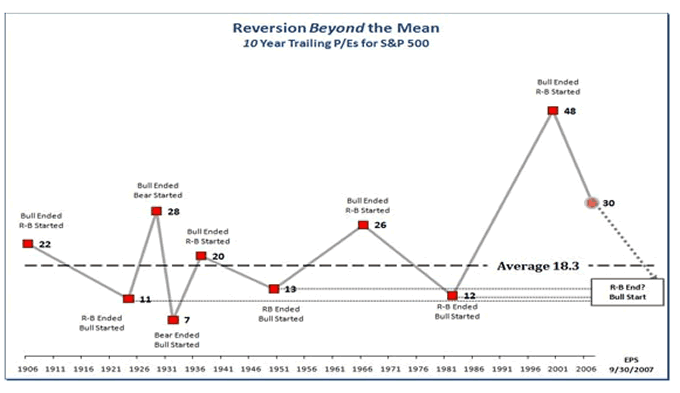
They go from high valuations to low valuations and back. Around 2000 we were at 48. It's down to 30 today on those long, ten-year runs, and it always corrects below the mean. Valuations are mean-reverting machines.

If you just look at one year, you get the same effect. You have a P/E average of 15 – remember they're projecting 28. You don't have a projection of 28 in a recession and not have the stock market feel that.
Maine, Maryland, and Weddings
It takes a full day to get from Texas to Leen's Lodge ( http://www.leenslodge.com/ ) in Grand Lake Stream, Maine. Trey and I make the last part of the trip by float plane. This is the third time I've gone with Trey, and I really look forward to the trip. It's just a great bunch of guys. As I have noted, we do make predictions about the markets. Last year a number of readers sent in their predictions, and we have tabulated those. I will report back on how well we all did, and some of you will win a book for being the best predictors.
It looks like I am going to Maryland for a day in a few weeks, and New York is looming on the horizon again, as well as another trip to Baltimore to be with my really good friend Bill Bonner (of Daily Reckoning fame) for his 60 th birthday party. Now that should be a blast.
It is amazing how many details have to be worked out for a wedding. And it is just a few days away. Tiffani will be gone on her honeymoon for almost an entire month, so a lot of business details have to be worked out for the interim. She and Ryan will be in South Africa and Ireland, and I really do want to leave her alone. She deserves some time away. When she comes back, we will really start to work on our book.
Have a great week. Enjoy the summer with friends and family.
Your ready for some fishing analyst,
By John Mauldin
John Mauldin, Best-Selling author and recognized financial expert, is also editor of the free Thoughts From the Frontline that goes to over 1 million readers each week. For more information on John or his FREE weekly economic letter go to: http://www.frontlinethoughts.com/learnmore
To subscribe to John Mauldin's E-Letter please click here:http://www.frontlinethoughts.com/subscribe.asp
Copyright 2008 John Mauldin. All Rights Reserved
John Mauldin is president of Millennium Wave Advisors, LLC, a registered investment advisor. All material presented herein is believed to be reliable but we cannot attest to its accuracy. Investment recommendations may change and readers are urged to check with their investment counselors before making any investment decisions. Opinions expressed in these reports may change without prior notice. John Mauldin and/or the staff at Millennium Wave Advisors, LLC may or may not have investments in any funds cited above. Mauldin can be reached at 800-829-7273.
Disclaimer PAST RESULTS ARE NOT INDICATIVE OF FUTURE RESULTS. THERE IS RISK OF LOSS AS WELL AS THE OPPORTUNITY FOR GAIN WHEN INVESTING IN MANAGED FUNDS. WHEN CONSIDERING ALTERNATIVE INVESTMENTS, INCLUDING HEDGE FUNDS, YOU SHOULD CONSIDER VARIOUS RISKS INCLUDING THE FACT THAT SOME PRODUCTS: OFTEN ENGAGE IN LEVERAGING AND OTHER SPECULATIVE INVESTMENT PRACTICES THAT MAY INCREASE THE RISK OF INVESTMENT LOSS, CAN BE ILLIQUID, ARE NOT REQUIRED TO PROVIDE PERIODIC PRICING OR VALUATION INFORMATION TO INVESTORS, MAY INVOLVE COMPLEX TAX STRUCTURES AND DELAYS IN DISTRIBUTING IMPORTANT TAX INFORMATION, ARE NOT SUBJECT TO THE SAME REGULATORY REQUIREMENTS AS MUTUAL FUNDS, OFTEN CHARGE HIGH FEES, AND IN MANY CASES THE UNDERLYING INVESTMENTS ARE NOT TRANSPARENT AND ARE KNOWN ONLY TO THE INVESTMENT MANAGER.
John Mauldin Archive |
© 2005-2022 http://www.MarketOracle.co.uk - The Market Oracle is a FREE Daily Financial Markets Analysis & Forecasting online publication.
