


Stocks and Commodities Bubbles, Parabolic Moves, and Resulting Collapses
Stock-Markets / Liquidity Bubble Aug 09, 2008 - 12:17 PM GMTBy: Tim_Wood

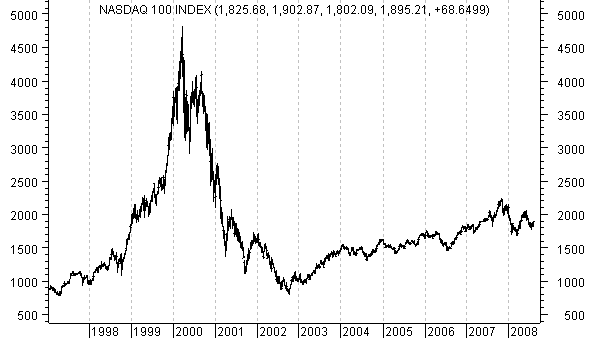
 In the chart below I have included a weekly chart of the Nasdaq 100. Beginning at the 4-year cycle low that occurred in October 1998, we can see that price rose sharply in February 1999. In fact, in that 4-month period this index moved from a low of 1,063.74 up to 2,150.83. This was a 102% advance in only 4 months. As we moved into October of 1999 this advance was much more orderly, but still managed to advance another 400 points during this time period and in doing so the Nasdaq 100 had advanced 143% in a mere 12 months. As this move received more and more attention more and more people jumped on the bandwagon with the hottest tech stock. As a result, a bubble began to form.
From the October low at 2,299.95 the Nasdaq then advanced another 2,516. 39 points over the next 5 months. It was at this point that the advance went parabolic and in some 17 months the Nasdaq 100 had altogether advanced from the 1998 4-year cycle low at 1,063.74 into the March 2000 high at 4,816.34 for a total advance of 352.77%. From that high the Nasdaq 100 fell back to 795.25, which totally erased the entire move up from the 1998 4-year cycle low in which the dot-com bubble began and I still remember people talking about the tech stocks and why tech was back at the 2002 bottom. To date the Nasdaq 100 is still off of its high by some 60%.
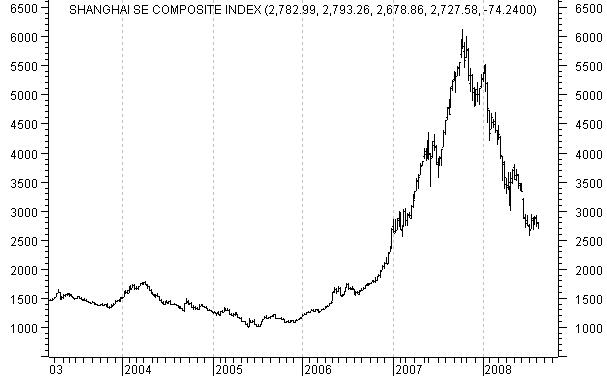
In another example of bubble mania I want to show you a weekly chart of the Shanghai Index. We all know what's been going on in China and the extreme growth that they have experienced over the last few years. As the general population began to hear about China's growth, investors flocked to their stock markets at record pace. I remember being at an investor conference last year and virtually everyone was talking about China. If something was rising, then it was because of China. I knew then that this was a sign of a bubble, especially given the parabolic advance that was underway. But of course, no one could see that because “this time was different” and I pretty well left the subject alone.
I was busy enough trying to convince my subscribers that our own equity markets were still making their 4-year cycle top. Anyway, this time turned out not to be so different after all. From the 2005 low the Shanghai Index advanced from 998.23 into its 2007 peak of 6,124.04, which equates to an advance of 513.49%. This is yet another example of how a parabolic advance unfolds. These moves begin as normal advances out normal cyclical bottoms. But, if an advance is strong enough to begin to attract a lot of attention, then at that point the herds begin to pile on board. It is then this massive inflow of speculation that launches a move into a parabolic state. A parabolic advance will continue as long as there is an inflow of money to keep the move going. But, then at some point the inflow of funds begins to fade and when it does gravity sets in. It is at that point that price begins to soften. As price begins to soften the smarter money begins to exit and prices begin to soften more. In the end all parabolic advances end pretty much the same and the late comers to the party are typically left holding the bag. To date, the Shanghai Index is down some 55 % off of its top.
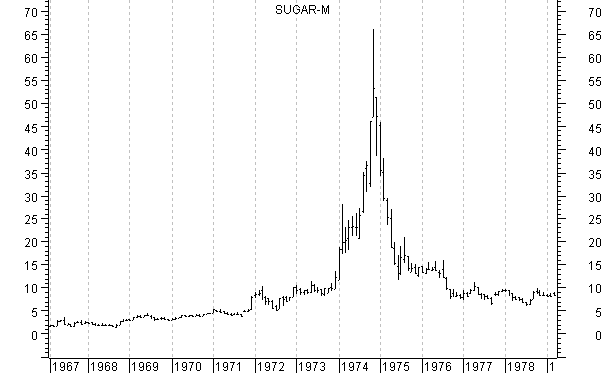
Next I want to show you what may be the biggest bubble of the last 34 years and I bet that only 1 in 1,000 people, or less, even know about it. Below I have included a monthly chart of sugar for the period between 1967 and 1978. At the low in September of 1968 sugar was selling for 1.31 cents per pound. By January 1971 sugar had advanced to 5.32 cents a pound. This was a 306% advance over a 28 month period. By December 1973 sugar prices had advanced to 13.53 per pound, which accounted for a 932.82% advance from the 1968 lows. But, there was still more in this case as this is the point in which the parabolic price spike began and sugar finally peaked at 66 cents a pound in November 1974. This bubble had then advanced 4,938%.
But wait, at the time this was not viewed as a bubble. There were “reasons” to justify such advance. I found an article about the rising sugar prices in the early 1970's and I thought that you might find this quote of interest.
“By the end of 1972, there had been four straight sugar seasons with record crops. Yet consumption actually outpaced supplies in 1972, literally eating into sugar inventories over the next year. The 1973-74 sugar season began with extremely tight supply conditions worldwide; demand continued to rise. ”
“There was evidence that some big industry users were stockpiling sugar in anticipation of higher prices. Soon people were grabbing sugar off the shelves in armloads to offset rising prices. Others were grabbing cubes off restaurant tables for home use. Dinner guests were arriving with five-pound bags of sugar instead of the traditional bottle of wine or bouquet of flowers. Even people who had never given the sugar futures markets a moment's thought knew something was up when they walked into the local coffee shop and noticed that the sugar had vanished from the table. Quite simply, global demand for sugar had exceeded supply, and before long the price of sugar headed for the roof.
“Everyone had a theory for the high prices. Sugar traders had no idea where prices might be when the US's long-standing price supports expired at the end of 1974; some blamed the high prices on a ‘scarcity of cheap labour to harvest sugarcane'; others pointed to the failure of the European sugar-beet crop. Others even suspected that both the Soviet Union, which had just suffered two bad production years in a row in its own sugar crop, and ‘Arab oil money' (remember that oil crisis of the 1970s?) had moved into the sugar futures markets, along with a rise in speculation by others looking to make money from rising prices.”
Guys, does this not sound familiar? Given the short fall of sugar inventories, increasing demand and a growing world of consumers, cheap sugar was a thing of the past. It was a new paradigm. Yes, it was “Peak Sugar” and the world would never be the same again. For the most part if we replace the word sugar with the word oil in the above article it sounds like today. As you can see on this sugar chart, by 1977 sugar had dropped back down to just over 6 cents and by 1985 sugar prices had dropped to 2.3 cents per pound. Sugar has since recovered some, but even in this inflationary cycle sugar is still only trading at 14 cents a pound.
Now I want to show you a weekly chart of crude oil, which can be found below.
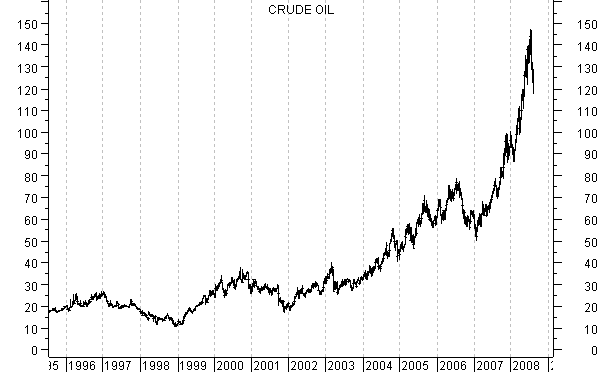
Many of you may not remember, but in December 1998 crude oil touched $10.35 per barrel. I remember buying gasoline in December of 1998 in Texas for 68 cents a gallon. Between 1999 and 2001 there were major longer-term cycles bottoming in most every commodity. As price began to advance out of these naturally occurring cyclical lows no one gave too much thought to them. But, as price began to move up, commodities drew more and more attention. This in turn drove prices higher and higher and higher. Since we moved into 2008 the advance in crude oil become parabolic and has recently hit an all time high of $147.27. As prices advanced, just as with sugar, people began to say that it was for this reason and that. Some say that it's because of the weak dollar. If that's the case then why is it that oil was trading in the 14 to 20 dollar range between 1992 and 1995 when the dollar was trading in the low 80's, which is less than 10% from where it is now?
Others say that it's “Peak Oil.” I'll be honest here. I simply do not buy the argument that Peak Oil is the sole reason oil prices have now advanced 1,281%. Now, this is not to say that long-term supply is not a factor, but in my opinion and based on the data that I have at hand, the real demand for oil has not changed so drastically over the last 9½ years to justify this sort of a move. This advance in oil began like any other advance. Sure, there may be some long-term supply issues just as there was with sugar in the early 1970's. But, as this advance in oil has unfolded, it drew attention because of the stories of Peak Oil and China and so on. As a result, people began to jump on the hottest trend and the normal advance was transformed into a parabolic mania. I wrote about these parabolic moves here in both late June and again in late July.
Since the break down from the July high, crude oil has declined some 20% and in doing so it has become oversold on an intermediate-term basis. This in turn makes conditions ripe for a bounce and a retest of the recent highs. If you will look back at both the Nasdaq and the Shanghai charts, above, you will see that following the initial break out of these parabolic advances there was a bounce and in both cases that bounce failed to take price back above its high. In doing so, a failed rally occurred and it was then, with this next leg down, that the parabolic advance really came unraveled. In the case of sugar, there simply was no bounce. Point being, the current intermediate-term oversold conditions now make a bounce in oil very possible. But, if such a bounce does in fact take root and if it fails to better the July high, then at that time even lower prices should soon follow.
I have begun doing free Friday market commentary that is available at www.cyclesman.com/Articles.htm so please begin joining me there. Should you be interested in more in depth analysis that provides intermediate-term turn points utilizing the Cycle Turn Indicator, which has done a fabulous job, on stock market, the dollar, bonds, gold, silver, oil, gasoline, and more, those details are available in the newsletter and short-term updates. The dollar and commodities are unfolding as expected. The details of these development and future expectations are covering great detail in the monthly newsletter. A subscription includes access to the monthly issues of Cycles News & Views covering the Dow theory, and very detailed statistical based analysis plus updates 3 times a week.
By Tim Wood
Cyclesman.com
© 2008 Cycles News & Views; All Rights Reserved
Tim Wood specialises in Dow Theory and Cycles Analysis - Should you be interested in analysis that provides intermediate-term turn points utilizing the Cycle Turn Indicator as well as coverage on the Dow theory, other price quantification methods and all the statistical data surrounding the 4-year cycle, then please visit www.cyclesman.com for more details. A subscription includes access to the monthly issues of Cycles News & Views covering the stock market, the dollar, bonds and gold. I also cover other areas of interest at important turn points such as gasoline, oil, silver, the XAU and recently I have even covered corn. I also provide updates 3 times a week plus additional weekend updates on the Cycle Turn Indicator on most all areas of concern. I also give specific expectations for turn points of the short, intermediate and longer-term cycles based on historical quantification.
Tim Wood Archive |
© 2005-2022 http://www.MarketOracle.co.uk - The Market Oracle is a FREE Daily Financial Markets Analysis & Forecasting online publication.
