


Gold Bull Market Set to Resume on Strong Fundamentals
Commodities / Gold & Silver Aug 29, 2008 - 01:24 PM GMTBy: Zeal_LLC

 As the precious metals summer doldrums come to a close, we need to assess the damage from another season of gold hatred and disdain. Like déjà vu for veteran gold investors, the mainstream financial media took advantage of gold's seasonal weakness to proclaim the death of the Ancient Metal of Kings.
From a technical perspective gold's summer activity indeed gave the naysayers fodder to jump on the “End of the Gold Bull!” and “Gold's Bubble has Burst!” bandwagons. Gold's $190 plunge from mid-July to mid-August saw it knife through a number of key support levels. This caused blood to flow in the streets even for the gold faithful.
Doldrums is an understatement for the rotten sentiment witnessed in the latter half of this summer. And honestly it is quite shocking to see the fear that $800 gold instills in folks. Investors are quick to forget that gold broke through $800 for the very first time in this bull less than a year ago. And it wasn't until the first day of 2008 that gold reached the $850 level for the first time in 28 years.
From a strategic perspective gold is in fine technical shape. It was just about a year ago that it launched from $650 into one of its most powerful uplegs bull to date that saw it briefly eclipse $1000 in March. And while gold seems to be exhibiting gut-wrenching volatility, it has been consolidating on the high side of this most recent upleg and is likely positioning itself to launch into a glorious new upleg that I suspect will surpass the early-2008 highs.
While technicals are useful and give traders the opportunity to game the interim movements of this yellow metal, it is the core fundamentals that support the secular nature of gold's bull. Gold is a commodity without equal and its myriad of fundamental drivers should continue to support a secular uptrend that is probably only near the halfway mark in duration. This is why after the carnage of summer it is vital to review the fundamentals that will continue to drive gold's bull.
Of course the allure of gold is timeless. All throughout history the beauty, preciousness, and rarity of this metal has made it highly sought after. Gold continues to transcend time and to this day is still considered the ultimate store of wealth for people in every part of the world.
And these traits lead to one of gold's strongest fundamentals, its value as a hedge against wildly inflating fiat currencies. Paper money not backed by gold has and will always fail, as proven throughout history. In fact the first stage of gold's bull was primarily driven by the weakness of the world's reserve currency, the US dollar.
Provocatively gold's all-time nominal high achieved early this year is nowhere near where it needs to be to reach its high measured in constant 2008 dollars. Using the highly-flawed and ultra-conservative US Consumer Price Index we can inflate gold's nominal price history and see that it is actually cheap at today's prices. Gold would have to reach $2400 in order to achieve a real all-time high .
Ultimately currency inflation hedging and storing value are just a couple of gold's many fundamental attributes. At Zeal we have been touting gold's bullish fundamentals since the very beginning of its bull over seven years ago. And I encourage you to peruse our most recent fundamental essay that details the case for a secular gold bull.
But though there are many fundamentals that do support gold going higher, the one that reigns superior is economics. Economics is the most fundamental of fundamentals and its principles are the cornerstone of all market trends.
Supply and demand are of course the key components of economic fundamentals. If demand outpaces supply then prices will naturally rise as relatively more money chases after fewer goods. And inversely if supply outpaces demand prices will fall as relatively less money bids on more abundant goods.
When supply and demand are off kilter, the resulting economic imbalance has a near-term effect on prices that should appropriately adjust demand. Prices will either fall to grow demand or rise to decrease demand. And depending on how wide the gap is between supply and demand, prices can swing wildly in either direction in order to achieve an interim balance.
In gold we have seen these near-term economic trends play out very well. Since 2001 the price of gold has risen fast enough and high enough to quell the demand for jewelry, gold's largest consumption category. According to data provided by the World Gold Council, compiled by GFMS Ltd., the demand for gold jewelry has fallen by 800 metric tons since 2000. While consumption has grown in other categories, this decrease in jewelry demand has for the most part bridged the supply/demand gap, but only temporarily.
In contrast to near-term price trends the long-term result of an imbalance is simply a matter of suppliers adjusting their output to meet demand. And in commodities a material change in output is indeed a long-term endeavor. So with the price of gold on the rise, resulting from supply not meeting demand through the course of this bull, suppliers have been tasked to grow their production of gold.
And in the gold trade the majority of supply comes from good-old-fashioned mining. About 70% of the world's annual gold supply is extracted from the bowels of the earth. So with prices high and demand high, over seven years into this bull the gold miners should be quickly ramping up supply, right? Well looking at the chart below this doesn't appear to be the case.
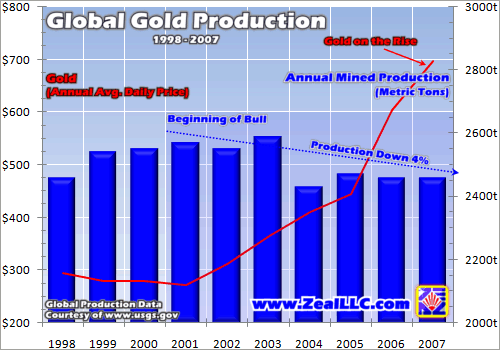
According to data compiled by the US Geological Survey, the mined supply of gold has been trending down since the beginning of this gold bull. This trend is astonishing, and really is counterintuitive to what you think would be happening this far into a secular bull.
Since 2001 the annual average daily price of gold has been trending higher each year, and has averaged an incredible $911 in the first half of 2008. Yet mine production is down! You would think these skyrocketing prices would be all the incentive miners need to ramp up supply and capture legendary profits for their shareholders.
And you don't have to look very far to see that there is a disconnect at the production level. Take the world's top-four primary gold miners for example. Barrick Gold (ABX-NYSE), Newmont Mining (NEM-NYSE), AngloGold Ashanti (AU-NYSE), and Gold Fields (GFI-NYSE) are collectively responsible for over a quarter of the annual mined supply of gold. And astonishingly these senior miners are projecting combined 2008 production to be 4.5m ounces less than what they produced in 2006, an 18% decrease .
To further buttress this disparity, according to GFMS the total supply of gold in 2007 from all sources was down by over 500 metric tons (16m ounces) from just two years prior. Now high gold prices have kept demand in check, thus leading to only a slight supply deficit in 2007, but this lack of production growth from the mining sector presents a serious structural problem.
Decreasing jewelry consumption has indeed allowed the economics of gold to stay relatively balanced in the interim, but this is not a perpetual trend. Gold jewelry consumption is back on the rise from its 2006 low, and will continue to rise as the world accepts higher gold prices. And interestingly this decrease in jewelry consumption has barely balanced growth on the investment front.
According to GFMS, the investment demand for gold has grown by nearly 500 metric tons since 2000. And as this gold bull continues to mature in Stage Two and eventually enters Stage Three, it is investment demand that will lead the charge on the growth front. And the investment demand for gold will be a lot less sensitive to price than any of the other consumption categories.
In the previous essay of this series I presented the case for why global per-capita gold consumption is likely to rise as a result of sharp demand growth from the world's developing nations, particularly the Asian countries that have a cultural affinity for gold investment. If this trend plays out like I believe it will, the mined supply of gold will need to increase by at least 15% over the next 15 or so years.
So for the gold market to have any hope of balancing trade going forward, supply simply must rise. And this increase in supply has to come from the gold miners. The supply dilemma you see in the chart above needs to be confronted and corrected in order for this to happen.
Next week I plan on detailing the challenges that the gold mining industry is facing. There are of course many challenges that result from the economic and socioeconomic issues of today, but we are finding that years of underinvestment in infrastructure and exploration leading into this bull has taken its toll.
Mining in general is a tough business. The time and capital required to bring a mine to life from discovery to commercial production is extensive. And when you throw in scarcity, geopolitics, operating cost inflation, geological problems, labor shortages, and many more factors gold miners are faced with, it is apparent this industry is not for the faint of heart. This ongoing lack of production growth will continue to put a strain on the gold trade.
Shifting gears, a major fundamental factor to consider that feeds into the supply side of economics is longevity via the almighty reserves. Gold reserves are simply defined as a base of gold ore which can be economically extracted at the time of determination.
Reserves are the lifeblood of gold miners, as their operational and financial-market health is defined by these ounces in the ground. And since reserves feed production, miners must continually explore for and discover new reserves to replace those that are depleted.
When analysts and investors look at a mine or a mining company, fundamentals from operations (or projected operations) such as volume, operating costs, and profitability are important, but mining life draws the most attention. Mining life is simply reserves divided by annual production.
If a mine has 1m ounces of gold reserves and is producing 100k ounces of gold each year, it has a mining life of approximately 10 years. Companies can be looked at in the same fashion. Newmont for example has total gold reserves at all of its combined properties of 87m ounces. At a production rate of 5.1m ounces per annum, Newmont has a mining life of 17 years.
Global mining life can also be calculated thanks to reserves and production data provided by the USGS. As you can see in the chart below the USGS estimates that total global gold reserves in 2007 fall in the neighborhood of 42k metric tons (1.35b ounces). With annual mined production around 2500 metric tons (80m ounces), global mining life is about 17 years.
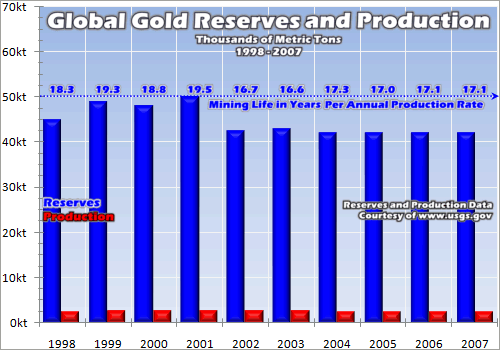
You will find that when you research the gold miners most of the quality companies have mining lives of at least 10 years, with many even over 20 years. And this USGS mining-life estimate is very representative of the average mining lives of those elite gold miners that trade in the HUI and XAU gold-stock indexes.
But there are a couple of things about this chart that I find disturbing. First you can see that a big drop in global reserves occurred in 2002. According to the USGS this resulted from a significant decrease in reserves reported from South Africa , the country that had long been the largest gold producer in the world until recently.
Not only has gold production been declining in South Africa for over 20 years running, a combination of lack of reserve renewal, high operating costs, labor problems, and declining ore grades has this long-standing gold powerhouse struggling to maintain its stature. Apparently in revaluing its assets South Africa came to the conclusion that its gold reserves were not as robust as originally thought.
But it is not this South African drop in reserves that is alarming to me. As you can see mining life has been consistent. But consistent is not good enough for how high gold prices have climbed. Since a reserve is a reserve based on economics, reserves should be growing with the price of gold.
In the simplest of terms, gold is only economical if production costs are less than what it can be sold for on the open markets. For example, back in 2001 when the average gold price was $270, in-ground gold was only a reserve if total operating costs were well under this price. But as prices climb higher, gold that is harder to extract and process, thus more expensive to produce, should become economical.
Before a reserve becomes economical, it resides in the ‘resources' categories. And mining companies sit on a lot of resources in hopes that they become economical one day. At any given time resources are either waiting for the appropriate geological studies to deem them economical or they have failed studies that at the time determined the gold to not be economical.
Interestingly there is in fact a lot of gold in the earth, but much of it does not enjoy favorable-enough geological conditions to mine profitably. It takes a lot of expertise and even some luck to find gold deposits that are economical to mine. But the beautiful thing about mining is every resource has a price tag on it.
So if gold prices go high enough, those resources that are hard to get to or too low-grade, whether at existing mining operations or undeveloped discoveries, will eventually become economical. In going from $250 to $800, there should be a lot more resources that become reserves simply based on economics.
Those gold miners in 2001 sitting on resources that had projected operating costs of say $500, twice the market price, would never have dreamed of bringing a mine into production at the time. But in today's environment, gold extracted at operating costs of $500 would be very profitable. Now granted there does need to be some inflationary adjustments for studies performed back when oil was $20, but operating costs are still not rising proportionately with gold.
So while the mining industry is performing sufficient-enough reserve renewal so that global reserves remain steady, the fact that reserves aren't growing considering the massive increase in gold's price is concerning. And no matter how you look at it, this does not bode well for the future of gold mining.
If you are at all attuned to the gold mining sector in the last couple years, you're familiar with these companies' CEOs' constant grumblings about the existing gold mining environment and how difficult it is to find gold and develop mines these days. But in looking at the lack of global reserve and production growth, this isn't just lip service to explain why they are struggling, this is reality.
It would be interesting to find out what percentage of today's reserve renewal is upgrading already-discovered resources based on rising prices versus fresh new discoveries. I would lean more towards the former as gold discovery, especially large deposits, is just not prevalent these days. The easy gold has been picked over or is unattainable based on factors I'll discuss next week.
Ultimately the trend of declining gold production and the lack of reserve growth is a huge boon for gold's long-term fundamentals. And with the demand for gold expected to rise led by investment demand, the economics alone tell us this gold bull is nowhere near extinct.
After weathering the PM summer doldrums, the smart investors aware of gold's fundamentals know to look past the hype and avoid the capitulation that is inflicting their comrades. Though the word bubble has been loosely tossed around in the same sentence as gold, this commodity is nowhere near bubble status. And when gold does eventually inflate into a bubble, it will be accompanied by uncontrollable greed and a popular mania. Gold has not been popular yet. It is still a contrarian play and should greatly reward those faithful that stick with it.
At Zeal we have been gold bulls since the very beginning of this bull. In our acclaimed monthly newsletter, Zeal Intelligence , we first started recommending gold to our subscribers in May 2001 when it was in the $260s and gold stocks when they were the pariahs of the markets, trading vastly lower than where they are today.
With gold's fundamentals still wildly bullish, we believe this bull has a lot of room left to run. And with gold entering into what is likely a season of strength , we've begun layering in trades to position ourselves for the next upleg. If you are interested in mirroring our trades and/or are looking for cutting-edge commodities markets research and analysis, please subscribe to our newsletter today .
The bottom line is global mined gold production and reserves are not growing as they should be in the face of fast-rising prices. If gold demand continues to rise as expected, the economic fundamentals alone support this gold bull for many more years as suppliers struggle to keep up.
And with these alarming production and reserve trends, it is apparent there is a structural problem in the gold mining industry. The miners are in a constant battle to renew reserves and grow production. And they are failing at this. Next week I'll discuss some of the challenges that the gold mining industry is faced with.
By Scott Wright
So how can you profit from this information? We publish an acclaimed monthly newsletter, Zeal Intelligence , that details exactly what we are doing in terms of actual stock and options trading based on all the lessons we have learned in our market research as well as provides in-depth market analysis and commentary. Please consider joining us each month at … www.zealllc.com/subscribe.htm
Thoughts, comments, or flames? Fire away at scottq@zealllc.com . Depending on the volume of feedback I may not have time to respond personally, but I will read all messages. Thanks!
Copyright 2000 - 2007 Zeal Research ( www.ZealLLC.com )
Zeal_LLC Archive |
© 2005-2022 http://www.MarketOracle.co.uk - The Market Oracle is a FREE Daily Financial Markets Analysis & Forecasting online publication.
