


Lehman's Bankruptcy the Ultimate Wall Street Derivatives Defaults Nightmare
Stock-Markets / Credit Crisis 2008 Sep 15, 2008 - 09:35 AM GMT

 Martin D. Weiss writes: In the wake of Lehman's demise, Fed Chairman Bernanke and Treasury Secretary Paulson will try to put out the word that it's no great trauma.
But it's a lie and they know it. If they openly admitted that the Lehman collapse will paralyze Wall Street, torpedo the stock market and sink the economy, they'd have to pony up $100 billion or more to support it. Instead, their agenda was to push big banks to put up the money. And they failed to do so.
No matter what, there's no denying that the Lehman debacle is a massive and immediate threat to U.S. and global markets. At the latest reckoning, Lehman had $691 billion in assets. That makes it bigger than Wachovia, twice as big as Washington Mutual, and over sixteen times larger than Schwab.
Lehman's debts — at $668.6 billion — are also enormous. Even if you added together all the debts of TD Ameritrade, E-Trade and Schwab, you'd still have only $108.5 billion, or less than one-sixth the total debts which Lehman reports.
In fact, among brokers, there are only two other U.S. firms that beat Lehman in the debt category: Morgan Stanley, with $1 trillion, and Merrill Lynch, with $988 billion.
Can you imagine anyone in his right mind making the argument that a Merrill Lynch downfall would be "no great trauma to investors and financial markets"? Of course not.
The reality: The collapse of America's third-largest brokerage operation is very serious business with equally serious consequences. The primary concern ...
Defaults on Derivatives
We've lost count of how many times the authorities have virtually sworn on a stack of Bibles that "our financial system is fundamentally sound."
But no one could possibly lose count of their recent desperate efforts to prevent the system's collapse — actions which directly belie their words:
One — the coordinated efforts by central banks to flood the global economy with liquidity in the summer of 2007.
Two — the hasty bailout of Bear Stearns in March of this year.
Three — the giant Fannie and Freddie rescue announced just eight days ago.
Each time they intervene, they say "we must not reward CEOs who deceive the public and walk off with multibillion dollar bonus checks." And each time they say it's the "last time we'll make an exception to that rule."
But then they go ahead and do it anyhow, not only breaking their own word ... but also trashing the long tradition of restraint established by their predecessors since the Great Depression.
Why? Because they had neither the courage nor the audacity to confront Wall Street's ultimate nightmare: A collapse in the giant mountain of derivatives.
Derivatives are essentially bets on interest rates, foreign currencies, stocks or specific events like the bankruptcy of a particular company. The interest rate-related bets are by far the biggest. But the bets on bankruptcies — called credit default swaps — are the fastest growing and the most volatile.
These derivatives were originally designed to help hedge investments reduce risk — like insurance policies. But in practice, they've been increasingly used to leverage investments, increasing the risks of participants.
Here are some essential facts that illustrate the enormity of the problem ...
* The amounts are absurdly large. The total "notional," or face value, of derivatives held by U.S. banks is $180 trillion, and it's three times that much globally. This figure is said to overstate the actual market risk. But it does not overstate the risk of defaults such as those that could be triggered by the failure of a company the size of Lehman Brothers.
* Over 90% of all derivatives are traded outside of regulated exchanges. Consequently, other than very general information, the authorities have no mechanism for keeping track — let alone efficiently cleaning up the mess in the wake of a giant failure.
* Off the balance sheets. Some companies report nothing more than the total value of their derivatives in footnotes to their financial statements. Others don't report at all. Consequently, the actual risk, amounts and even the very existence of derivatives is often poorly disclosed to investors.
* Disclosure in the brokerage industry is especially bad. 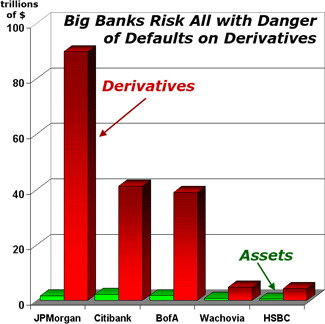 Many brokerages are private and do not disclose more than their rank and serial number. The SEC collects sparse data and does not publish it. So if you want to figure out how much derivates risk your broker is exposed to, good luck! Getting the information can be like pulling teeth.
* Concentrated in the hands of five major players. Nearly 97% of all U.S. bank-held derivatives are concentrated in the hands of just five major U.S. banks — JPMorgan Chase, Citibank, Bank of America, Wachovia and HSBC.
* Far larger than assets. As you can see in the chart to the left, the pile-up of derivatives greatly exceeds the total assets of the firms. At the same time, in most cases, the default risk related to these holdings greatly exceed the banks' capital.
* Big brokers are also loaded with derivatives. Merrill Lynch has $4.2 trillion. Morgan Stanley has $7.1 trillion. As best we can determine, Lehman Brothers has significantly less — $729 billion. But in proportion to its dwindling capital, its exposure seems to be among the worst.
* The capital of major firms has been further weakened by recent losses and the failure to raise enough capital to cover them. The chart below tells the story in a nutshell:
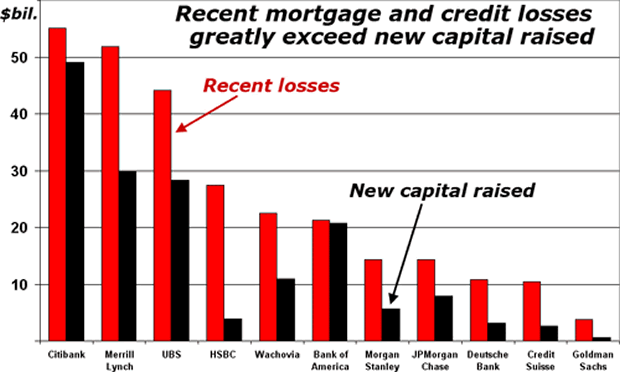
Consistently, in bank after bank, the losses suffered from the mortgage and credit crisis have exceeded the amount of new capital they could raise. This was true when investors still had confidence in their ability to overcome the difficulties. It's even more true today.
Here's the great dilemma: The tangled web of bets and debts linking each of these giant players to the other is so complex and so difficult to unravel, it may be impossible for the Fed to protect the financial system from paralysis if just one major player defaults. And if Lehman is not that player, the next one will be.
To understand why, put yourself in the shoes of a senior derivatives trader at a big firm like Morgan Stanley (which has $7.1 trillion in derivatives on its books and about $10 billion in capital).
Let's say you're personally responsible for $500 billion in derivatives contracts with Bank A, essentially betting that interest rates will decline.
By itself, that would be a huge risk. But you're not worried because you have a similar bet with Bank B that interest rates will go up .
It's like playing roulette, betting on both black and red at the same time. One bet cancels the other, and you figure you can't lose.
Here's what happens next ...
- Interest rates go up, reflecting a 2% decline in bond prices.
- You lose your bet with Bank A.
- But, simultaneously, you win your bet with Bank B.
- So, in normal circumstances, you'd just take the winnings from one to pay off the losses with the other — a non-event.
But here's where the whole scheme blows up and the drama begins: Bank B suffers large mortgage-related losses. It runs out of capital. It can't raise additional capital from investors. So it can't pay off its bet. Suddenly and unexpectedly ...
You're on the hook for your losing bet. But you can't collect on your winning bet.
You grab a calculator to estimate the damage. But you don't need one — 2% of $500 billion is $10 billion. Simple.
Bottom line: In what appeared to be an everyday, supposedly "normal" set of transactions ... in a market that has moved by a meager 2% ... you've just suffered a loss of ten billion dollars, wiping out all of your firm's capital.
Now, you can't pay off your bet with Bank A — or any other losing bet, for that matter.
Bank A, thrown into a similar predicament, defaults on its bets with Bank C, which, in turn, defaults on bets with Bank D. Bank D has bets with you as well ... it defaults on every single one ... and it throws your firm even deeper into the hole.
So now do you understand why bookies belong to the Mafia and why gamblers who welsh on their debts wind up at the bottom of the East River? It's because defaulting gamblers are a grave threat to the entire system, just like Lehman Brothers is today.
Now do you see why the $180 trillion in U.S. derivatives, supposedly overstating the true risk, is actually a lot riskier than almost everyone cares to admit? It's because defaulting banks or brokerage firms are also a grave threat to the entire system.
And now do you understand why Mr. Bernanke and Mr. Paulson are probably bluffing?
Don't let them fool you. The Lehman Brothers debacle is a far greater threat than anyone has dared tell you. And if you haven't done so already, you must take the urgent defensive action we've been recommending day after day, week after week.
All the instructions are in my recent Money and Markets issues .
In a nutshell: Sell all your vulnerable stocks and bonds before it's too late, stashing the proceeds in cash with short-term Treasuries or a Treasury-only money market fund. And to the degree that you're unable to sell, buy inverse ETFs to protect yourself from devastating losses.
Don't wait for the market's reaction to the Lehman collapse. Act now.
Good luck and God bless!
Martin
This investment news is brought to you by Money and Markets . Money and Markets is a free daily investment newsletter from Martin D. Weiss and Weiss Research analysts offering the latest investing news and financial insights for the stock market, including tips and advice on investing in gold, energy and oil. Dr. Weiss is a leader in the fields of investing, interest rates, financial safety and economic forecasting. To view archives or subscribe, visit http://www.moneyandmarkets.com .
Money and Markets Archive |
© 2005-2022 http://www.MarketOracle.co.uk - The Market Oracle is a FREE Daily Financial Markets Analysis & Forecasting online publication.
