
Best of the Week
DEFLATION is Winning! - Watch the Video its FREE
Most Popular of the Week
1.Cap and Trade Bill HR 2454 Will Lead to Capital Flight - Dr_Ron_Paul
2.Goldman Sachs The Fourth Branch of the U.S. Government- Graham_Summers
3.The Coming Economic Apocalypse- Roy_F_Grieder
4.The End of the Recession?- John_Mauldin
5.Bernanke is a Total Failure Unsuited for Role as Fed Chairman- Mike_Shedlock
6.Fed Market Manipulation, Surmounting The Main Threat To Profits And Protection -DeepCaster_LLC
7.China Mega-trend Stocks Stealth Bull Market Update, SSEC Up 47%- Nadeem_Walayat
Weeks Analysis
Current Recession Is a Severe Credit Bust of Depression-Era Magnitude- 4th July 09
"Super Imperialism:" The Economic Strategy of Imperial America- 3rd July 09
The Smart Grid Will Offer Exceptional Investing Opportunities- 3rd July 09
Inflationary Crack-up Boom has Commenced in the G7 Economies!- 3rd July 09
Yen Carry Trade Suggests Global Stock Markets Base Building Underway- 3rd July 09
Silver Stocks and ETF - 3rd July 09
A Message for Armchair Economists- 3rd July 09
The Keynesian System, the Economics of Illusion- 3rd July 09
U.S. Housing Market Recovery Process Outlook- 3rd July 09
Japanese Yen: Resumption of the Bull Market ? - 3rd July 09
What’s Happening in Crude Oil?- 3rd July 09
Temporary Bounce in EUR/GBP Now Possible- 3rd July 09
Silver Response to Inflation and Deflation the United States - 3rd July 09
Economic Recovery Green Shoots Doused with Herbicide- 3rd July 09
U.S. Economy Economic Recovery Achilles Heel- 3rd July 09
U.S. Unemployment Soars Whilst Fed Funnels More Cash to the Banksters- 3rd July 09
Challenges and Enormous Opportunities in Alternative Energy- 3rd July 09
Listen to Citigroup Analysts at Your Own Peril- 3rd July 09
DEFLATION Video Antidote to the Mainstream Inflation Consensus- 3rd July 09
U.S. Economy Heading for Japan of the 1990's or Argentina 2002?- 2nd July 09
Profiting From Stock Market Sector Dead Cat Bounces- 2nd July 09
Basic Financial Markets Analysis Part2- 2nd July 09
U.S. Unemployment Rate Hits 9.5%, Jobs Contract 18th Straight Month- 2nd July 09
In the Future, Interest Rates Will Soar and Consumers Will be Sore Also- 2nd July 09
Preserve Your Wealth with Precious Metals- 2nd July 09
Understanding The Dangers of Leveraged ETFs- 2nd July 09
Stock Market Seasonality What is Going to Happen with the Upcoming July 4th Holiday?- 2nd July 09
China Wants New Global Currency Which is Positive for Gold- 2nd July 09
The DJIA Stock Market Index, Chess and the Idiotic Robots - 2nd July 09
Stock Market and Dollar Upward Wedge Patterns - Signs of the times- 2nd July 09
Stock Markets Jump Out Of The Gate Before Fading- 2nd July 09
Commodities Sector Timing Trading for Gold, Oil, Silver and Natural Gas - 2nd July 09
Asia-Pacific Economies Grow As Developed Economies Wither- 2nd July 09
Million Dollar Question, What's Next for S&P 500 Stock Market Index - 2nd July 09
Will China Lead the World Out of Recession?- 2nd July 09
Make Bernie Madoff the Next Fed Chairman- 2nd July 09
U.S. Treasury Bond Market Update- 2nd July 09
U.S. Housing Market Blast From the Past- 2nd July 09
U.S. Launches Offensive Operations in Cyberspace (CYBERCOM)- 1st July 09
Rising Financial Markets See Brighter Times- 1st July 09
The Magic of the Golden Cross-Over Signal in Gold, Silver and Huey- 1st July 09
Faber & Greenspan: Shills for Fed Snake Oil on Deflation and Hyperinflation- 1st July 09
Walls to Block U.S. Deflation- 1st July 09
Banks Squeeze Credit Card Account Holders- 1st July 09
Is George Soros Long or Wrong on the Global Economic Rebound?- 1st July 09
How to Profit From Japan's Stock Market Shareholder Crisis- 1st July 09
The Case for Economic Depression, Credit Destruction - 1st July 09
Warning of Severe Economic Collapse, Mainstream Media Sustainable Recovery Hype- 1st July 09
Great Banking Confusion - 1st July 09
Stock Market S&P 500 Index Trend Update for July 2009- 1st July 09
Stock Market Ends Second Quarter With a Whimper- 1st July 09
Investment Grade Bonds Return 9.2%, Junk Returns 29%- 1st July 09
The Great Bank Robbery: How the Federal Reserve is destroying Americ- 1st July 09
Is Inflation a Fact… Or Just An Opinion? Part1- 1st July 09
Is America Broke- 1st July 09
U.S. Housing Market Deteriorates as Foreclosures Soar- 1st July 09
Lawrence Roulston: Every Reason in the World to Believe Gold Will Go Higher- 1st July 09
Is the U.S. Fed Juicing the Stock Market?- 30th June 09
Gold Breakout Above $1,000 Only a Question of Time- 30th June 09
U.S. House Prices Have Bottomed - 30th June 09
How to Improve Your FICO Credit Rating Score- 30th June 09
The Case Against Hyper Inflation- 30th June 09
Which Tek Stock is a Better Investment, Apple vs. RIMM - 30th June 09
Obama: Wrong on the Economy, Wrong on Healthcare (Part 1)- 30th June 09
What Happened to the Stock Market New Goldilocks Era?- 30th June 09
Inflationary Pressures and the MAE Faber Investment Strategy- 30th June 09
Goldman Sachs The Fourth Branch of the U.S. Government- 30th June 09
OECD Joins the UK Double Dip Recession Forecast Club- 30th June 09
Summer Sun Shines on Rising UK House Prices in June- 30th June 09
The Real Crisis is Beginning to Unfold… and It’s Not Financial Part2- 30th June 09
A 20-Year Stocks Bear Market?- 30th June 09
Objective Analysis of the Increase in the Fed's Balance Sheet - 29th June 09
Green Shoots Recovery Forex Markets Fatigue & Intermarket Setup- 29th June 09
Government Regulations to Force Agricultural Food Prices Higher- 29th June 09
Power Shortage at the U.S. Fed?- 29th June 09
Crude Oil and Natural Gas Trading- 29th June 09
Stock Market Summer Crash Forecast- 29th June 09
This Summer May Prove Hot for Gold Prices Despite the Weak Seasonal Tendencies- 29th June 09
U.S. Jump in Savings Rates Means Debt Deflation in America- 29th June 09
CNBC Admits to Manipulated Market that Continues To Be Propped Up By Government Intervention - 29th June 09
Important Week Ahead For Economic Data- 29th June 09
Where to Find Jobs in a Jobless Economic Recovery- 29th June 09
Bernanke is a Total Failure Unsuited for Role as Fed Chairman- 29th June 09
Stock Index Trading Signals Update- 29th June 09
Public Sector Pensions Deficit of £1.2 trillion Adds to Britains Debt Crisis- 29th June 09
Energy Fields in Gold and How to Trade Them- 29th June 09
GLD, SLV, USO & UNG ETF Commodity Trading Update- 29th June 09
Manipulated Financial Markets and Mainstream Media- 28th June 09
Ben Bernanke on the Great Depression- 28th June 09
Honest Money Gold & Silver Report - Market Wrap W/E 26th July- 28th June 09
What PIMCO's Bill Gross Doesn’t Want You to Know (Part 2)- 28th June 09
The Coming Economic Apocalypse- 28th June 09
SHEPHERD’S of Financial Markets ILLUSION- 28th June 09
Global Stock Market Performance and P/E Ratio Valuations- 28th June 09
Global Business Sentiment Improves Inline with Stock Market Trends- 28th June 09
The Possibility of Credit Collapse Deflation - 28th June 09
The Inflation Deflation Debate and Myth of the Kondratieff Wave- 28th June 09
China Mega-trend Stocks Stealth Bull Market Update, SSEC Up 47%- 28th June 09
Embrace Deflation - It's The Cure, Not The Problem- 27th June 09
The Stock Markets Repeating Weekly Pattern- 27th June 09
Dow Jones INDU On-Balance-Volume Stock Market Sell Signal - 27th June 09
The End of the Recession?- 27th June 09
Has the Stock Market Peaked for 2009? - 27th June 09
Stock Market Trading Range Continues...Bullish Pattern Holds Potential- 27th June 09
What PIMCO's Bill Gross Doesn’t Want You to Know (Part 1) - 27th June 09
Why Higher Gold Prices Will Come- 27th June 09
A Case For U.S. Treasury Bonds!- 27th June 09
Fed Market Manipulation, Surmounting The Main Threat To Profits And Protection- 27th June 09
How the Media Uses Buffett to Make Money- 27th June 09

Free Instant Analysis

Free Instant Technical Analysis


Market Oracle FREE Newsletter

Most Popular 2009
1. Depression 2009 The Largest Train Wreck in Economic History - Darryl_R_Schoon (41,747)
2.UK Housing Market Crash and Depression Forecast 2007 to 2012 - Nadeem_Walayat (34,233)
3. Emerging Giants Russia, China, Brazil and India Looming Collapse 2009 - Martin Weiss (29,977)
4. Baby Boomers- Your Generation's Crisis Has Arrived - James Quinn (26,442)
5. Ten Major Threats Facing the U.S. Dollar in 2009 - Eric_deCarbonnel (26,023)
6. Nouriel Roubini 2009 U.S. GDP Forecasting 40% Home Mortgage Failures? - Andrew_Butter (24,711)
7. Stock Market Crash 2009: Fine Tuning DJIA Target To 5,800 - Eric_Chevrette (23,492)
8. US, UK, Eurozone Banks Face Collapse: Global Banking System Insolvent - Mike_Shedlock (21,114)
9. UK CPI Inflation, RPI Deflation Forecast 2009 - Nadeem_Walayat (20,821)
10.Gold Price Forecast 2009 - Nadeem_Walayat (20,317)
11. Stock Market Crash Red Alert: Meltdown Imminent! - Martin Weiss (19,648)
12.Fed Manipulating Market Prices, Gold, Oil and Bonds - Rob_Kirby (19,219)
13. The Great Depression has Arrived- Collapsing American Dreams - David_Vaughn (19,054)
14. Stock Market to Fall AT LEAST Another 40%! - Martin Weiss (18,963)
15. Hyperinflation Begining in China and Will Destroy the U.S. Dollar - Eric_deCarbonnel (18,651)
Most Popular 2008
1. The Great Depression 2008 - It can't happen to us....can it?”
2. The Battle for America Has Begun- Strategic Forecasts
3. UK House Prices Plunge Over the Cliff
4. US Banking System Teetering on the Brink of Collapse
5. US Economy Forecast 2008 - First Recession then Recovery
6. How Safe is My FDIC-Insured Bank Account?
7. Rising Risk of a Systemic Financial Meltdown:The 12 Steps to Financial Disaster By Nouriel Roubini
Most Popular 2007
1. US Housing Market Crash to result in the Second Great Depression
2. Operation FALCON - The USA is turning into a Police State
3. UK Housing Market Crash of 2007 - 2008 and Steps to Protect Your Wealth
4. US Housing Bubble Meltdown: "Is it too late to get out"?
5. Global Liquidity Crisis when the Credit Boom comes to an End
Most Popular 2006
1. Last Warning! Three-Pronged Collapse ... Stocks, Bonds and Real Estate
2. UK Interest Rate forecast for 2007 - Bank of England to do battle with inflation
3. UK Interest Rates Forecast to rise much higher due to rising Inflation and high Money Supply Growth
4. Emerging Markets outlook for 2007 - India, China, Russia, Eastern Europe and Brazil

News Feeds
RSS Feeds
Links

Money Forums
Certz
TradingTheCharts
Housing Market Forecasts
Local Issues


Deflation IS WINNING - Are You?

US Housing Market - Only One Sub-prime cockroach?

Housing-Market / US Housing Mar 29, 2007 - 11:24 AM

By: Hans_Wagner

Housing-Market

One of the Trading Rules identified by Dennis Gartman of The Gartman Letter states that there is never only just one cockroach. If you see one, you know more are hiding in the walls and behind the counters. Investors who seek to beat the market should carefully consider this principle when they are considering investments in sectors that are experiencing trouble. They also might want to read Ahead of the Curve: A Commonsense Guide to Forecasting Business and Market Cycles by Joe Ellis is an excellent book on how to predict macro moves of the market.

Well, as I mentioned in earlier commentaries, the problems in the sub-prime mortgage market are going to become more significant over time. Where there is one cockroach, there will be many more. For example, www.lenderimplode.com lists 39 sub-prime mortgage firms that have either shut down or been taken over so far.


New Century Financial, one of the largest sub-prime mortgage lenders, stopped taking new loan applications, and they are no longer continuing the origination or funding of mortgage loans. New Century is experiencing a wave of lenders who are demanding that they take back the mortgages they sold. The market is betting that they will be unable to do so. Nor will they be able to sell any of their current mortgages they originated, as no one would buy them. All lenders that have generated some sub-prime mortgages are facing the same problem. Those with sufficient capital will be able to absorb the losses. Those that are undercapitalized or have much larger exposure to the sub-prime market will likely go under. As a result many of the buyers of the Mortgage Backed Securities are going to lose some money.

As I mentioned before, sub-prime mortgages are pooled and then divided into different risk tranches. The most risky of these tranches are the equity portion of the pools, typically about 4%. These equity portions are again put into pools with 80% of these equity portions now getting investment-grade ratings. It is these pools of mortgage backed securities that are losing money for their investors.

As the problem grows the rating agencies are going to encounter problems due to their failure to properly identify the risks of these securities. Watch out for the lawyers as they make their case.

So how did this happen. Maybe a brief story will help present the case. In the past when many of us obtained our mortgages, we went through what seemed like an exhaustive process providing our lender all our financial details including income, assets, savings, debit history, tax returns etc. All this documentation helped to assure that each of us had the means to afford the payments and were likely to meet our obligations.

Then along came the more aggressive mortgage companies that found they could sell the loans they generated to lenders who packaged them into the Mortgage Backed Securities mentioned earlier. These mortgage firms were able to generate substantial volumes of loans without all the formal documentation that characterized earlier mortgage applications. With the low rates provided by the Federal Reserve it was easy to get borrowers to commit to loans they may not be able to afford.

Let's look at a hypothetical, example that is based on facts from real circumstances. John worked as a laborer making about $30,000 per year and he was current on his payments on his two credit cards with limits of $2,000 and $4,000. He bought a new house in 2005 for $400,000 with the builder picking up the closing costs. He found a mortgage company that offered to help him buy his first home with no money down and an 80/20 loan. This means that he did not have to pay any money into his first house. Further, he does not have to pay PMI or mortgage insurance. John pays on the 80% first loan, meaning he is not paying down the mortgage, but rather increasing his debt. The negative amortization loan helps him afford the payments. 

So after a couple of years John owes more than $420,000 on his house. He also realizes that he has overpaid for the house and it hasn't appreciated in value like he thought. In fact he probably owes more than $100,000 than the house is worth. There are also a number of other houses for sale in his neighborhood all for sale at much less than he owes on his mortgage. 

So what are John's options? He can try to refinance, but with the tighter mortgage requirements now, he cannot get a loan. He cannot keep up with the payments, so that won't work. If he can sell the house, he will owe the difference between what he gets from the sale and his outstanding mortgage, leaving him still in debt. That one is hard to take for a first time home buyer. Or he can walk away and let the house go into foreclosure. Those holding the mortgage will then lose money. Likely they will also look for ways to recover their investment by hiring a lawyer. Not a good situation for anyone, except maybe the lawyers. Oh, and John no longer owns a home and is facing bankruptcy.

Recently a special committee to the Federal Reserve warned to expect a rise in the number of foreclosures. In fact sub-prime mortgages represent about 20% of the total market with more than 50% of these loans ending up in foreclosure. Expect the trend to continue to rise.

This problem is expanding into the prime mortgage market as well. Hugh Moore of Guerite Research uses what he calls Prime Mortgage Home Equity Withdrawals (PMHEW):

"Based on data from FHLMC (Freddie Mac), PMHEW grew from an average 0.55% of GDP between 1993 and 2000 to an average 1.93% between 2001 and 2006. It reached an astonishing 2.93% of GDP in the second quarter of 2006. However, Freddie Mac is projecting that PMHEW will decline 20% in 2007 and an additional 30% in 2008; 43% below 2006 levels. Such a drop could reduce GDP by 1% to 2% over a two-year period of time. The decline in PMHEW is due to the fact that the mortgages most likely to be refinanced in 2007, 2008 (and 2009) were originated in 2004 and 2005 and housing prices have appreciated little since then. In short, those homeowners most likely to refinance are running out of excess equity."

The chart below shows that Freddie Mac expects PMHEW to drop by more than 50%. Keep in mind that this is based on current housing valuations.
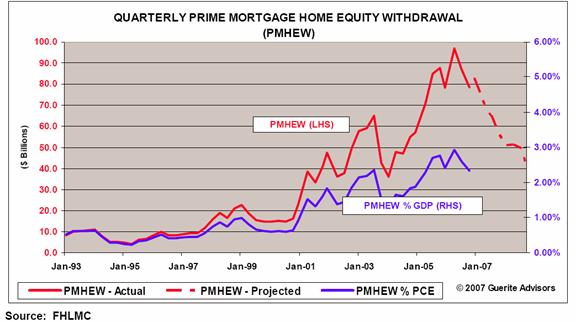
The bottom line is that consumers are going to have less to spend, causing further downward pressure on the U.S. economy. Will this cause the U.S. to go into a recession? Only time will tell. This situation should put upward pressure on long term rates as funding institutions tighten up their credit standards and borrowing criteria. It is also likely to help slow the economy as new home construction slows due to the growing inventory of new and existing homes for sale. There will also be pressure from Congress to do something about this terrible situation. This means the market will be closely watching the housing numbers over the next few weeks to see if the problem is getting worse. Something we all must monitor.

By Hans Wagner
tradingonlinemarkets.com

My Name is Hans Wagner and as a long time investor, I was fortunate to retire at 55. I believe you can employ simple investment principles to find and evaluate companies before committing one's hard earned money. Recently, after my children and their friends graduated from college, I found my self helping them to learn about the stock market and investing in stocks. As a result I created a website that provides a growing set of information on many investing topics along with sample portfolios that consistently beat the market at http://www.tradingonlinemarkets.com/


Comments


Post Comment (Moderated)


(Note: If on Submitting you are returned to the Main Index Page then due to caching your comment has not been accepted, Press refresh and try again)

Free Credit Crisis Survival Toolkit
