


End of the Financial World- LIBOR TED Spread Flashes Trouble
Stock-Markets / Credit Crisis Bailouts Sep 27, 2008 - 03:57 AM GMTBy: John_Mauldin


- Who's Afraid of a Big, Bad Bailout?
- It's the End of the World As We Know It
- The TED Spread Flashes Trouble
- The Transmission Mechanism
- Let's Make a Deal
Flying last Tuesday, overnight from Cape Town in South Africa to London, I read in the Financial Times that Republican Congressman Joe Barton of Texas was quoted as saying (this is from memory, so it is not exact) that he had difficulty voting for a bailout plan when none of his constituents could understand the need to bail out Wall Street, didn't understand the problem, and were against spending $700 billion of taxpayer money to solve a crisis for a bunch of (rich) people who took a lot of risk and created the crisis. That is a sentiment that many of the Republican members of the House share.
As it happens, I know Joe. My office is in his congressional district. I sat on the Executive Committee for the Texas Republican Party representing much of the same district for eight years. This week, Thoughts from the Frontline will be an open letter to Joe, and through him to Congress, telling him what the real financial problem is and how it affects his district, helping explain the problem to his constituents , and explaining why he has to hold his nose with one hand and vote for a bailout with the other.
Just for the record, Joe has been in Congress for 24 years. He is the ranking Republican on the Energy and Commerce Committee, which is one of the three most important committees and is usually considered in the top five of Republican House leadership. He is quite conservative and has been a very good and effective congressman. I have known Joe for a long time and consider him a friend. He has been my Congressman at times, depending on where they draw the line. I called his senior aide and asked him how the phone calls were going. It is at least ten to one against supporting this bill, and that is probably typical of the phones all across this country. People are angry, and with real justification. And watching the debates, it reminds us that one should never look at how sausages and laws are made. It is a very messy process.
I think what follows is as good a way as any to explain the crisis we are facing this weekend. This letter will print out a little longer, because there are a lot of charts, but the word length is about the same. Let's jump right in.
It's the End of the World As We Know It
Dear Joe,
I understand your reluctance to vote for a bill that 90% of the people who voted for you are against. That is generally not good politics. They don't understand why taxpayers should spend $700 billion to bail out rich guys on Wall Street who are now in trouble. And if I only got my information from local papers and news sources, I would probably agree. But the media (apart from CNBC) has simply not gotten this story right. It is not just a crisis on Wall Street . Left unchecked, this will morph within a few weeks to a crisis on Main Street . What I want to do is describe the nature of the crisis, how this problem will come home to your district, and what has to be done to avert a true, full-blown depression, where the ultimate cost will be far higher to the taxpayers than $700 billion. And let me say that my mail is not running at 10 to 1 against, but it is really high. I am probably going to make a lot of my regular readers mad, but they need to hear what is really happening on the front lines of the financial world.
First, let's stop calling this a bailout plan. It is not. It is an economic stabilization plan. Run properly, it might even make the taxpayers some money. If it is not enacted very soon (Monday would be fine), the losses to businesses and investors and homeowners all over the US (and the world) will be enormous. Unemployment will jump to rates approaching 10%, at a minimum. How did all this come to pass? Why is it so dire? Let's rewind the tape a bit.
We all know about the subprime crisis. That's part of the problem, as banks and institutions are now having to write off a lot of bad loans. The second part of the problem is a little more complex. Because we were running a huge trade deficit, countries all over the world were selling us goods and taking our dollars. They in turn invested those excess dollars in US bonds, helping to drive down interest rates. It became easy to borrow money at low rates. Banks, and what Paul McCulley properly called the Shadow Banking System, used that ability to borrow and dramatically leverage up those bad loans (when everyone thought they were good), as it seemed like easy money. They created off-balance-sheet vehicles called Structured Investment Vehicles (SIVs) and put loans and other debt into them. They then borrowed money on the short-term commercial paper market to fund the SIVs and made as profit the difference between the low short-term rates of commercial paper and the higher long-term rates on the loans in the SIV. And if a little leverage was good, why not use a lot of leverage and make even more money? Everyone knew these were AAA-rated securities.
And then the music stopped. It became evident that some of these SIVs contained subprime debt and other risky loans. Investors stopped buying the commercial paper of these SIVs. Large banks were basically forced to take the loans and other debt in the SIVs back onto their balance sheets last summer as the credit crisis started. Because of a new accounting rule (called FASB 157), banks had to mark their illiquid investments to the most recent market price of a similar security that actually had a trade. Over $500 billion has been written off so far, with credible estimates that there might be another $500 billion to go. That means these large banks have to get more capital, and it also means they have less to lend. (More on the nature of these investments in a few paragraphs.)
Banks can lend to consumers and investors about 12 times their capital base. If they have to write off 20% of their capital because of losses, that means they either have to sell more equity or reduce their loan portfolios. As an example, for every $1,000 of capital, a bank can loan $12,000 (more or less). If they have to write off 20% ($200), they either have to sell stock to raise their capital back to $1,000 or reduce their loan portfolio by $2,400. Add some zeroes to that number and it gets to be huge.
And that is what is happening. At first, banks were able to raise new capital. But now, many banks are finding it very difficult to raise money, and that means they have to reduce their loan portfolios. We'll come back to this later. But now, let's look at what is happening today. Basically, the credit markets have stopped functioning. Because banks and investors and institutions are having to deleverage, that means they need to sell assets at whatever prices they can get in order to create capital to keep their loan-to-capital ratios within the regulatory limits.
Remember, part of this started when banks and investors and funds used leverage (borrowed money) to buy more assets. Now, the opposite is happening. They are having to sell assets into a market that does not have the ability to borrow money to buy them. And because the regulators require them to sell whatever they can, the prices for some of these assets are ridiculously low. Let me offer a few examples.
Today, there are many municipal bonds that were originally sold to expire 10-15 years from now. But projects finished early and the issuers wanted to pay them off. However, the bonds often have a minimum time before they can be called. So, issuers simply buy US Treasuries and put them into the bond, to be used when the bond can be called. Now, for all intents and purposes this is a US government bond which has the added value of being tax-free. I had a friend, John Woolway, send me some of the bid and ask prices for these type of bonds. One is paying two times what a normal US Treasury would pay. Another is paying 291% of a normal US Treasury. And it is tax-free! Why would anyone sell what is essentially a US treasury bond for a discount? Because they are being forced to sell, and no one is buying! The credit markets are frozen.
Last week, I wrote about a formerly AAA-rated residential mortgage-backed security (RMBS) composed of Alt-A loans, better than subprime but less than prime. About 5% of the loans were delinquent, and there are no high-risk option ARMs in the security. It is offered at 70 cents on the dollar. If you bought that security, you would be making well over 12% on your money, and 76% of the loans in the portfolio of that security would have to default and lose over 50% of their value before you would risk even one penny. Yet the bank which is being forced to sell that loan has had to write down its value. As I wrote then, that is pricing in financial Armageddon. (You can read the full details here .)
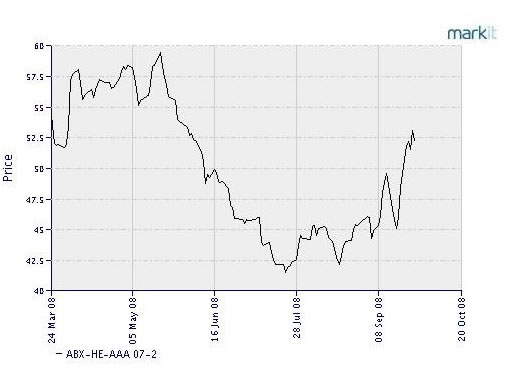
Let's look at the following graph. It is an index of AAA-rated mortgage bonds, created by www.markit.com . It is composed of RMBSs similar to the one I described above. Institutions buy and sell this index as a way to hedge their portfolios. It is also a convenient way for an accounting firm to get a price for a mortgage-backed security in a client bank's portfolio. With the introduction of the new FASB 157 accounting rule, accountants are very aggressive about making banks mark their debt down, as they do not want to be sued if there is a problem. Notice this index shows that bonds that were initially AAA are now trading at 53 cents on the dollar, which is up from 42.5 cents two months ago.
Accountants might look at the bond I described above, look at this index, and decide to tell their clients to mark the bonds down to $.53 on the dollar. The bank is offering the bond at $.70 because it knows there is quality in the security. They are being forced to sell. And guess what? There are no buyers. An almost slam-dunk 12% total-return security with loss-coverage provisions that suggest 40% of the loans could default and lose 50% before your interest rate yields even suffered, let alone risk to your principal – and it can't find a buyer.
One of the real reasons these and thousands of other good bonds are not selling now is that there is real panic in the markets. The oldest money market fund "broke the buck" last week, because they had exposure to Lehman Brothers bonds. We are seeing massive flights of capital from money market funds, including by large institutions concerned about their capital. What are they buying? Short-term Treasury bills. Three-month Treasury bills are down to 0.84%.
It gets worse. Last week one-month Treasury bills were paying a negative 1%!!! That means some buyers were so panicked that they were willing to buy a bond for $1 that promised to pay them back only $.99 in just one month. The rate is at 0.16% today. If something is not done this weekend, it could go a lot lower over the next few days. That is panic, Joe.
I don't want to name names, as this letter goes to about 1.5 million people and I don't want to make problems for some fine banking names; but there is a silent bank run going on. There are no lines in the street, but it is a run nevertheless. It is large investment funds and corporations quietly pulling their money from some of the best banks in the country. They can do this simply by pushing a button. We are watching deposit bases fall. It does not take long. Lehman saw $400 billion go in just a few months this summer. Think about that number. Any whiff of a problem and an institution that is otherwise sound could be brought low in a matter of weeks. And the FDIC could end up with a large loss that seemed to have come from out of nowhere.
The TED Spread Flashes Trouble
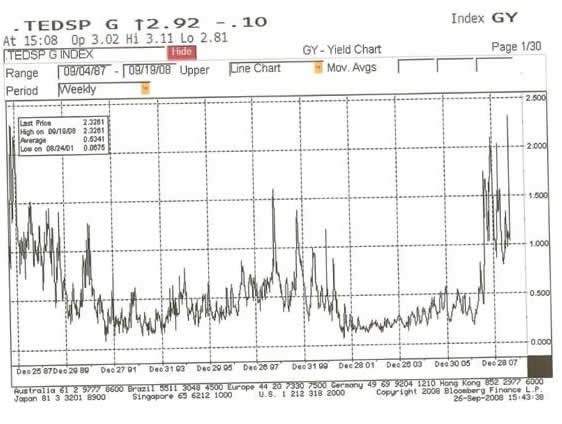
There is something called the TED spread, which is the difference between three-month LIBOR (the London Inter Bank Offered Rate which is in euro dollars, also called The Euro Dollar Spread, thus TED) and three-month US Treasury bills. Three-month LIBOR is basically what banks charge each other to borrow money. Many mortgages and investments are based on various periods of LIBOR. Look at the chart below. Typically the TED spread is 50 basis points (0.50%) or less. When it spikes up, it is evidence of distress in the financial markets. The last time the TED spread was as high as it is now was right before the market crash of 1987. This is a weekly chart, which does not capture tonight's (Friday) change, which would make it look even worse. Quite literally, the TED spread is screaming panic.
The Fed has lowered rates to 2%. Typically, three-month LIBOR tracks pretty close to whatever the Fed funds rate is. Starting with the credit crisis last year, that began to change. Look at the chart below.
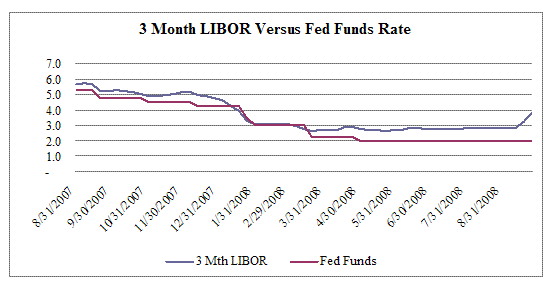
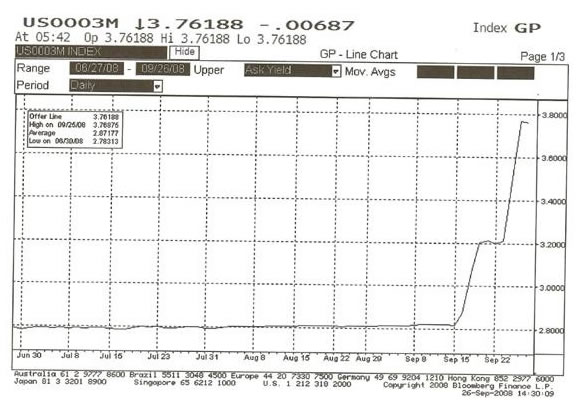
Remember, LIBOR is what banks charge to each other to make loans. Lower rates are supposed to help banks improve their capital and their ability to make loans at lower interest rates to businesses and consumers. Look at what has happened in the past few weeks, in the chart above. The spread between three-month LIBOR and the Fed funds rate is almost 200 basis points, or 2%! That is something that defies imagination to market observers. On the chart above, it looks like it has not moved that much, but in the trading desks of banks all over the world it is a heart-pounding, scare-you-to-death move. The chart below reflects what traders have seen in the past two weeks, and it moved up more today.
Now let's look at the next chart. This is the amount of Tier 1 commercial paper issued. This is the life blood of the business world. This is how many large and medium-sized businesses finance their day-to-day operations. The total amount of commercial paper issued is down about 15% from a year ago, with half of that drop coming in the last few weeks. Quite literally, the economic body is hemorrhaging. Unless something is done, businesses all over the US are going to wake up in a few weeks and find they simply cannot transact business as usual. This is going to put a real crimp in all sorts of business we think of as being very far from Wall Street.
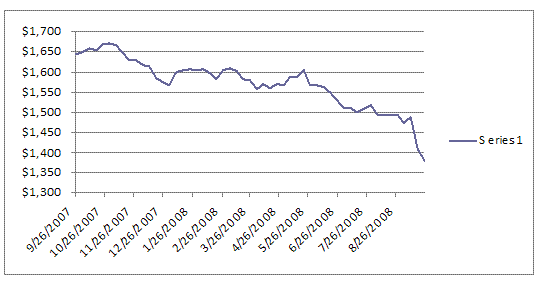
I could go on. Credit spreads on high-yield bonds that many of our best high-growth businesses use to finance their growth are blowing out to levels which make it impossible for the companies to come to the market for new funds. And that is even if they could find investors in this market! There are lots of other examples (solid corporate loans selling at big discounts, asset-backed securities at discounts, etc.), but you get the idea. Suffice it to say that the current climate in the financial market is the worst since the 1930s. But how does a crisis in the financial markets affect businesses and families in Arlington, Texas, where my office and half of your district is?
The Transmission Mechanism
The transmission in a car takes energy from the engine and transfers it to the wheels. Let's talk about how the transmission mechanism of the economy works.
Let's start with our friend Dave Moritz down the street. He needs financing to be able to sell an automobile. To get those loans at good prices, an auto maker has to be able to borrow money and make the loans to Dave's customers. But if something does not stop the bleeding, it is going to get very expensive for GM to get money to make loans. That will make his cars more expensive to consumers. Cheap loans with small down payments are the life blood of the auto selling business. That is going to change dramatically unless something is done to stabilize the markets.
Credit card debt is typically packaged and sold to investors like pension funds and insurance companies. But in today's environment, that credit card debt is going to have to pay a much higher price in order to find a buyer. That means higher interest rates. Further, because most of the large issuers of credit cards are struggling with their leverage, they are reducing the amount of credit card debt they will give their card holders. If they continue to have to write down mortgages on their books because of mark-to-market rules which price assets at the last fire-sale price, it will mean even more shrinkage in available credit.
Try and sell a home above the loan limits of Fannie and Freddie today with a nonconforming jumbo loan. Try and find one that does not have very high rates, because many lenders who normally do them simply cannot afford to keep them on their balance sheets. And a subprime mortgage? Forget about it. This is going to get even worse if the financial markets melt down.
We are in a recession. Unemployment is going to rise to well over 6%. Consumer spending is going to slow. This is an environment which normally means it is tougher for small businesses and consumers to get financing in any event. Congress or the Fed cannot repeal the business cycle. There are always going to be recessions. And we always get through them, because we have a dynamic economy that figures out how to get things moving again.
Recessions are part of the normal business cycle. But it takes a major policy mistake by Congress or the Fed to create a depression. Allowing the credit markets to freeze would count as a major policy mistake.
I have been on record for some time that the economy will go through a normal recession and a slow recovery, what I call a Muddle Through Economy. This week I met with executives of one of the larger hedge funds in the world. They challenged me on my Muddle Through stance. And I had to admit that my Muddle Through scenario is at risk if Congress does not act to stabilize the credit markets.
Let's Make a Deal
Why do we need this Stabilization Plan? Why can't the regular capital markets handle it? The reason is that the problem is simply too big for the market to deal with. It requires massive amounts of patient, long-term money to solve the problem. And the only source for that would be the US government.
There is no reason for the taxpayer to lose money. Warren Buffett, Bill Gross of PIMCO, and my friend Andy Kessler have all said this could be done without the taxpayer losing money, and perhaps could even make a profit. As noted above, these bonds could be bought at market prices that would actually make a long-term buyer a profit. Put someone like Bill Gross in charge and let him make sure the taxpayers are buying value. This would re-liquefy the banks and help get their capital ratios back in line.
Why are banks not lending to each other? Because they don't know what kind of assets are on each other's books. There is simply no trust. The Fed has had to step in and loan out hundreds of billions of dollars in order to keep the financial markets from collapsing. If you allow the banks to sell their impaired assets at a market-clearing fair price (not at the original price), then once the landscape is cleared, banks will decide they can start trusting each other. The commercial paper market will come back. Credit spreads will come down. Banks will be able to stabilize their loan portfolios and start lending again.
Again, the US government is the only entity with enough size and patience to act. We do not have to bail out Wall Street. They will still take large losses on their securities, just not as large a loss as they are now facing in a credit market that is frozen. As noted above, there are many securities that are being marked down and sold far below a rational price.
If we act now, we will start to see securitization of mortgages, credit cards, auto loans, and business loans so that the economy can begin to function properly.
What happens if we walk away? Within a few weeks at most, financial markets will freeze even more. We will see electronic runs on major banks, and the FDIC will have more problems than you can possibly imagine. The TED spread and LIBOR will get much worse. Businesses which use the short-term commercial paper markets will start having problems rolling over their paper, forcing them to make difficult cuts in spending and employment. Larger businesses will find it more difficult to get loans and credit. That will have effects on down the economic food chain. Jim Cramer estimated today that without a plan of some type, we could see the Dow drop to 8300. That is as good a guess as any. It could be worse. Home valuations and sales will drop even further.
The average voter? They will see stock market investments off another 25% at the least. Home prices will go down even more. Consumer spending will drop. What should be a run-of-the-mill recession becomes a deep recession or soft depression. Yes, that may be worst-case scenario. But that is the risk I think we take with inaction.
A properly constructed Stabilization Plan hopefully avoids the worst-case scenario. It should ultimately not cost the taxpayer much, and maybe even return a profit. The AIG rescue that Paulson arranged is an example of how to do it right. My bet is that the taxpayer is going to make a real profit on this deal. We got 80% of AIG, with what is now a loan paying the taxpayer over 12%, plus almost $2 billion in upfront fees for doing the loan. That is not a bailout. That is a business deal that sounds like it was done by Mack the Knife.
This deal needs to be done by Monday. Every day we wait will see more and more money fly out the doors of the banks, putting the FDIC at ever greater risk. Panic will start to set in, moving to ever smaller banks. Frankly, we are at the point where we need to consider raising the FDIC limits for all deposits for a period of time, until the Stabilization Plan quells the panic.
I understand that this is a really, really bad idea according classical free-market economic theory. You know me; I am as free market as it comes. But I also know that without immediate action a lot of people are really going to be hurt. Unemployment is not a good thing. Losses on your home and investments hurt. It is all nice and well to talk about theories and contend the market should be allowed to sort itself out; and if we have a deep recession, then that is what is needed. But the risk we take is not a deep recession but a soft depression. The consequences of inaction are simply unthinkable.
Joe, I am telling you that the markets are screaming panic. Yes, Senator Richard Shelby has his 200 economists saying this is a bad deal. But they are ivory tower kibitzers who have never sat at a trading desk. They have never tried to put a loan deal together or had to worry about commercial paper markets collapsing. I am talking daily with the people on the desks who are seeing what is really happening. Shelby's economists are armchair generals far from the front lines. I am talking to the foot soldiers who are on the front lines.
Every sign of potential disaster is there. You and the rest of the House have to act. It has to be bipartisan. This should not be about politics (even though Barney Frank keeps talking bipartisan and then taking partisan shots, but I guess he just can't help himself). It should be about doing the right thing for our country and the world. I know it will not be fun coming back to the district. Talking about TED spreads and LIBOR will not do much to assuage voters who are angry. But it is the right thing to do. And I will be glad to come to the town hall meeting with you and help if you like.
With your help, we will get through this. In a few years, things will be back to normal and we can all have stories to tell to our grandkids about how we lived through interesting times. But right now we have to act.
Colorado, California, London, and Sweden
It is time to hit the send button. This was personally a great week. For whatever reason, I did not suffer jet lag flying to South Africa for just two days, then overnight to London, and back the next day. It was a good trip. I will report more about South Africa in a later letter, but this e-letter is already a little long.
I leave Sunday for a quick trip to Longmont, Colorado (near Boulder) to look at a very interesting technology company (InPhase) that makes holographic memory disks, with good friend Dr. Bart Stuck of Signal Lake Partners.
I will be in San Diego and Orange County the 16 th and 17 th of October for back-to-back speeches, then I leave Sunday for London for two days and then on to Sweden for a conference and speeches there, a quick trip to Malta, and then back home, where I will be chained to my desk by daughter Tiffani as we do interviews and write a book.
I do enjoy traveling from time to time, seeing the rest of the world. One of my secret pleasures is reading International Living and thinking about what it would be like to have another home somewhere. Cheap thrills. You can subscribe if you like by following this link.
Have a great week. I fully believe (OK, deeply hope) that Congress will act. We can all breathe a collective sigh when they do.
Your still believing in Muddle Through analyst,
By John Mauldin
John Mauldin, Best-Selling author and recognized financial expert, is also editor of the free Thoughts From the Frontline that goes to over 1 million readers each week. For more information on John or his FREE weekly economic letter go to: http://www.frontlinethoughts.com/learnmore
To subscribe to John Mauldin's E-Letter please click here:http://www.frontlinethoughts.com/subscribe.asp
Copyright 2008 John Mauldin. All Rights Reserved
John Mauldin is president of Millennium Wave Advisors, LLC, a registered investment advisor. All material presented herein is believed to be reliable but we cannot attest to its accuracy. Investment recommendations may change and readers are urged to check with their investment counselors before making any investment decisions. Opinions expressed in these reports may change without prior notice. John Mauldin and/or the staff at Millennium Wave Advisors, LLC may or may not have investments in any funds cited above. Mauldin can be reached at 800-829-7273.
Disclaimer PAST RESULTS ARE NOT INDICATIVE OF FUTURE RESULTS. THERE IS RISK OF LOSS AS WELL AS THE OPPORTUNITY FOR GAIN WHEN INVESTING IN MANAGED FUNDS. WHEN CONSIDERING ALTERNATIVE INVESTMENTS, INCLUDING HEDGE FUNDS, YOU SHOULD CONSIDER VARIOUS RISKS INCLUDING THE FACT THAT SOME PRODUCTS: OFTEN ENGAGE IN LEVERAGING AND OTHER SPECULATIVE INVESTMENT PRACTICES THAT MAY INCREASE THE RISK OF INVESTMENT LOSS, CAN BE ILLIQUID, ARE NOT REQUIRED TO PROVIDE PERIODIC PRICING OR VALUATION INFORMATION TO INVESTORS, MAY INVOLVE COMPLEX TAX STRUCTURES AND DELAYS IN DISTRIBUTING IMPORTANT TAX INFORMATION, ARE NOT SUBJECT TO THE SAME REGULATORY REQUIREMENTS AS MUTUAL FUNDS, OFTEN CHARGE HIGH FEES, AND IN MANY CASES THE UNDERLYING INVESTMENTS ARE NOT TRANSPARENT AND ARE KNOWN ONLY TO THE INVESTMENT MANAGER.
John Mauldin Archive |
© 2005-2022 http://www.MarketOracle.co.uk - The Market Oracle is a FREE Daily Financial Markets Analysis & Forecasting online publication.
