


Current Economic Crisis Worse than the Great Depression
Economics / Economic Depression Nov 02, 2008 - 08:08 PM GMT

 The mainstream media and Wall Street have reached the consensus that the current credit crisis is the worst since the post-war period. George Soros' statement that ”the world faces the worst finance crisis since WWII” epitomizes the collective wisdom. The crisis is currently the ultimate scapegoat for all the economic evils that currently plague the global financial system and the global economy – from collapsing stock markets of the world to food shortages in third world counties. We are repeatedly assured that the ultimate fault lies with the Credit Crisis itself; if there were no Credit Crisis, all of these terrible things would never have happened in the economy and the financial markets.
The most extraordinary thing is that the mainstream media has never attempted to compare the current economic environment to the one preceding the Great Depression. In essence, it is assumed outright that the Great Depression can never possibly happen again, ever, thus obviating the need for such a comparison. I actually believe that the macroeconomic fundamentals today are much worse, so that we are in for a protracted period of economic depression – a depression much worse than the Great Depression, a depression that would likely be remembered in history as “The Second Great Depression” or The Greater Depression , as Doug Casey has called it so aptly. Here is why I believe that this is the case.
Duplicating Mistakes from the Great Depression
At its core, the environment of the 1990s, and the response of the Fed to the tech-telecom bust has created an economic environment that has encouraged the repetition of the very same mistakes that led to the Great Depression. Here is a concise summary of widely recognized mistakes of the 1920s, without going into the details, with obvious parallels in the current environment:
- Asset Bubbles – first in the stock market during the 1990s, then in real estate during the 2000s, pretty much mirroring the stock and real estate market bubbles of the 1920s.
- Securitization – although not in the very “ultra-modernistic” form and shape of the 2000s, with slicing and dicing of pools and tranches of seniority, it was widely recognized in the 1930s that securitization during the 20s drove the domino effect in the U.S. financial system during the Great Depression.
- Excessive Leverage – just like in 2008 the topic du jour is “deleveraging”, so the unwinding of leverage during the 1930s was the driver of forced liquidations and financial pain. Of course, it was very clear back then that the root of the problem was not deleveraging per se, but the excessive leverage that took place prior to the deleveraging process. “Investment Pools” were then instrumental in both the securitization and excessive leverage, just like the Hedge Funds of today.
- Corrupt Gatekeepers – we know well that the Enrons and Worldcoms were aided and abetted by the accounting firms – those same firms that were supposedly the Gatekeepers of the financial community, yet handsomely profited from the boom while neglecting their watchdog functions. In the current financial crisis, we also know that the rating agencies were also making hay during the boom. Very similar were the issues during the 1920s that led to the establishment of the SEC and other regulatory bodies to replace the malfunctioning “gatekeepers” at the time.
- Financial Engineering – we are led to believe that financial engineering is a rather recent phenomenon that flourished during the New Age Finance Era of the last 15 years, yet financial engineering was prevalent in the 1920s with very clear goals: (1) to evade restrictive regulations, (2) to increase leverage, and (3) to remove liabilities from the books, all too familiar to all of us today.
- Lagging Regulations – just like the regulatory environment lagged the events of the 1920s and regulations were introduced only after the Great Depression had obliterated the U.S. financial system, so we are yet to see new regulations addressing the causes of the current crisis. Understandably, regulations should have foreseen today's financial problems and should have been introduced before the crisis.
- Market Ideology – back in the 1920s, just like in the last two decades, the market ideology of “laissez faire”, which Soros quite appropriately described as “Market Fundamentalism”, has swept the financial markets. Of course, the free market knows the best, but the reality is that the money market is not really free – when the Fed determines the cost of money (interest rates), and can fix this cost for as long as it wants, then all sorts of financial imbalances can be sustained without the discipline imposed by the market. This can lead to all sorts of problems that we actually have to face today.
- Non-Transparency – back in the 1930s, it was widely recognized that businesses and especially financial institutions lacked transparency, which allowed for the accumulation of significant imbalances and abuses. Today, financial markets and institutions have intentionally compromised transparency in a number of ingenious, or better disingenuous, accounting trickeries and financial gimmicks, like off-balance-sheet entities (SIVs), hard-to-understand derivatives, and opaque instruments with mind-boggling complexity. Today CEOs and Chief Risk Officers of major financial institutions cannot figure out their own risk exposures. Originally, lack of transparency was designed to fool the markets; ironically, modern-day financial executives have gotten to the point of fooling themselves.
Worse than the Great Depression
So, why Worse Than The Great Depression ? What makes me believe that the current depression will be worse than the Great Depression? I present six of the most important fundamentals that are “baked in the cake” and that suggest of a Greater Depression .
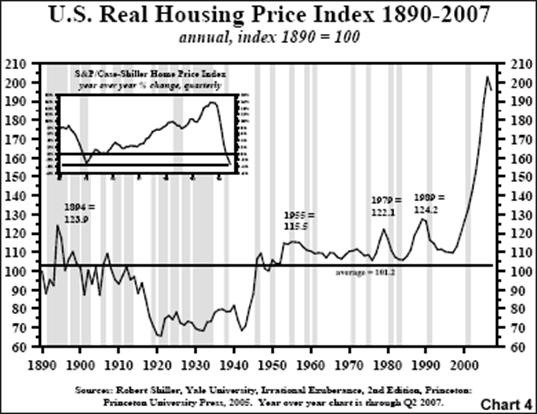
- Overvalued Real Estate. The real estate market has been driven by a number of innovations in real estate finance. Overvaluation in real estate implies overvaluation in real estate financial instruments; an implosion of real estate prices implies an implosion in those instruments. It is widely recognized by economists that the Case-Shiller Index is a good proxy for the prices of real estate. A widely-recognized chart from 1890 to 2007 tells the story. The chart makes it crystal clear that the current overvaluation of real estate in real terms grossly exceeds the one during the 1920s. The coming correction in real estate will be protracted and gut-wrenching, with an expected cumulative effect that is much worse than the Great Depression.
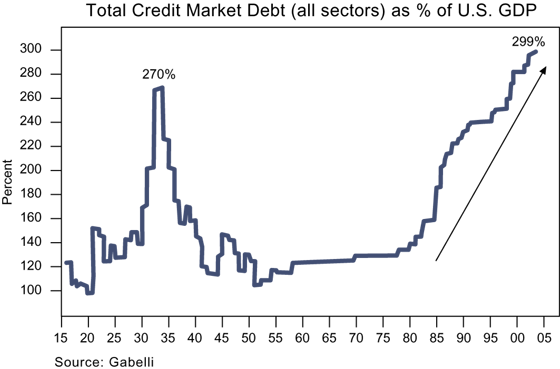
- Total U.S. Credit. Credit makes leverage: the more credit in the financial system, the more leveraged it is. Today's total U.S. credit relative to GDP has surpassed significantly the levels preceding the Great Depression. Back then, the total amount of credit in the financial system almost reached an astonishing 250% of GDP. Using the same metric today, the debt level in the U.S. financial system surpassed 350% in 2008, while the level in 1982 was “only” 130%. As Charles Dumas from Lombard Street Research put it quite aptly, "we've had a 30-year leveraging up of America, ending in an unchecked orgy."
The chart below shows a dramatic buildup of debt (leverage) in the 1920s and a deleveraging from 1930 to 1945 (or 1952). Then it shows a consistent buildup of debt afterwards, with a dramatic rise since the 1990s, and surpassing in 2000 the previous peak in 1929. The chart shows the level of 299% at the end of 2005, but the level has already reached 350% by 2008.
Of course, leveraging, as already indicated above, must necessarily be followed by deleveraging.
The best way to think about leverage is to compare it with using drugs, while deleveraging is like detox. The problem is not that the detox is killing the patient who has abused drugs for years; what is really killing the patient is the drug abuse itself. However, one thing is clear – the patient must either go through a painful detox or die; the same applies for the financial system – it must either deleverage or implode.
- Explosion of Derivatives. Derivatives have been likened by Warren Buffet to “financial weapons of mass destruction”. The notional amount of total derivatives, as well as “Value at Risk” (VaR), has skyrocketed in recent years with the potential to destabilize the financial system for decades. To put it more allegorically, derivatives hang like a sword of Damocles over the financial system.
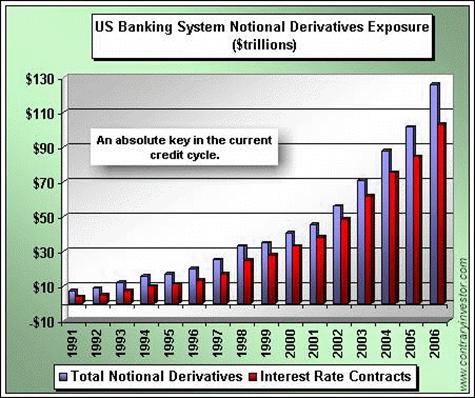
A comparison with the 1920s is difficult to make. mostly Derivatives back then were extensively used, although not widely understood. Given that I am not aware of any statistics of derivatives for the period of the 1920s, a meaningful comparison based on hard data is admittedly impossible. Nevertheless, I would venture to make an intelligent guess that the size of modern-day derivatives is hundreds or even thousands of times larger relative to the size of the economy in comparison to the 1920s. Some of the latest reports indicate that the total notional value of derivatives outstanding surpasses one quadrillion dollars. To put this into perspective, this amounts to almost 100 times the GDP of the U.S. economy.
The chart below shows the explosion of derivatives in the U.S. banking system. You can see that in 1991 the notional value of the derivatives was about the size of the U.S. GDP. By 2006 the size has grown to about 10 times the GDP, vastly outgrowing the real economy.
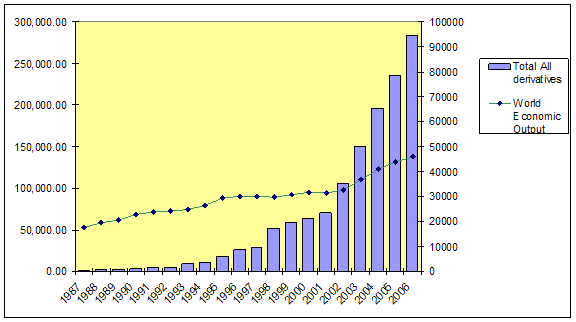
The chart below shows an even more telling picture. It shows world GDP and world's notional value of derivatives. Again, while there is no direct comparison with the 1920s, it is clear that the overall level of derivatives has skyrocketed during the last two decades and presents risks that were simply not present at the onset of the Great Depression. The unwinding of these derivatives could only be compared with a nuclear explosion in the financial system.
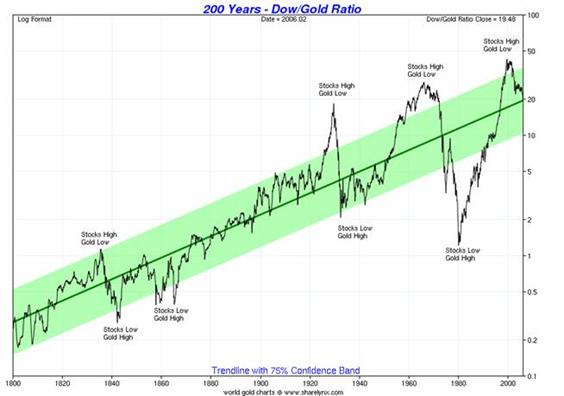
- Dow-Gold Ratio. The Dow-Gold ratio represents the most important ratio between the relative prices of financial assets and real assets. The Dow component represents the valuation of financial assets; the gold component – of real assets. When leverage in the financial system increases significantly, so does this ratio. A very high ratio is interpreted as an imbalance between financial and real assets – financial assets are grossly overvalued, while real assets are grossly undervalued. It also implies that a correction eventually will be necessary – either through deflation, which implies deleveraging and a collapsing stock market, or through inflation, which implies stagnant stock market for many years and steadily rising prices of real assets, commodities, and gold, usually associated with stagnant economy and typically resulting in stagflation. The first case—deflation—occurred during the 1930s, while the second case—stagflation—occurred during the 1970s.
The graph below illustrates the above concepts. The very high Dow-Gold Ratio in 1929 was followed by the Great Depression, while the higher level in 1966 was followed by the stagflationary 70s. It is evident from the chart the peak in 2000 surpassed the previous two peaks in 1929 and 1966, so this provides a reasonable expectation that the forthcoming return to “normalcy” will be more painful than the Great Depression, at least in terms of cumulative pain over the next 10-15 years.
- Global Bubbles . It is impossible to make direct comparison with the 1920s, but today the global economy is rife with bubbles. Back then in the 1920s, the U.S. had its stock and real estate bubbles, while the European economies were struggling to rebuild from the devastations of WW1 that ended in 1919. I am personally not aware of any other bubbles during this period, although I welcome reader feedback on this topic.
Today the picture is very different. The U.S. economy had a stock market and real estate bubble that has surpassed its own during the 1920s. Colossal US current account deficits have fuelled extraordinary growth in global monetary reserves. As a result, Europe has real estate bubbles across the board, from the U.K. and Ireland, throughout the Mediterranean (Spain, France, Italy and Greece), to the entire Baltic region (Latvia, Lithuania, and Estonia) and the Balkans (Romaina and Bulgaria). Even worse, many Asian countries (China, Korea, etc.) also have their own stock and property bubbles, only with the exception of Japan, which is still in the process of recovering from its own during the 1980s. Thus, during the 1920s only the U.S. suffered from gross financial imbalances, while today the imbalances have engulfed the whole world – both developed and developing. It stands to reason that the unwinding of those global imbalances is likely to be more painful today than it was during the Great Depression due to both size and scope.
- Collapsing Bretton Woods II. The global monetary system was on a quasi-gold standard during the 1920s. Back then dollars and pounds were convertible to gold, while all other currencies were convertible to dollars and pounds. An appropriate way to think about it is that of a precursor to the Bretton Woods from 1945-1971. What is important to understand is that while the system was fiat in nature, gold imposed significant limitations to credit expansion and leveraging.
Somewhat similar was the role of Bretton Woods that lasted from 1945 to 1971. The dollar was tied to gold, while all other fiat currencies were tied to the dollar. Just like the interwar period, gold imposed some limitations on credit and financial imbalances.
We now live in what has been termed Bretton Woods II. Essentially, this is a pure fiat dollar standard, where all currencies are convertible to dollars, either at fixed or floating exchange rates, while the dollar itself is convertible to “nothing”. Thus, the dollar has no limitations imposed to it by gold, so without the discipline of gold, the current global monetary system has accumulated significantly more imbalances than ever before in modern capitalism. These imbalances show up in the international monetary system as unsustainable trade deficits (and surpluses), skyrocketing official dollar reserves in some European and many Asian central banks, and the proliferation of Sovereign Wealth Funds; more generally, these imbalances result in a myriad of bubbles, overleveraging, and other maladjustments already discussed above.
Today Bretton Woods II is in the process of disintegration. The world is slowly but steadily losing its confidence in the dollar as the world reserve currency. A flight from the dollar is in progress and the collapse of the global monetary system is imminent. As Bretton Woods II disintegrates and a new system replaces it, the process of readjustment will be necessarily more painful than the respective process during the Great Depression.
A caution on terminology is necessary here. While the literature over the last 10-20 years has widely recognized the term “Bretton Woods II”, in September-October of 2008 the term was widely used by the media to describe a proposed international summit with the goal of reconstructing a new international monetary system designed from scratch, just like “Bretton Woods”. Instantly dubbed by the media “Bretton Woods II”, this term could be potentially very confusing as it could mean very different things to different people. The interested reader should consult Wikipedia's Bretton Woods II where both meanings are explained in detail.
Conclusion
Since August of 2007 we have witnessed the relentless escalation of the credit crisis: a steady constriction of credit markets, starting with subprime mortgage-backed securities, spreading to commercial paper, then to interbank credit, and then to CDOs, CLOs, jumbo mortgages, home equity lines of credit, LBOs and private equity markets, and then generally to the bond and securities markets.
While the media describes the problem as one of illiquidity and confidence, a more serious analysis indicates that boom-time credit has been employed unproductively and so losses must be incurred. In other words, scarce capital has been misallocated, poorly invested, and effectively wasted. No amount of monetary or fiscal policy can fix the errors of the past, just like no modern treatment can quickly restore to health a drug addict debilitated from a decade-long drug abuse.
Based on indicators like - (1) global real estate overvaluation, (2) indebtedness, (3) leverage, (4) outstanding derivatives, (5) global bubbles, and (6) the precariousness of the global monetary system, I would argue that the accumulated imbalances in the current period surpass significantly those preceding the Great Depression. I therefore conclude that the coming U.S. (and possibly) global depression will be of greater magnitude than the Great Depression of the 1930s. It likely suggests that we are entering a historic period that will likely be known as The Greater Depression .
Investor beware! Only gold can protect you from the ravages of another Depression!
By Dr Krassimir Petrov
Krassimir Petrov ( Krassimir_Petrov@hotmail.com ) has received his Ph. D. in economics from the Ohio State University and currently teaches Macroeconomics, International Finance, and Econometrics at the American University in Bulgaria. He is looking for a career in Dubai or the U. A. E.
Dr Krassimir Petrov Archive |
© 2005-2022 http://www.MarketOracle.co.uk - The Market Oracle is a FREE Daily Financial Markets Analysis & Forecasting online publication.
