


Commodities Supply Destruction
Commodities / Metals & Mining Nov 07, 2008 - 04:52 AM GMTBy: HRA_Advisory
 [ Editor's note : The following article was sent to subscribers in September. The intent was to remind readers what to look for in the various metals sectors in terms of supply going forward. Balance will return to the market not just from eventual demand increases but also (and perhaps mainly) from supply cut backs. We chose zinc to focus on as it has the largest percentage of uneconomic operations at current prices. For reasons we go into in the article, we expect a quicker supply response then in past cycles.
That is happening with zinc; two of the potential shut downs we referred to below have occurred as have several others of similar size and a couple of larger operations will likely shut by year end. The effect the market meltdown will have on the supply pipeline that analysts are still using to project prices 3-5 years out will be dealt with in a separate article. For now, suffice it to say that the 5%+ annual supply increases that analysts continue to use in assuming supply and demand will not be balanced again for several years are the stuff of fantasy.]
It's been a brutal summer for the entire resource sector on both the metals and equities side, compounding an already nasty year. The past six weeks have brought one of the steepest sell offs we've ever seen for both commodities and materials stocks. There has been a lot of talk about demand destruction, but less focus, as usual, on the supply side of the equation.
While we agree that slowing G7 economies are obviously taking their toll on demand, there are two sides to every market. In order to be able to gauge why and when the bottom is coming its important to follow not just changes in apparent demand, and price, but also the supply side response to them.
We've constantly made the point that this cycle has been as much about supply as demand. It's also very much about costs, which have skyrocketed in the past few years. Markets are about dynamic equilibrium, and are in a constant state of flux as they attempt to maintain it.
Most of this decade has been very good to mining companies, with base metal and more recently bulk commodity miners in particular having better bottom lines and share price gains then anyone living can remember. All that started to change when a combination of perceived demand destruction due to very large price increases (nickel, oil) and over supply concerns (zinc, lead and copper) and of course fear of recession/depression (all the above - and everything else) began to batter prices.
To that concern has to be added a wholesale exodus this quarter by hedge funds. Most of them took their real poundings in the energy markets, but it was a build up of redemption calls that kicked off broad based sells. Given how badly markets have fared, similar issues are no doubt being faced by equity funds of all types. Analysts have turned almost universally bearish, which has only added to the downward pressure. A couple of high profile hedge funds just announced they are closing up shop. They have been defeated by a spiral of market weakness begetting losses that create redemption calls that require heavy selling pressure, further weakening equity prices and thus starting the next round of losses-redemptions-selling. All of this of course includes de-leveraging the market since the role of hedge funds is meant to act as a fulcrum for trading strategies.
In this environment the large resource stocks that offer some liquidity, and which should be very large gainers for those who went long early, become the means to cut cheques for both redemption to funders and capital to lenders that provided leverage.
So, how does the mining sector react to recent drops in metal prices? Very quickly, if the events of the past couple of weeks is any guide. Changes on the supply side will happen most quickly where prices have retreated to levels that make more of the marginal supply uneconomic. Speed will also be related to the mix of company size in a given market. A BHP or RTZ can ride out a bad market; a small company that is wholly dependent on external financing for capital costs often cannot.
In order to examine the supply side effects we are going to zero in on one base metal market. We want to stress that we are not presenting this as some sort of market panacea, especially for the companies directly affected. Metal markets are dominated by traders who will not get bullish until the credit crisis starts to truly ease and there is some evidence that G7 economies have at least stopped collapsing. Heatless robber barons mainly exist in Edwardian literature and Michael Moore mockumentaries. No one likes closing operations and putting people out of work, but sometimes it's unavoidable. It is part of the creative destruction that makes markets function. And it is almost always a precursor to a reversal in prices for metals, so it bears watching.
The best example of this process at work today is the zinc market where a number of operations have announced closure in the past couple of weeks.
Nickel has seen similar falls from its price peak but it is a more concentrated sector in terms of large producers. The biggest players are able to scale back production slightly at several operations and only one significant closure has been announced, so far. Note too, that the nickel market also has a lot of very small private miners of laterite ore. A number of these operations have also shut and more will follow, but they don't make the news and are much harder to track.
Zinc is a much less concentrated sub-sector, and has a wider geographic base of producers. The zinc sector has a large number of participants, and the largest aggregate producer is China where news of supply cuts isn't likely to quickly become public. So far, the announced closures affect both large miners with diverse operations that relinquish highest cost operations first, and single mine companies that simply won't find the money to keep going.
In addition to the officially announced closures or probable closures we discuss below there are a number of operations that are, in our opinion, very close to the brink. A cursory look over the Q2 numbers from various operations we thought may be at risk indicates 3-400,000 tonnes of 2009 zinc production in serious jeopardy, where closure announcement have not been made. Some of these producers may find a way through but some are very unlikely to be in production by year end without a strong upturn in zinc prices. Keep in mind that this is over and above the announced cuts outlined below.
In the past month there have been three definitive closure announcements, namely Hudbay's Balmat Mine (30,000 tonnes per year), Perilya's reduction at the Broken Hill mine in Australia (40,000 tpy), and early closure of the Teck/Xstrata Lennard Shelf mine (50,000 tpy). To that can be added Lundin Mining's Aljustral mine in Portugal , slated to produce 55,000 tpy. While LUN has not officially pulled the plug management stated it was likely and have written off the mine's capital cost in Q2.
Other recent reductions of forward supply include suspension of development work at the Perkoa project in Burkina Faso that had been slated to produce 68,000 tpy starting next year, and the likely shelving of the Ozernoe project in Siberia by Lundin Mining (Lundin has been moving to stronger copper production, and we had not figured this venture into its cash flow yet). While this last example is due as much to politics as metal prices, it is nonetheless very significant as the planned output starting in 2011/2012 is 300,000+ tpy.
All-in, the announced cuts amount to 120,000 tones per year of zinc output, and another 100,000+ tonnes of cuts are highly likely to occur in a mater of weeks.
Increasing supplies of zinc in the 2008-2009 periods are not a surprise and are, in fact, the reason zinc was one of the early casualties in the metal price pull back. Estimates at the start of this year were for a 300,000 tonne surplus in 2008 and 700,000 tonne surplus in 2009.
More recent estimates by the International Lead-Zinc Study Group (an industry group) placed the 2008 H1 surplus at 72,000 tonnes, or about half the amount expected at the start of the year. Note that this change occurred before any of the closures discussed above. When they are taken into account, the actual surplus for 2008 should be very small, even when some demand destruction from slowing economies is taken into account.
The 2009 surplus is much larger, though it too will drop very significantly, especially if some of the operations in trouble throw in the towel before year end as we expect. That would still lead to a big inventory build up, but the market will start looking forward to 2010, when some large operations start coming off line. The first scheduled shut down is the Brunswick mine in Q1 2010, with rated production of just under 240,000 tpy. A number of other large operations come off line later, and some of those might be subject to early closure as well.
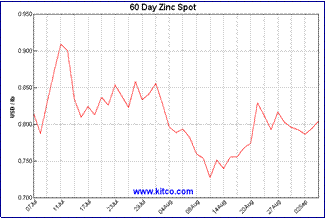
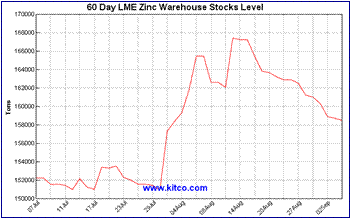
The charts on the previous page show the 60 day history of zinc prices and LME inventories to the start of September. A you can see, the price bottomed in early August at $0.73, about when the closure announcements started and the inventories peaked at the same time. Keep in mind that these are short term charts, so the price bottom may or may not be “the” bottom.
The supply story for zinc can be repeated to a greater or lesser degree for any base metal. Nickel is a much more concentrated market and there has already been one significant closure announcement (Xstrata's Falcondo operation in the Dominican Republic ) and it would not take much to move nickel supply back to deficit.
Copper has not seen similar announcements because the price hasn't fallen very much. There have been some slowdowns on the part of major producers, the most notable being Southern Copper reducing its 2008 production guidance by 120,000 tonnes, and Freeport McMoRan/RTZ reducing the 2008 copper production guidance at the Grasberg mine by 67,000 tonnes. .
In addition to production stoppages, a sustained period of lower prices is going to play havoc with the project pipeline. We have talked in the past about forward supply projections being far too generous. History seems about to be repeated in this regard.
Different analysts and industry groups have their own lists of new projects they use when guessing output levels several years out. Xstrata produced a famous chart we have used in presentations that showed consensus projections for future copper production have been hugely above actual numbers through the entire decade.
The gulf between projected and actual future production is sure to widen again. With credit markets snuffed out worldwide, development projects that do not have extraordinary economics or money in place are unlikely to get funded in the next few quarters. Its not that mining investments are inherently poor; miners continue to generate some of the best earnings around. There simply isn't much large scale risk capital around for anything.
In short, most of the dire oversupply predictions can be thrown out the window. How large the oversupply actually is will depend on how the world economy does and how much demand drop there actually is going forward. Demand growth has slowed for most metals, though it's still positive. Only time will tell if the rest of the world has decoupled from the US economy. We still very much think the important demand generating economies have, but Mr. Market will not believe that until it shows up in hard numbers over the next few months.
We stress again that we are not expecting zinc (or other metal) prices to be shooting skyward in the short term. The sort of gloom emanating from the zinc production sector, and negativity from base metal analysts, is however standard fare at a bottom even if it's a long bottom . It's worth remembering that most all base metal producer analysts missed the bottom at the start of this decade. We won't be shocked if they miss the next one. Ω
David Coffin and Eric Coffin
http://www.hraadvisory.com
David Coffin and Eric Coffin are the editors of the HRA Journal, HRA Dispatch and HRA Special Delivery; a family of publications that are focused on metals exploration, development and production companies. Combined mining industry and market experience of over 50 years has made them among the most trusted independent analysts in the sector since they began publication of The Hard Rock Analyst in 1995. They were among the first to draw attention to the current commodities super cycle and the disastrous effects of massive forward gold hedging backed up by low grade mining in the 1990's. They have generated one of the best track records in the business thanks to decades of experience and contacts throughout the industry that help them get the story to their readers first. Please visit their website at www.hraadvisory.com for more information.
You can add yourself to our free mailing list here in order to receive articles of interest like this and occasional special reports and trial issues of the HRA publications.
© 2008 Copyright Eric deCarbonnel - All Rights Reserved
Disclaimer: The above is a matter of opinion provided for general information purposes only and is not intended as investment advice. Information and analysis above are derived from sources and utilising methods believed to be reliable, but we cannot accept responsibility for any losses you may incur as a result of this analysis. Individuals should consult with their personal financial advisors.
HRA Advisory Archive |
© 2005-2022 http://www.MarketOracle.co.uk - The Market Oracle is a FREE Daily Financial Markets Analysis & Forecasting online publication.
