


More on Gold and the Reflation of Assets
Commodities / Gold & Silver Nov 20, 2008 - 10:46 AM GMT

 Larry Edelson writes: Not surprisingly, my Money and Markets column last week about a new monetary system based on an upward revaluation of the price of gold set off quite a buzz all over the world. It was picked up by CBS MarketWatch, The Financial Times , The Market Oracle, and more.
Some Think I'm Crazy, That I've Lost My Mind. No Problem.
They can think and say whatever they want. I have thick skin.
Moreover, I have history on my side — Franklin Roosevelt's 1933 confiscation and revaluation of gold and subsequent devaluation of the dollar.
I also have company in my camp: Take a look at Fed Chairman Ben Bernanke's comments on the subject …
 |
| By an Executive Order on April 5, 1933, President Franklin Roosevelt confiscated all gold, which led to a devaluation of the U.S. dollar. |
” … it's worth noting that there have been times when exchange rate policy has been an effective weapon against deflation. A striking example from U.S. history is Franklin Roosevelt's 40 percent devaluation of the dollar against gold in 1933-34, enforced by a program of gold purchases and domestic money creation. The devaluation and the rapid increase in money supply it permitted ended the U.S. deflation remarkably quickly … the episode illustrates that monetary actions can have powerful effects on the economy, even when the nominal interest rate is at or near zero, as was the case at the time of Roosevelt's devaluation.”
Also consider George Soros' recent proposal for a new monetary system involving the Special Drawing Rights, or SDRs, at the IMF: Currencies would be devalued … then repegged to each other and to SDRs … and then SDRs would be circulated as an international currency.
For Soros' proposal to work, though, it's my opinion that gold would have to play some sort of role.
Given the importance of all this and the high probability that some tinkering by the G-20 is already in the works, I'd like to elaborate a bit more on the subject, and then answer some questions I've received.
But first, let me cover the main points of my previous column …
Point #1: It's simple: If current efforts to prevent a debt-deflationary spiral and depression won't be effective, central banks and governments around the world have the ability to change the rules of the game.
Or as I put it in last week's Money and Markets column, “ if they can't print money fast enough, they can resort to changing the value of the money (devaluing).”
History is squarely on my side here. I've already explained to you how Roosevelt did it. But now take a look at other historical precedents in the table I have for you today.
It proves, unequivocally, that devaluations work, and that devaluations can occur simultaneously across countries.
| How the Gold Standard and Currency Devaluations Affected Different Countries During the Great Depression | |||
| Country | Left Gold Standard (MM/YY) | Devalued Currency (MM/YY) | Industrial Production Bottomed |
| Australia | 12/29 | 3/30 | 1930 |
| New Zealand | 9/31 | 4/30 | 1930 |
| Austria | 4/33 | 9/31 | 1931 |
| Finland | 10/31 | 10/31 | 1931 |
| Japan | 12/31 | 12/31 | 1931 |
| Norway | 9/31 | 9/31 | 1931 |
| UK | 9/31 | 9/31 | 1931 |
| Sweden | 9/31 | 9/31 | 1932 |
| Canada | 10/31 | 9/31 | 1932 |
| Denmark | 9/31 | 9/31 | 1932 |
| Greece | 4/32 | 4/32 | 1932 |
| U.S. | 3/33 | 4/33 | 1932 |
| France | – | 10/36 | 1935 |
| Netherlands | – | 10/36 | 1935 |
| Czech | – | 2/34 | 1935 |
| Poland | – | 10/36 | 1935 |
| Belgium | – | 3/35 | 1936 |
| Italy | – | 10/36 | 1936 |
Note the 12 countries that either came completely off the gold standard or devalued their currencies by 1933 (via raising the price of gold): All of them came out of the Depression almost immediately.
Australia and New Zealand came out of the slump first, barely one year after the Depression started.
The U.S. came out of the Depression much later, largely because it stubbornly defended the gold standard by keeping and even raising interest rates during the Depression (to prevent loss of gold reserves).
Meanwhile, of the five countries that unbendingly clung to the gold standard, refusing to devalue their currencies until much later, as late as 1936 — they all stayed in the Great Depression much longer, an average of 2.33 years longer.
Point #2: For multiple currencies to be simultaneously devalued to help reflate assets, a benchmark must become part of the system.
As you can also see from my table, several countries revalued or left the gold standard simultaneously, devaluing their currencies. That was only possible because there was a benchmark at the heart of the system back then … gold.
To do the same today, some stable benchmark would have to be reintroduced into the system, even if only temporarily to help make the transition.
There are several choices and proposals out there, including the SDRs at the IMF, and the World Currency Unit (WCU) proposed by Lok-sang Ho, Professor of Economics and Director of the Centre for Public Policy Studies, Lingnan University.
Both proposals have their advantages. But they also have inherent disadvantages: The value of the SDRs already in existence fluctuates daily. So they would have to repeg SDRs to a third party benchmark (likely gold).
The WCU uses a nation's GDP to value and allocate money supply. But that gives international businesses and investors an advantage over domestic investors due to Purchasing Power Parity (PPP) quirks.
My view: Ironically, after years of panning it, leasing it, loaning it out, and even selling it — gold will have to play some sort of role in the new monetary system (although as I noted last week, it need not be confiscated).
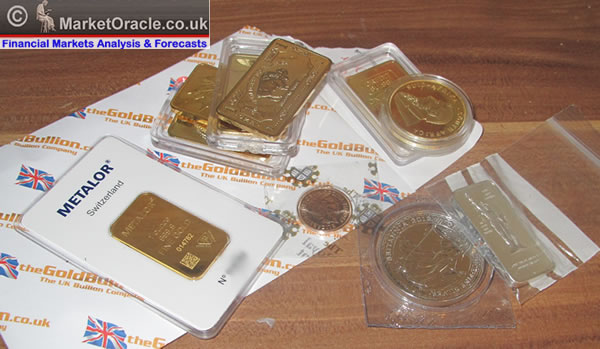 |
| Right now, gold is extremely undervalued, and something you want to own. Period. |
Point #3: Gold, whether it's directly or indirectly part of a new monetary system or not — is extremely undervalued.
At its current price of about $735, in today's dollars gold is 67% cheaper than it was in 1980. For gold to reach its 1980 high in today's dollars, it would have to trade at $2,270 an ounce.
And as I pointed out last week, if there's even the slightest role for gold in a new monetary system, it can trade even higher — I figure as high as $5,100 an ounce, which would be the equivalent of monetizing about 10% of the massive $53 trillion of debts in the U.S.
But don't focus on the ultimate price of gold. Instead all you need to know is that no matter how you look at it, gold is extremely undervalued and something you want to own. Period.
Now, on to some of the questions I've received, and my answers …
Q: What role do you think silver will play in a new monetary system?
A: None. Silver is not a monetary metal and, contrary to wide belief, it is not in short supply.
Q: You noted that the current official central bank price of gold is $42.22 an ounce. What is the difference between that price and the market price?
A: He quoted you the current price of gold. Central banks value the gold on their balance sheets at $42.22 an ounce, at cost. In my view, they will be revaluing their gold, much higher.
Q: Larry, I think your analysis is very well reasoned, but I have a question. What happens to things like wages if there is a currency devaluation like you describe?
A: The theory is that the inflation a currency devaluation would spark would eventually cause wage inflation as well, which is precisely what happened post the 1934 dollar devaluation.
Q: So that I understand properly, what actually happens when currency is devalued?
A: Since each unit of new currency is worth less, it takes more units to buy an asset. It causes an asset reflation to occur and also eases debt burdens.
Q: How do you see gold stocks responding?
A: To the moon!
Q: Would it better to own physical gold or gold stocks?
A: A mixture of both, per my recommendations in the core gold section of my newsletter .
Q: Would gold and gold miner based ETFs move in concert with the rise in gold?
A: Yes, though there may not be a 100% correlation. I would also expect gold and gold mining shares to move up sharply ahead of the news, in anticipation of a revaluation.
Q: Larry, I believe you were the first and only one who years ago predicted correctly that central bankers and governments worldwide will be racing to devalue their currencies against each other.
My query is, what is the best time to get aggressive with gold and gold shares? In the Great Depression, it was after the crash into the 1932 low.
A: Simple. Don't try to time it exactly. Gold now!
Q: I come from Israel where the money was devalued endlessly since more than 50 years ago. Savers lost their shirts — the value of their savings was reduced.
Those who owed money (mostly on mortgages) made a fortune because they owed the same number of devalued currency units. Are you suggesting that something similar is about to happen?
A: Exactly. Only this time, a huge portion of the world will participate and, instead of doing it over and over again, a very large devaluation will occur in one fell swoop.
Q: Could this end up causing hyperinflation?
A: Yes, it could. But if done properly, hyperinflation could be avoided — largely by going back to a fixed rate currency regime or via the introduction of an international payments currency, such as the IMF's SDRs, as George Soros is proposing.
Q: When and how long do you think it will take to implement? It apparently did not come up at last weekend's G-20 meeting.
A: I am sure it's already been discussed. If the global economy and deflation worsen by the next G-20 meeting in April, I suspect the discussions on a new monetary system will be accelerated.
I estimate it would take a year to transition to it.
Q: But Larry, gold is looking weak right now. What gives?
A: Don't focus on short-term moves, in any market. Keep the long term in view. I suggest holding all of your gold, even if it falls back to $636, which is a major long-term support level.
If that were to give way, it would mean deflation is dragging on a bit longer, and we could even see $500 gold. But even then, I would be a buyer with both hands.
For core gold holdings, keep in mind that the upside potential of the precious yellow metal is at least $2,270 … and probably higher, to over $5,000 an ounce.
Hence, even if gold were to fall back to $500 first, your risk based on gold's current price is about $235 — compared to upside potential that ranges from $2,235 to over $4,200 per ounce.
That's a favorable risk-to-reward ratio — of as much as $17 for every $1 you risk.
Q: What is your take on the huge disconnect between the exchange-traded or paper price for gold and the drastically higher price (if you can even find any) for physical gold?
A: There is always a premium for physical gold over the spot futures price of gold. It includes the cost of fabrication into ingots, bars, or bullion coins.
In a bull market, the premium rises as dealers try to lift the markups and their profit margins.
Nevertheless, it is important to note that the physical gold market is getting very tight, with supplies dwindling and even the U.S. Treasury suspending sales of American Eagles.
In my view, that's consistent with how I see events unfolding. As I noted previously, central banks and treasury departments will stop lending and leasing out gold, then stop selling it … and in the next stage, start buying.
Best,
Larry
This investment news is brought to you by Money and Markets . Money and Markets is a free daily investment newsletter from Martin D. Weiss and Weiss Research analysts offering the latest investing news and financial insights for the stock market, including tips and advice on investing in gold, energy and oil. Dr. Weiss is a leader in the fields of investing, interest rates, financial safety and economic forecasting. To view archives or subscribe, visit http://www.moneyandmarkets.com .
Money and Markets Archive |
© 2005-2022 http://www.MarketOracle.co.uk - The Market Oracle is a FREE Daily Financial Markets Analysis & Forecasting online publication.
