
Best of the Week
Most Popular
1. Will Iran Kill the PetroDollar? - Marin Katusa
2. Tail Events, Isolation, New Normal Of Hyper Monetary Inflation - Jim_Willie_CB
3. Kodak's Former Moment, A Lesson for You, Me and America - Gary_North
4.The Five Stages of Collapse and the Coming Paradigm Shift in Silver - Steve_St_Angelo
5. UK Recession 2012 Certain as Bank of England Prepares to Ramp Up Money Printing Presses - Nadeem_Walayat
6. HMRC Extends Tax Deadline by 2Days for Self Assessment Online Filing - Nadeem_Walayat
7. Gold GLD ETF Investors Mass Exodus - Zeal_LLC
8. Credit Crisis Perfect Storm, Robert Prechter Discusses What's Backing Your Dollars - Robert Prechter
9. Best Cash ISA 2012 to Reduce Stealth Inflation Theft of Value of Savings - Nadeem_Walayat
10.Financial Markets 2012, When Leverage Fails - Ty_Andros
Last 5 Days Analysis
Learn How to Apply Fibonacci Retracements to Your Stock Index Trading - 8th Feb 12
Do Low Interest Rates Power Stock Markets Higher? - 8th Feb 12
SILVER: The Illegitimate Child Of The Commodities Family - 8th Feb 12
A New Reason Gold Stocks Will Soar - 8th Feb 12
The Deception of 0% Interest Rates, High Costs and Capital Destruction - 8th Feb 12
Bring Down the New World Order with Free Market Education - 8th Feb 12
Gold Increases In Value During Inflation or Deflation Scenarios - 8th Feb 12
Gold Holds Steady as U.S. Dollar Hits 2-Month Low - 8th Feb 12
Markets Risk Train Chugs Along, Overbought Does Not Mean a Correction is Coming - 8th Feb 12
Banking, U.S. Housing Market and Mortgages - 8th Feb 12
Has Zero Interest Rate Policy Held Back Economic Recovery? - 8th Feb 12
Graphite and Rare Earth Metals for the 21st Century - 8th Feb 12
Gold Odysseus Journey Continues! - 8th Feb 12
The Fed Resumes Printing Money to Monetize U.S. Government Debt - 7th Feb 12
Timing the Market: Predicting When the FED Will Act Next (Feb 12) - 7th Feb 12
U.S. War With Iran? - 7th Feb 12
Abandoning the U.S. Dollar for Gold - 7th Feb 12
Financial Crisis American Gridlock, Why The “Left” And The “Right” Are Both Wrong - 7th Feb 12
The Fed is Engineering Barack Obama’s Re-Election Campaign - 7th Feb 12
Finding Fundamentals Key to Gold Stocks Investing - 7th Feb 12
US Debt Will Explode Without Changes - 7th Feb 12
Gold Compared to Past Bubbles - 7th Feb 12
Illusion Of Economic Recovery – Feelings & Facts - 7th Feb 12
In the Gold Bullring - 7th Feb 12
This Precious Metal Could Rise 125% Over the Next 10 Months - 6th Feb 12
Washington Heading for War on Syria - 6th Feb 12
Gold "Rollercoaster" Heads Yet Lower as Greece Hits "Crunch Time for Bankruptcy" - 6th Feb 12
Did Friday's Gold Price Action Signal a Stock Market Top? - 6th Feb 12
Monday Financial Markets Madness – What’s This Greece Thing? - 6th Feb 12
Stock Market Investors Dangerous Times Ahead, Will Impact Gold - 6th Feb 12
Gold, Stocks and Euro Fall As Possible Greek Debt Default Looms - 6th Feb 12
Bond Investors Pour into Emerging Market Debt in Hunt for Higher Yields - 6th Feb 12
New Spy Technology Could Be Worth Billions - 6th Feb 12
U.S. Fraudulent Election Year Unemployment Data, Lies, Lies, More and Bigger Lies - 6th Feb 12
Double Liability for Bank Shareholders, Officers and Directors - 6th Feb 12
Stock Market Next Short-term Top in Sight - 6th Feb 12
U.S. Home Foreclosures and Shadow Banking: Why All the "Robo-signing"? - 5th Feb 12
Look at What 'Worked' in the Great Depression - 5th Feb 12
Putting Good U.S. Employment Numbers in Perspective, College Education Isn’t Enough - 5th Feb 12
Stock Market Weekend Update - 5th Feb 12
The Doomsday Machine - 4th Feb 12
Are US Treasury Bond Markets a Sell? - 4th Feb 12
Obama’s Refinancing Swindle, Banks Want to Dump Millions of Risky Mortgages Onto FHA - 4th Feb 12
The Euro Zone and the Crisis of Sovereign Debt - 4th Feb 12
Is the U.S. 'Decoupling' From the European Debt Crisis? - 4th Feb 12
The Crucial Pillar of the New World Order - 4th Feb 12
Gold Junior Mining Stocks Poised to Rebound - 4th Feb 12
U.S. January Employment Situation Shows Widespread Improvement, but Short of Full Employment Mandate - 4th Feb 12
U.S. Non Farm Payrolls Interesting Market Divergences - 4th Feb 12
Gold and Silver Mining Stocks Tops Might Be Just Around the Corner - 4th Feb 12
Critical Materials for Critical Technologies - 3rd Feb 12
Junior Gold Mining Stock - 3rd Feb 12
SOPA, PIPA, The State of US Surveillance - 3rd Feb 12
Essential Investor Preparations for The Big Crisis - 3rd Feb 12
U.S. Jobs, El-Erian U.S. Structural Issues Aren't Being Dealt With - 3rd Feb 12
What Every U.S. Investor Should Know About Inflation - 3rd Feb 12
U.S. Mint Gold Coin Sales Return to Fundamental Driven Demand - 3rd Feb 12
Gold Bull Market Bigger than Ever - 3rd Feb 12
Banking Crisis 2012 "Robo-Signing" of Foreclosure Affidavits Just Tip of Iceberg - 3rd Feb 12
Stock and Financial Markets Crash is Coming, Key Signs of Reversal - 3rd Feb 12
Real U.S. Economic Picture: "There is No Recovery" - 3rd Feb 12
Poland Gives Green Light to Massive Natural Gas Fracking Efforts - 3rd Feb 12
Where to Invest 2012 and What to Avoid - 2nd Feb 12
Liquid Natural Gas Stocks Are Set to Take Off - 2nd Feb 12
Godzilla Will Come Out of Tokyo Bay Before Japan Economy and Stock Market Rebounds - 2nd Feb 12
Gold Challenges Resistance at $1,750/oz – Technicals and Fundamentals Remain Very Positive - 2nd Feb 12
German Central Bailing Out Europe - 2nd Feb 12
In the Wake of Davos: "Strong Economic Medicine" for the European Union - 2nd Feb 12
The American Economy is "Dead": The Illusion of Economic Recovery - 2nd Feb 12
Irish People Bailout of Bond Holders, Vincent Browne v The European Central Bank Video - 2nd Feb 12
How Far Will Debt Deleveraging Go? How Much LSD Can an Elephant Take? - 2nd Feb 12
Great Deals on Gold and Silver 2012 - 2nd Feb 12

Free Instant Analysis

Free Instant Technical Analysis


Market Oracle FREE Newsletter

How You Can Identify Stock Market Turning Points Using Fibonacci

Inside Story on Septembers Financial and Economic Meltdown- Video

Stock-Markets / Financial Crash Feb 20, 2009 - 08:33 PM

By: Submissions

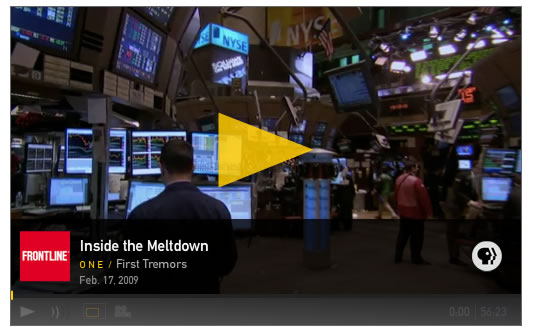
Stock-Markets Diamond Rated - Best Financial Markets Analysis ArticleOn Thursday, Sept. 18, 2008, the astonished leadership of the U.S. Congress was told in a private session by the chairman of the Federal Reserve that the American economy was in grave danger of a complete meltdown within a matter of days. "There was literally a pause in that room where the oxygen left," says Sen. Christopher Dodd (D-Conn.) As the housing bubble burst and trillions of dollars' worth of toxic mortgages began to go bad in 2007, fear spread through the massive firms that form the heart of Wall Street. By the spring of 2008, burdened by billions of dollars of bad mortgages, the investment bank Bear Stearns was the subject of rumors that it would soon fail.

"Rumors are such that they can just plain put you out of business," Bear Stearns' former CEO Alan "Ace" Greenberg tells FRONTLINE.

The company's stock had dropped from $171 to $57 a share, and it was hours from declaring bankruptcy. Federal Reserve Chairman Ben Bernanke acted. "It was clear that this had to be contained. There was no doubt in his mind," says Bernanke's colleague, economist Mark Gertler .

Bernanke, a former economics professor from Princeton, specialized in studying the Great Depression. "He more than anybody else appreciated what would happen if it got out of control," Gertler explains.

To stabilize the markets, Bernanke engineered a shotgun marriage between Bear Sterns and the commercial bank JPMorgan, with a promise that the federal government would use $30 billion to cover Bear Stearns' questionable assets tied to toxic mortgages. It was an unprecedented effort to stop the contagion of fear that seemed to be threatening the rest of Wall Street.

While publicly supportive of the deal, Treasury Secretary Henry Paulson , a former Wall Street executive with Goldman Sachs, was uncomfortable with government interference in the markets. That summer, he issued a warning to his former colleagues not to expect future government bailouts, saying he was concerned about a legal concept known as moral hazard.

Within months, however, Paulson would witness the virtual collapse of the giant mortgage companies Fannie Mae and Freddie Mac and preside over their takeover by the federal government.

The episode sent shockwaves through the economy as confidence in Wall Street began to evaporate. Within days, in September 2008, another investment bank, Lehman Brothers, was on the brink of collapse. Once again, there were calls for Bernanke and Paulson to bail out the Wall Street giant. But Paulson was under intense political pressure from conservative Republicans in Washington to invoke moral hazard and let the company fail.

"You had a conservative secretary of the Treasury and conservative administration. There was right-wing criticism over Bear Stearns," says Congressman Barney Frank (D-Mass.), chairman of the House Financial Services Committee.

Paulson pushed Lehman's CEO Dick Fuld to find a buyer for his ailing company. But no company would buy Lehman unless the government offered a deal similar to the one Bear Stearns had received. Paulson refused, and Lehman Brothers declared bankruptcy.

FRONTLINE then chronicles the disaster that followed . Within 24 hours, the stock market crashed, and credit markets around the world froze. "We're no longer talking about mortgages," says economist Gertler. "We're talking about car loans, loans to small businesses, commercial paper borrowing by large banks. This is like a disease spreading."

"I think that the secretary of the Treasury could not fully comprehend what that linkage was and the extent to which this would materialize into problems," says former Lehman board member Henry Kaufman.

Paulson was thunderstruck. "This is the utter nightmare of an economic policy-maker," Nobel Prize-winning economist Paul Krugman tells FRONTLINE. "You may have just made the decision that destroyed the world. Absolutely terrifying moment."

In response, Paulson and Bernanke would propose -- and Congress would eventually pass -- a $700 billion bailout plan. FRONTLINE goes inside the deliberations surrounding the passage of the legislation and examines its unsuccessful implementation.

"Many Americans still don't understand what has happened to the economy," FRONTLINE producer/director Michael Kirk says. "How did it all go so bad so quickly? Who is responsible? How effective has the response from Washington and Wall Street been? Those are the questions at the heart of Inside the Meltdown ."


© 2005-2012 http://www.MarketOracle.co.uk - The Market Oracle is a FREE Daily Financial Markets Analysis & Forecasting online publication.


Comments

Dan
22 Feb 09, 11:51
PBS's corporate bias

Question: Why did PBS's Frontline program rely so much on 'mainstream' press sources like the Wall Street Journal, New York Times, Vanity Fair (?!??) and CNBC for background info on the credit crisis? Why didn't Frontline's producers approach at least one sober 'bear' economist who called all of this mess back in 2005 or before?!?

Also, the 'collapse' of Bear Stearns had more to do with Bear's massive silver shorting positions and other unbenounced internicine warfare issues on the Street than it did with Bear's exposure to mortgage backed securities.

Programs like this are a whitewash.


Alec
23 Feb 09, 19:42
Same old, same old

Dan, just a wild guess, but I would bet they didn't reference the bearish economists in this piece, for the same reasons nobody mentioned bearish economists in the mid 1920's.


Post Comment (Moderated)


Commenting Issue - If on submitting you are returned to the main Index Page (50% chance) then your comment has not been accepted, Follow below steps for 95% chance of comment being accepted.

  1. Click your browser Back button (from main index page).
  2. COPY your comment text from Comment box (i.e. copy to clipboard).
  3. Press PAGE Refresh - You should see the message "You are not authorized to carry out this operation"
  4. Paste your comment back into the comment text box.
  5. Click Submit - If everything goes okay you will remain on the article page with the message "Your comment was held for moderation and will be reviewed shortly".
  6. If instead you are again returned to the main index page then repeat 1-5, alternatively EMAIL to comments @ marketoracle.co.uk quoting the article number.

FREE Deflation Survival GuideFREE Updated 118 Page Independant Investor E-book