


U.S. Faces Second Lost Economic Decade Because of Misguided Stimulus
Economics / Great Depression II Oct 23, 2009 - 02:00 PM GMTBy: Mike_Shedlock

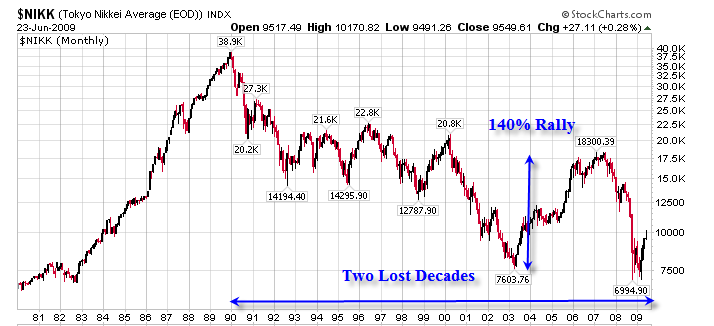
 Japan has gone through two lost decades, in and out of deflation, with nothing to show for it but increasing debt to GDP and a stock market still 70% below its peak.
Now, Richard Koo of Nomura Research Institute Ltd. says U.S. Risks Japan-Like ‘Lost Decade’ on Stimulus Exit.
U.S. officials contemplating an exit from record fiscal stimulus are in danger of repeating mistakes that plunged Japan into its lost decade of stagnant growth, according to Richard Koo of Nomura Research Institute Ltd.
“This isn’t a cold, its more like pneumonia,” said Koo, author of “Balance Sheet Recession,” a 2003 book about the malaise that hit Japan after its stock and real-estate markets crashed in 1990. “We still need more government spending,” he said, adding it could take “three to five years to get out of this mess, even under the best of circumstances.”
Koo’s comments echo the view of economists including Nobel laureate Paul Krugman, who warn that the U.S.’s likely return to growth in the second half of 2009 doesn’t mean a sustained recovery is assured. The Obama administration aims to rein in a record $1.4 trillion budget deficit as growth returns, seeking to safeguard the value of a declining dollar.
“If you learn your lesson from the Japanese experience, you don’t remove your fiscal stimulus until private sector de- leveraging is over,” Koo, 55, chief economist at the research arm of Japan’s biggest brokerage, said in an interview at his Tokyo office last week. “When we see the private sector coming to borrow again, I’ll be the loudest person on earth arguing for fiscal reform. That’s the exit.”
Koo calculates that the bursting of Japan’s asset bubble in 1990 erased 1,500 trillion yen ($16 trillion) in wealth, equivalent to three times the size of the economy. Companies focused on repaying debt rather than undertaking new projects, causing demand to plummet and triggering a cycle in which cash flows fell, asset prices dropped and balance sheets deteriorated.
This time it’s the U.S. consumer that’s inundated with debt. Household debt soared more than 10 percent each year from 2002 to 2005, when the economy expanded an average of 2.75 percent.
“We have zero interest rates and still nothing’s happening,” Koo said. Businesses and households don’t want to borrow money even at zero rates; they’re too busy rebuilding savings and paying off debt, he said.
“We had these false starts,” Koo said. “The economy would begin to improve and then we’d say ‘oh my god, the budget deficit is too large.’ Then we’d cut fiscal stimulus and collapse again. We went through this zigzag for 15 years.”Real Lesson of Japan's Lost Decades
Neither Koo nor Krugman have learned a thing about the Real Lesson of Japan's Lost Decades.
The real lesson is no matter how much money you throw around, economies cannot recover until noncollectable debts are written off. That is why you have “zero interest rates and still nothing’s happening.”
The moment fiscal stimulus stops economies are virtually guaranteed to relapse until the core problem is resolved. The problem is Asset Bubbles, Malinvestments, and debts that cannot possibly be collected.
Bailing out the banks did nothing to fix these problems. Consumers are still saddled in debt, in underwater mortgages, with no job. Moreover, there is no driver for jobs given rampant overcapacity in nearly every sector.
Banks do not want to lend in this kind of environment so they don't. Businesses do not want to expand in this kind of environment so they don't. Meanwhile the Obama administration is making matters worse by increasing taxes on small businesses and proposing everyone pay for health insurance, with businesses forced to offer a plan or pony up part of the cost.
This too is giving small businesses an incentive not to hire. Housing prices are too high yet the Administration and Congress are hell bent on propping up prices. The solution is to let prices fall until they are affordable.
The irony is after all the bitching we have heard and all the "Affordable Housing Plans" out of Congress, we have a golden opportunity for affordable housing and no one wants it.
This proves beyond a shadow of a doubt that "affordable housing" was nothing but a scam for the Fannie Mae, Freddie Mac Congressional slush fund all along.
Creative Destruction
Please consider some excerpts from Creative Destruction
Two Lost Decades
The Japanese Stock Market is about 25% of what it was close to 20 years ago! Yes, I know, the US is not Japan, that deflation can't happen here, etc, etc. Of course deflation did happen here, so the question now is how long it lasts.
The five month, 50% rebound in the S&P 500 was certainly spectacular. However, the more important question is where to from here?
Take a look at Japan's "Two Lost Decades" for clues.
Creative destruction in conjunction with global wage arbitrage, changing demographics, downsizing boomers fearing retirement, changing social attitudes towards debt in every economic age group, and massive debt leverage is an extremely powerful set of forces.
Bear in mind, that set of forces will not play out over days, weeks, or months. A Schumpeterian Depression will take years, perhaps even decades to play out.The chart shows that over the last two decades, Japan had four rallies of 50% or greater, yet two decades later the Nikkei is 75% off its peak.
Is it impossible for that to happen here?
Christina Romer on Impact of Stimulus on GDP
Christina Romer, on the Obama Administration Council of Economic Advisers talks about Lessons from the Great Depression for Economic Recovery in 2009.
She is another one with totally hopeless views about the lessons of Japan. The above link points to a 11 page PDF filled with complete nonsense about the lessons of Japan.
How "Something For Nothing" Ideas Become Policy
Romer is a true believer in the free lunch theory of economics, that one can spend one's way out of a problem of too much debt.
Logically it cannot be done. Inquiring minds might be interested in How "Something For Nothing" Ideas Become Policy
Illusions of Stimulus
My friend "HB" has the following thoughts I wish to share.
I know Romer best for her misinterpretation of what happened in 1937-38. She believes that the fallback into full-scale depression from 'depression light' (as evidenced by unemployment in 1938 almost returning to the highest levels of the depression trough 32/33) is proof that it was a mistake to tighten policy (fiscal and monetary) too early.
In other words, according to her, if the Fed had continued pumping as furiously as possible, then everything would have been alright.
In reality, the entire inflationary mini-boomlet-within-the-depression was simply an illusion. 'GDP growth' that is bought with monetary pumping and feckless fiscal spending only misdirects and ultimately consumes even more scarce capital.
Fiscal stimulus may temporarily give the impression of a recovery, but it is not a genuine recovery. It makes things worse. The moment the pumping is abandoned, the true state of affairs is simply unmasked. That is what happened in 37/38 - a slight tightening of monetary policy revealed the fact that the mini-boomlet was as unsound as its predecessor boom in the years prior to the '29 crash.
It would not have been possible to hide this reality forever. There is nothing, absolutely nothing, that government intervention can achieve in terms of 'fixing' the economy. The choice was in either abandoning the unsound policy and the unsound investments it produced, or careen toward a complete destruction of the currency system.
Once again, I stand amazed at how people can look at this, and look at Japan, and look at the housing bubble/bust sequence, and still believe that monetary pumping and deficit spending are viable tools of economic policy when a bust occurs. It really boggles the mind, reminding me of Einstein's definition of insanity, 'doing the same thing over and over again and expecting a different result'.Japan's Public Debt Nightmare
Japan' public debt is 170 percent of GDP, the highest in the G20. Increased debt is all that has been accomplished by Keynesian silliness and Monetarist nonsense.
Over 10 years ago, the advice from Greenspan and the Fed to Japan was to write off the debts so that a recovery could begin. Japan did not do so and now has a dramatically escalating government debt to GDP problem, virtually guaranteed to blow sky high.
Death of Muddle Through
If you have not yet done so please consider Death of Muddle Through
Japanese Disease
John Mauldin: Some readers wrote this week telling me I am far too worried about a rising government deficit. Right now we are at roughly 42% of debt to GDP. In 1989, at the start of the lost decades, Japan had a debt-to-GDP ratio of 51%. Now it is at 178%, and the world has not come to an end for them. In fact, they are running massive government deficits today and plan to do so for a long time. Why, I am asked, can’t we be like Japan?
In 1989, private Japanese debt (businesses and consumers) was at a debt-to-GDP ratio of 212%. Now it is at 110%. And the total of both government and private debt is roughly the same (within 5%) of where it was 20 years ago. Along with running large trade surpluses, private debt has been exchanged for government debt. Savings have fallen from the mid-teens to about 2% today, as the country is rapidly aging and now using its savings to live on. And how much has all that government spending helped the country?
John Mauldin Quoting Hoisington: For all intents and purposes, Japan has had no growth for almost two decades. Their nominal GDP is where it was 17 years ago, and the number of employed people is at 20-years-ago levels. An aging population has masked their unemployment problems, as older citizens retire. Their savings went to government debt. Taxes were raised numerous times. Since government deficit spending has no long-term multiplier effect, growth has been nonexistent. (By the way, that research about multiplier effects has also been done by Christina Romer, the chairman of the current President’s Council of Economic Advisors, and further explored by European economists. There is general agreement on these facts.)Japan Rethinks A Dam
The irony is Christina Romer does not even recommend what she knows to be true, assuming that Hoisington has summarized her position on multipliers accurately.
Now, Krugman, Romer, and others are all espousing the same tactics that got Japan in deep, deep trouble, except the "lesson" supposedly is Japan did not spend enough even as Japan rethinks its own policy.
Please consider Japan Rethinks a Dam, and a Town Protests.
The clatter of construction machinery still fills this forested mountain gorge, where legions of men in hard hats busily pour concrete, clear hillsides and erect a huge, unfinished bridge whose concrete supports tower over the valley floor like crucifixes in an immense graveyard.
It seems an apt analogy. Japan’s new government has suspended the $5.2 billion Yamba Dam being built here and turned this valley four hours north of Tokyo into a symbolic final resting place for the nation’s postwar order, which relied on colossal public works spending.
The Democratic Party government of Prime Minister Yukio Hatoyama has chosen this dam as the first of 48 national government-financed dams that it wants to scrap, worth tens of billions of dollars.
Japan had around 60 large dams under construction in 2005, making it the world’s fourth largest dam-building nation, according to The International Journal on Hydropower and Dams, despite having a land area smaller than California’s.
Decades of pouring concrete have been widely blamed in Japan for cluttering rural areas with needless dams and roads to nowhere. They have also saddled the country with the developed world’s largest national debt — nearly twice its $5 trillion economy. Mr. Hatoyama’s party has vowed to replace Japan’s postwar “construction state” and the jobs it created with something closer to a European-style social welfare system.
That my friends is exactly what public work stimulus projects do on average. Now Obama wants to gut public schools, rewire them, and make them energy efficient. At what cost? At what benefit?
Expect other infrastructure projects as well. Some may be useful, many won't. The money has to come from somewhere and that somewhere is higher taxes, a cheapening of the US dollar, or both.
Such infrastructure projects did not work in Japan and they will not work here.
Yen Poised To Blow Up
Fiscal stimulus failed in Japan, it will fail here as well. When it fails, expect to see more calls for more "stimulus".
Japan has already reached the boiling point. The Yen is poised to blow up as Japanese savers in an aging population need to live off their savings instead of saving more at 0% interest rates.
Cause and Effect
Final analysis shows the U.S. Faces Second Lost Decade "Because" of Misguided Stimulus, not as a result of pulling stimulus too early as Koo, Krugman, and Romer suggest.
If that sounds wrong then just take a look at how we got here: Hoping to end the recession of 2001-2002, the Fed slashed interest rates, held them too low, too long, we had the mother of all housing/credit booms and the global economy crashed.
The US has nothing to show for all that stimulus other than a wrecked economy, massive debt that needs to be written off, and extremely wealthy parasite bankers bailed out by consumers after contributing to these problems.
Koo, Krugman, and Romer think more spending and more debt will solve the problem although Japan has proven without a doubt that such attempts are economic madness.
What got the world out of the great depression certainly was not insane monetary stimulus but rather WWII. War destroyed the productive capacity of much of the world, and with US productive capacity completely untouched and with returning soldiers ready to start families, the US led the world out of depression.
Let's hope it does not come to war again to solve these problems.
By Mike "Mish" Shedlock
http://globaleconomicanalysis.blogspot.com
Click Here To Scroll Thru My Recent Post List
Mike Shedlock / Mish is a registered investment advisor representative for SitkaPacific Capital Management . Sitka Pacific is an asset management firm whose goal is strong performance and low volatility, regardless of market direction.
Visit Sitka Pacific's Account Management Page to learn more about wealth management and capital preservation strategies of Sitka Pacific.
I do weekly podcasts every Thursday on HoweStreet and a brief 7 minute segment on Saturday on CKNW AM 980 in Vancouver.
When not writing about stocks or the economy I spends a great deal of time on photography and in the garden. I have over 80 magazine and book cover credits. Some of my Wisconsin and gardening images can be seen at MichaelShedlock.com .
© 2009 Mike Shedlock, All Rights Reserved
Mike Shedlock Archive |
© 2005-2022 http://www.MarketOracle.co.uk - The Market Oracle is a FREE Daily Financial Markets Analysis & Forecasting online publication.
