


Chinese Yuan v The U.S. Dollar: In The Case of Global Reserve Currency
Currencies / US Dollar Mar 03, 2010 - 03:10 PM GMTBy: Dian_L_Chu

 The practice of accumulating dollar reserves by the central banks has become more pronounced after the 1997 Asian financial crisis, when currency speculators hastened a balance of payments crisis in Thailand, Indonesia and South Korea by demanding dollars for local currency, depleting the central banks’ dollar reserves.
Fast forward 13 years later, the dollar’s status as the world's preferred reserve currency has come into question amid a ballooning budget deficit that keeps the U.S. dependent on foreign financing. Both Russia and China last year suggested a type of “super-sovereign reserve currency” to challenge the dollar, while Brazil and India also discussed substituting other assets for their dollar holdings.
IMF - “That Day Has Not Yet Come”
Reigniting the argument, Dominique Strauss-Kahn, the head of the International Monetary Fund (IMF), said last Friday that it would be “intellectually healthy to explore” the creation of a new global reserve currency to reduce dependence on the dollar.
Mr. Strauss-Kahn did say there could be a globally issued reserve asset some day, but “that day has not yet come.” However, his remarks signaled broader concern over the dominance of the dollar, and “the extent to which the international monetary system as a whole depends on the policies and conditions of a single, albeit dominant, country."
All these beg the question - Who could be the next global reserve currency succeeding the dollar?
Dollar Reserve - A Decade of Decline
The most recent foreign exchange report from the U.S. Treasury Dept. shows that the dollar reserve holding percentage has been on a steady decline - even before the financial crisis. As of 2009, the dollar still comprised about 60% of foreign reserves, compared with less than 30% for the euro, followed far behind by the pound and the yen. (see graph)
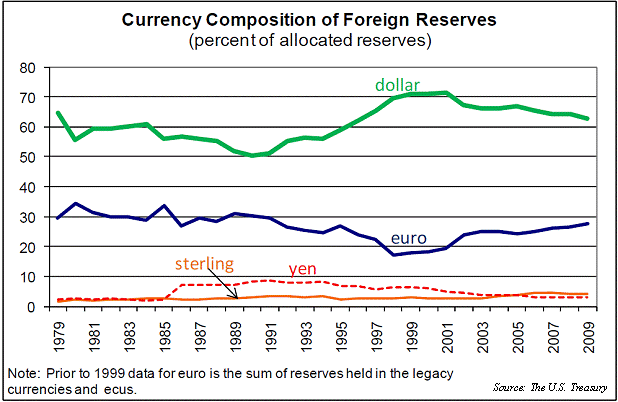
According to the Peterson Institute for International Economics, although the dollar remains the most important reserve currency over the last ten years through the first quarter of 2009, adjusting for the exchange rate effects, the dollar’s share in foreign exchange reserves has declined on balance 4.3%.
Reserve Currency Factors
The U.S. Treasury report points to several key factors identified by economists that determine the use of a currency for reserves:
- the size of the domestic economy
- the importance of the economy in international trade
- the size, depth, and openness of financial markets
- the convertibility of the currency
- the use of the currency as a currency peg
- domestic macroeconomic policies
PIIGS Decimate Euro
Based on these criteria, the euro zone, similar to the United States in size, share of global trade, and currency convertibility, makes the euro a viable contender for the dollar’s crown. And in contrast to the dollar, the euro has steadily taken market share regarding global foreign reserves during the past ten years, and has become the second most popular reserve currency. (see graph)
Unfortunately, the debt and budget woes of the PIIGS (Portugal, Italy, Ireland, Greece, and Spain) have seriously damaged the confidence and credibility of the European Union and the euro, essentially decimating the euro's chances as an alternative to the dollar.
The euro has already hit a one-year low against the yen, and nine-month low against the dollar on speculation that Greece’s credit rating will be downgraded further. The viability of the European Union and the euro as a going concern has also come into question.
Dollar Reigns Liquidity Supreme
Even without the Greece debacle, the lack of liquidity within the euro zone also makes it difficult to compete against the dollar. One important reason the US dollar remains the reserve currency is that the U.S. treasury market is the most liquid market of its sort. A liquid debt market allows central banks to intervene in foreign exchange markets in order to smooth currency fluctuations.
As noted by the U.S. Treasury Dept. report:
“The euro has not become the dollar’s equal as a reserve currency because there is no common sovereign-debt market across the euro zone.”
From that perspective, sterling and yen, the next two preferred reserve currencies following the euro, pale in comparison to the dollar in terms of liquidity and facilitating global trade. Moreover, Moody’s (MCO) warned of possible downgrades on UK and Japan due to high debt, interest payments and slow GDP growth. (The pound was in virtual free-fall at one stage this Monday and sank to a ten-month low against the dollar on renewed worries about a hung parliament.)
Gold or Yuan?
While there are many advocating an international gold standard, or another international standard currency based on a basket of commodities and/or currencies, it is very difficult to see sufficient international consensus for this to be practical or feasible.
So, waiting in the wings is the Chinese renminbi (RMB) or yuan. The appointment of Zhu Min, the deputy governor of China’s central bank, as a special adviser to the IMF seems to signal China’s assertion in the global currency scheme. The fund, historically led by a European but dominated by the United States, has tried to engage emerging economies like Brazil, China, India and Russia.
But according to economist Geng Xiao, director of the Brookings-Tsinghua Center for Public Policy, it’s still in China’s—and the world’s—best interest not to dump the dollar just yet.
Yuan Revaluation Solves Nothing
In an interview with McKinsey Quarterly, Xiao noted that there’s no argument on either side about the trade imbalance between China and the US. However, there are some philosophical differences between the two as the US places more emphasis on the short-term adjustment through price and the RMB exchange rate, whereas the Chinese put more emphasis on medium and long-term structural and institutional change.
Xiao finds it quite difficult for the exchange rate to correct the trade balance:
"Even if you change the exchange rate, it will have very little impact on US trade deficit because the US is going to buy from some other countries."
Time To Reform & Float
China needs time to push through difficult economic reforms at home before it can allow its currency to float freely against the dollar, as Xiao explains:
"China needs a benchmark so that the price can be compared to the global price, to the price structure, compatible with efficiency. That’s why price reform is more important than exchange-rate change... Exchange-rate change would not really change the inefficiencies … [as] the internal subsidies are still there."
Xiao estimates it’s going to take 5 to 10 years for China to correct its distortions - land reform, reform of the energy sector, state-owned-enterprise reform, and social welfare. Only when the productivity of China reaches that of the United States will the two countries’ price structures converge.
The Worst-Case Scenario
A worst-case scenario might come to fruition if China allows RMB appreciation expectation to continue, building up more foreign-exchange reserves, as Xiao cautions:
“I don’t see that there’s any way that China can significantly reduce its holding of the dollar assets….But if pushed hard, China can always do more. And even marginally, a little bit more is going to have a big impact in the market.”
Dollar Rules … For Now
Indeed, overtime, China should be able to transform into a modern market economy. And if the Chinese economy continues to grow at its current pace, the RMB will eventually become one of the important reserve currencies, just like the US dollar.
But for now, there are several factors strongly supporting the dollar. In addition to a liquid debt market, many commodities, including oil and gold, are quoted in the US currency. Roughly 88% of daily foreign exchange trades involve US dollars. One currency essentially facilitates global trade, and commodities can be priced homogenously wherever traded.
And China, the top U.S. debtor with a massive holding of $894.8 billion in Treasury securities at the end of last December, is shifting to longer-term US treasuries and at the same time accumulating US stocks, raising its overall holdings of long-term American securities.
China’s huge holdings of dollar reserves in the form of Treasury securities has become a concern for officials on both sides of the Pacific. However, the fact remains that the dollar is still the most liquid, the most stable currency, comparatively speaking. In that sense, it is unlikely for China to significantly reduce its holding of dollar assets in the foreseeable future.
Dethroned By 2050?
Most Western experts seem to agree that the prospect of a dollar replacement for a new world reserve currency is unlikely to materialize anytime soon because there is no serious alternative on the horizon.
Doubts also remain that the Chinese can challenge the greenback. Nevertheless, there seems to be more or less a consensus forming among many Western experts that the Chinese are on an unmistakable path toward challenging the dollar in a transition period of 10 to 15 years, roughly coinciding with the projections of Mr. Geng Xiao.
British economist Angus Maddison predicts that China will surpass the US by 2015. Drawing historic parallels of the last switch in reserve currency (from pound sterling to the US dollar) would imply the Chinese renminbi may be expected to replace the US dollar as a reserve currency around 2050, the mid-21st century.
Dollar Demise by A Greece-Like Crisis?
Meanwhile, even though the debt crisis of troubled southern European nations have taken hold of headlines lately, Moody’s and its peers have expressed concerns about the financial health in Japan, UK and the U.S., mostly centered around debt and debt service in these larger nations.
For instance, interest paid on U.S. Treasury debt has been soaring the last two years and is expected to reach over $700 billion a year by the end of the decade. The U.S.'s ratio of total debt to GDP is likely to exceed 90% this year, making it more indebted even than Spain and Portugal.
While the US has been enjoying the reserve currency status, this is by no means assured for the future. For now, investors are seeking refuge in the U.S. Treasury market. However, a broken-down political system, the debt and the deficit inevitably could sink America into a Greece-like crisis, nudging the dollar’s demise sooner, rather than later.
Dian L. Chu, M.B.A., C.P.M. and Chartered Economist, is a market analyst and financial writer regularly contributing to Seeking Alpha, Zero Hedge, and other major investment websites. Ms. Chu has been syndicated to Reuters, USA Today, NPR, and BusinessWeek. She blogs at Economic Forecasts & Opinions.
© 2010 Copyright Dian L. Chu - All Rights Reserved Disclaimer: The above is a matter of opinion provided for general information purposes only and is not intended as investment advice. Information and analysis above are derived from sources and utilising methods believed to be reliable, but we cannot accept responsibility for any losses you may incur as a result of this analysis. Individuals should consult with their personal financial advisors.
© 2005-2022 http://www.MarketOracle.co.uk - The Market Oracle is a FREE Daily Financial Markets Analysis & Forecasting online publication.
