


After Government Economic Stimulus
Economics / US Economy Jun 11, 2010 - 09:58 AM GMTBy: Andy_Sutton

 There is perhaps no better example of the destructive nature of government intervention than the current housing and retail goods markets. For the past three years a spend-happy Congress lavished these areas with stimulus spending, tax credits, and other palliatives all aimed at papering over the structural defects in these markets. In the case of housing, the problem was years of easy money, sky-high prices, and zero-standards lending.
In the case of retail goods, it was years of abuse of various types of credit to expand a spending bubble and increased reliance on foreign products. However, Congress has now buttoned up – in fear for their political existence in many cases. The public is aware and fearful of debt for the first time in recent memory. Living in a post-stimulus world; even if it is only until the next Congress is seated will be interesting to say the least.
The Housing Market’s Freefall
While the actual damage to the housing market in the near term cannot be totally assessed until later this month, there are some hints in the rate at which purchase applications for mortgages have plunged. The following data is compiled weekly and presented by the Mortgage Bankers Association:
Week ending |
Purchase |
Refinance |
Composite |
4/30/10 |
13.0% |
-2.1% |
4.0% |
5/7/10 |
-9.5% |
14.8% |
3.9% |
5/14/10 |
-27.1% |
14.5% |
-1.5% |
5/21/10 |
-3.3% |
17.0% |
11.3% |
5/28/10 |
-4.1% |
2.4% |
.9% |
6/4/10 |
-5.7% |
-14.3% |
-12.2% |
During the past 4 weeks, purchase applications are down a whopping 35%. It is easy to see the spike at the end of April as the end of the tax credit lured May’s (and perhaps June’s too) sales back a month. The downward trend of new purchase applications has continued into June despite very low relative interest rates for home loans. These low rates boosted the Refinance portion of the index during May and remain low, the national average currently at 4.88% according to bankrate.com.
With an upcoming election, we will now likely get the first glimpse at the true state of the housing market. Granted there are still many programs in place at the Fannie/Freddie/FHA level that are encouraging purchases to varying degrees, but it is not likely that direct stimulus through tax credits will be used for at least the next few months. What is very disconcerting is that more than half of the purchasing blitz during March and April was done on the back of government mortgages. Much in the way the government nationalized the student loan business it is now similarly giving the heave ho to private lenders in the mortgage market. These actions virtually guarantee the perpetuation of the distortions currently seen in this critical area.
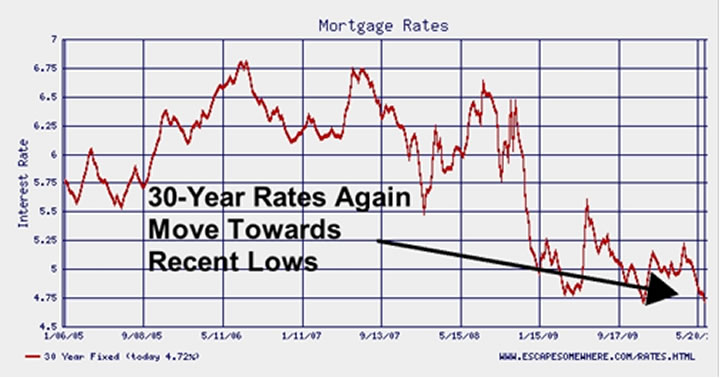
I had commented, perhaps cynically, to some friends back in 2005 that the housing bubble seemed to be little more than a giant property grab. With government now owning or guaranteeing the majority of mortgages (69 percent), it seems that very well could be the case. Unemployment is still high, decent paying jobs are difficult to come by, and people are still being laid off. Consumer debt burdens are causing the financial hardships endured by many to continue. Repossessions of houses just hit another all-time record high last month. When the government owns the mortgage and someone defaults, who gets the house? Some food for thought on a Friday afternoon.
Retail’s May Swoon
This morning’s retail sales report gave much more cause for concern than any of the recent month’s reports in this area. I’ve dissected these reports on several occasions for our paid subscribers to reveal the biases. Put simply the numbers are not what they seem and haven’t been for quite some time now. The biases, statistical and/or hedonic, tend to overstate retail sales.
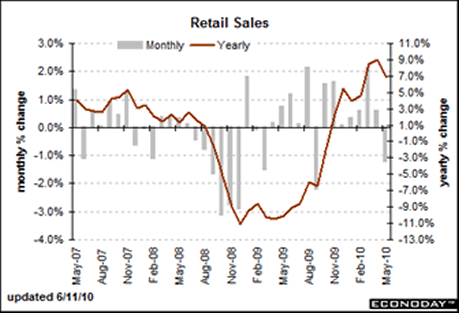
Even those biases could not conceal last month’s drop. It is quite likely that the 1.2% decrease in sales was caused in no small part by the ‘Here we go again’ mindset when global stock markets began another round of liquidation. The media had been blaming a late Memorial Day for the potential downdraft in sales well in advance of the release of this morning’s report, which really makes no sense. The drop in sales speaks volumes about the delicate nature of consumer confidence. It is easily shaken these days, and it doesn’t take much. Granted the European (and spreading) debt crisis is a huge problem and will affect us eventually, however, that is not the impression the average person has thanks to the largely absentee media in this country. The crash of 2008, however, is still on people’s minds, and there is a general fear of a recurrence of those conditions. So when the markets act up, people slow spending and increase savings. It is one of the few things we’ve seen in recent memory that actually makes sense. Ironically, the University of Michigan’s consumer sentiment index is telling us that confidence is at the highest level since 2008. So much for our brief trip back to sanity.
The retail sector has not been without its share in the government stimulus binge of the past three years either. Most of the stimulus other than the checks sent out in early 2008 has been indirect, however, the benefits from foreclosure prevention tactics, strategic defaults, and hyper-extended unemployment benefits have perpetuated the spending bubble much in the same way the housing bubble has been prodded along. However, with more and more states such as Colorado and California having to borrow money to pay unemployment benefits and record repos of homes, it would seems likely as though the fuel for this leg of the spending bubble might be petering out somewhat.
Another weight on the consumer is the comparatively higher interest rates on credit cards. According to creditcards.com, the national average for credit cards in May 2010 was 14.31%, up from 12.75% just 6 months ago. So even as banks have been able to borrow from the Fed for essentially nothing, they’ve repaid the consumer for the hefty bailouts by jacking interest rates. Of course the selling line here is that so many consumer loans are in default. Small wonder. Maybe if the underwriting department hadn’t taken 5 years off this wouldn’t have happened.
In summary, the pressures on these two critical markets are increasing as the government’s ability to intervene is hampered by a broadening awareness of its own insolvent state. Granted, one or two months does not a trend make, but we need to be aware of the possible paradigm shift that is occurring – the end of the age of perpetual stimulus.
Andrew W. Sutton, MBA received graduate honors in the field of Economics and is the Chief Market Strategist for Sutton & Associates, LLC, a Registered Investment Adviser in the Commonwealth of Pennsylvania. For more information about the company, its products and services, or contact information, please visit our website. Please feel free to distribute, copy or otherwise disseminate this information.
By Andy Sutton
http://www.my2centsonline.com
Andy Sutton holds a MBA with Honors in Economics from Moravian College and is a member of Omicron Delta Epsilon International Honor Society in Economics. His firm, Sutton & Associates, LLC currently provides financial planning services to a growing book of clients using a conservative approach aimed at accumulating high quality, income producing assets while providing protection against a falling dollar. For more information visit www.suttonfinance.net
Andy Sutton Archive |
© 2005-2022 http://www.MarketOracle.co.uk - The Market Oracle is a FREE Daily Financial Markets Analysis & Forecasting online publication.
