


Perhaps 60% of today's Crude Oil Price is Pure Speculation
Commodities / Crude Oil May 03, 2008 - 06:52 AM GMT

 The price of crude oil today is not made according to any traditional relation of supply to demand. It's controlled by an elaborate financial market system as well as by the four major Anglo-American oil companies. As much as 60% of today's crude oil price is pure speculation driven by large trader banks and hedge funds. It has nothing to do with the convenient myths of Peak Oil. It has to do with control of oil and its price. How?
First, the crucial role of the international oil exchanges in London and New York is crucial to the game. Nymex in New York and the ICE Futures in London today control global benchmark oil prices which in turn set most of the freely traded oil cargo. They do so via oil futures contracts on two grades of crude oil—West Texas Intermediate and North Sea Brent.
 A third rather new oil exchange, the Dubai Mercantile Exchange (DME), trading Dubai crude, is more or less a daughter of Nymex, with Nymex President, James Newsome, sitting on the board of DME and most key personnel British or American citizens.
Brent is used in spot and long-term contracts to value as much of crude oil produced in global oil markets each day. The Brent price is published by a private oil industry publication, Platt's. Major oil producers including Russia and Nigeria use Brent as a benchmark for pricing the crude they produce. Brent is a key crude blend for the European market and, to some extent, for Asia .
WTI has historically been more of a US crude oil basket. Not only is it used as the basis for US-traded oil futures, but it's also a key benchmark for US production.
‘The tail that wags the dog'
All this is well and official. But how today's oil prices are really determined is done by a process so opaque only a handful of major oil trading banks such as Goldman Sachs or Morgan Stanley have any idea who is buying and who selling oil futures or derivative contracts that set physical oil prices in this strange new world of “paper oil.”
With the development of unregulated international derivatives trading in oil futures over the past decade or more, the way has opened for the present speculative bubble in oil prices.
Since the advent of oil futures trading and the two major London and New York oil futures contracts, control of oil prices has left OPEC and gone to Wall Street. It is a classic case of the “tail that wags the dog.”
A June 2006 US Senate Permanent Subcommittee on Investigations report on “The Role of Market Speculation in rising oil and gas prices,” noted, “… there is substantial evidence supporting the conclusion that the large amount of speculation in the current market has significantly increased prices.”
What the Senate committee staff documented in the report was a gaping loophole in US Government regulation of oil derivatives trading so huge a herd of elephants could walk through it. That seems precisely what they have been doing in ramping oil prices through the roof in recent months.
The Senate report was ignored in the media and in the Congress.
The report pointed out that the Commodity Futures Trading Trading Commission, a financial futures regulator, had been mandated by Congress to ensure that prices on the futures market reflect the laws of supply and demand rather than manipulative practices or excessive speculation. The US Commodity Exchange Act (CEA) states, “Excessive speculation in any commodity under contracts of sale of such commodity for future delivery . . . causing sudden or unreasonable fluctuations or unwarranted changes in the price of such commodity, is an undue and unnecessary burden on interstate commerce in such commodity.”
Further, the CEA directs the CFTC to establish such trading limits “as the Commission finds are necessary to diminish, eliminate, or prevent such burden.” Where is the CFTC now that we need such limits?
They seem to have deliberately walked away from their mandated oversight responsibilities in the world's most important traded commodity, oil.
Enron has the last laugh…
As that US Senate report noted:
“ Until recently, US energy futures were traded exclusively on regulated exchanges within the United States , like the NYMEX, which are subject to extensive oversight by the CFTC, including ongoing monitoring to detect and prevent price manipulation or fraud. In recent years, however, there has been a tremendous growth in the trading of contracts that look and are structured just like futures contracts, but which are traded on unregulated OTC electronic markets. Because of their similarity to futures contracts they are often called “futures look-alikes.”
The only practical difference between futures look-alike contracts and futures contracts is that the look-alikes are traded in unregulated markets whereas futures are traded on regulated exchanges. The trading of energy commodities by large firms on OTC electronic exchanges was exempted from CFTC oversight by a provision inserted at the behest of Enron and other large energy traders into the Commodity Futures Modernization Act of 2000 in the waning hours of the 106th Congress.
The impact on market oversight has been substantial. NYMEX traders, for example, are required to keep records of all trades and report large trades to the CFTC. These Large Trader Reports, together with daily trading data providing price and volume information, are the CFTC's primary tools to gauge the extent of speculation in the markets and to detect, prevent, and prosecute price manipulation. CFTC Chairman Reuben Jeff rey recently stated: “The Commission's Large Trader information system is one of the cornerstones of our surveillance program and enables detection of concentrated and coordinated positions that might be used by one or more traders to attempt manipulation.”
In contrast to trades conducted on the NYMEX, traders on unregulated OTC electronic exchanges are not required to keep records or file Large Trader Reports with the CFTC, and these trades are exempt from routine CFTC oversight. In contrast to trades conducted on regulated futures exchanges, there is no limit on the number of contracts a speculator may hold on an unregulated OTC electronic exchange, no monitoring of trading by the exchange itself, and no reporting of the amount of outstanding contracts (“open interest”) at the end of each day.”
Then, apparently to make sure the way was opened really wide to potential market oil price manipulation, in January 2006, the Bush Administration's CFTC permitted the Intercontinental Exchange (ICE), the leading operator of electronic energy exchanges, to use its trading terminals in the United States for the trading of US crude oil futures on the ICE futures exchange in London – called “ICE Futures.”
Previously, the ICE Futures exchange in London had traded only in European energy commodities – Brent crude oil and United Kingdom natural gas. As a United Kingdom futures market, the ICE Futures exchange is regulated solely by the UK Financial Services Authority. In 1999, the London exchange obtained the CFTC's permission to install computer terminals in the United States to permit traders in New York and other US cities to trade European energy commodities through the ICE exchange.
The CFTC opens the door
Then, in January 2006, ICE Futures in London began trading a futures contract for West Texas Intermediate (WTI) crude oil, a type of crude oil that is produced and delivered in the United States . ICE Futures also notified the CFTC that it would be permitting traders in the United States to use ICE terminals in the United States to trade its new WTI contract on the ICE Futures London exchange. ICE Futures as well allowed traders in the United States to trade US gasoline and heating oil futures on the ICE Futures exchange in London .
Despite the use by US traders of trading terminals within the United States to trade US oil, gasoline, and heating oil futures contracts, the CFTC has until today refused to assert any jurisdiction over the trading of these contracts.
Persons within the United States seeking to trade key US energy commodities – US crude oil, gasoline, and heating oil futures – are able to avoid all US market oversight or reporting requirements by routing their trades through the ICE Futures exchange in London instead of the NYMEX in New York .
Is that not elegant? The US Government energy futures regulator, CFTC opened the way to the present unregulated and highly opaque oil futures speculation. It may just be coincidence that the present CEO of NYMEX, James Newsome, who also sits on the Dubai Exchange, is a former chairman of the US CFTC. In Washington doors revolve quite smoothly between private and public posts.
A glance at the price for Brent and WTI futures prices since January 2006 indicates the remarkable correlation between skyrocketing oil prices and the unregulated trade in ICE oil futures in US markets. Keep in mind that ICE Futures in London is owned and controlled by a USA company based in Atlanta Georgia .
In January 2006 when the CFTC allowed the ICE Futures the gaping exception, oil prices were trading in the range of $59-60 a barrel. Today some two years later we see prices tapping $120 and trend upwards. This is not an OPEC problem, it is a US Government regulatory problem of malign neglect.
By not requiring the ICE to file daily reports of large trades of energy commodities, it is not able to detect and deter price manipulation. As the Senate report noted, “The CFTC's ability to detect and deter energy price manipulation is suffering from critical information gaps, because traders on OTC electronic exchanges and the London ICE Futures are currently exempt from CFTC reporting requirements. Large trader reporting is also essential to analyze the effect of speculation on energy prices.”
The report added, “ICE's filings with the Securities and Exchange Commission and other evidence indicate that its over-the-counter electronic exchange performs a price discovery function -- and thereby affects US energy prices -- in the cash market for the energy commodities traded on that exchange.”
Hedge Funds and Banks driving oil prices
In the most recent sustained run-up in energy prices, large financial institutions, hedge funds, pension funds, and other investors have been pouring billions of dollars into the energy commodities markets to try to take advantage of price changes or hedge against them. Most of this additional investment has not come from producers or consumers of these commodities, but from speculators seeking to take advantage of these price changes. The CFTC defines a speculator as a person who “does not produce or use the commodity, but risks his or her own capital trading futures in that commodity in hopes of making a profit on price changes.”
The large purchases of crude oil futures contracts by speculators have, in effect, created an additional demand for oil, driving up the price of oil for future delivery in the same manner that additional demand for contracts for the delivery of a physical barrel today drives up the price for oil on the spot market. As far as the market is concerned, the demand for a barrel of oil that results from the purchase of a futures contract by a speculator is just as real as the demand for a barrel that results from the purchase of a futures contract by a refiner or other user of petroleum.
Perhaps 60% of oil prices today pure speculation
Goldman Sachs and Morgan Stanley today are the two leading energy trading firms in the United States . Citigroup and JP Morgan Chase are major players and fund numerous hedge funds as well who speculate.
In June 2006, oil traded in futures markets at some $60 a barrel and the Senate investigation estimated that some $25 of that was due to pure financial speculation. One analyst estimated in August 2005 that US oil inventory levels suggested WTI crude prices should be around $25 a barrel, and not $60.
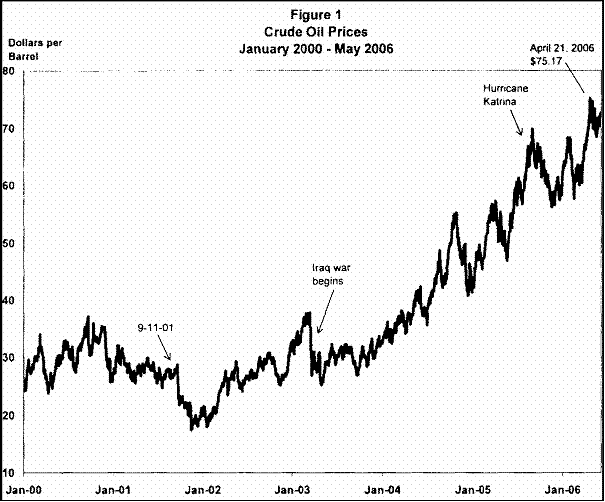
That would mean today that at least $50 to $60 or more of today's $115 a barrel price is due to pure hedge fund and financial institution speculation. However, given the unchanged equilibrium in global oil supply and demand over recent months amid the explosive rise in oil futures prices traded on Nymex and ICE exchanges in New York and London it is more likely that as much as 60% of the today oil price is pure speculation. No one knows officially except the tiny handful of energy trading banks in New York and London and they certainly aren't talking.
By purchasing large numbers of futures contracts, and thereby pushing up futures prices to even higher levels than current prices, speculators have provided a financial incentive for oil companies to buy even more oil and place it in storage. A refiner will purchase extra oil today, even if it costs $115 per barrel, if the futures price is even higher.
As a result, over the past two years crude oil inventories have been steadily growing, resulting in US crude oil inventories that are now higher than at any time in the previous eight years. The large influx of speculative investment into oil futures has led to a situation where we have both high supplies of crude oil and high crude oil prices.
Compelling evidence also suggests that the oft-cited geopolitical, economic, and natural factors do not explain the recent rise in energy prices can be seen in the actual data on crude oil supply and demand. Although demand has significantly increased over the past few years, so have supplies.
Over the past couple of years global crude oil production has increased along with the increases in demand; in fact, during this period global supplies have exceeded demand, according to the US Department of Energy. The US Department of Energy's Energy Information Administration (EIA) recently forecast that in the next few years global surplus production capacity will continue to grow to between 3 and 5 million barrels per day by 2010, thereby “substantially thickening the surplus capacity cushion.”
Dollar and oil link
A common speculation strategy amid a declining USA economy and a falling US dollar is for speculators and ordinary investment funds desperate for more profitable investments amid the US securitization disaster, to take futures positions selling the dollar “short” and oil “long.”
For huge US or EU pension funds or banks desperate to get profits following the collapse in earnings since August 2007 and the US real estate crisis, oil is one of the best ways to get huge speculative gains. The backdrop that supports the current oil price bubble is continued unrest in the Middle East , in Sudan , in Venezuela and Pakistan and firm oil demand in China and most of the world outside the US . Speculators trade on rumor, not fact.
In turn, once major oil companies and refiners in North America and EU countries begin to hoard oil, supplies appear even tighter lending background support to present prices.
Because the over-the-counter (OTC) and London ICE Futures energy markets are unregulated, there are no precise or reliable figures as to the total dollar value of recent spending on investments in energy commodities, but the estimates are consistently in the range of tens of billions of dollars.
The increased speculative interest in commodities is also seen in the increasing popularity of commodity index funds, which are funds whose price is tied to the price of a basket of various commodity futures. Goldman Sachs estimates that pension funds and mutual funds have invested a total of approximately $85 billion in commodity index funds, and that investments in its own index, the Goldman Sachs Commodity Index (GSCI), has tripled over the past few years. Notable is the fact that the US Treasury Secretary, Henry Paulson, is former Chairman of Goldman Sachs.
United States Senate Premanent Subcommittee on Investigations, 109th Congress 2nd Session, The Role of Market speculation in Rising Oil and Gas Prices: A Need to Put the Cop Back on the Beat ; Staff Report, prepared by the Permanent Subcommittee on Investigations of the Committee on Homeland Security and Governmental Affairs, United States Senate, Washington D.C., June 27, 2006. p. 3.
By F. William Engdahl
www.engdahl.oilgeopolitics.net
COPYRIGHT © 2008 F. William Engdahl. ALL RIGHTS RESERVED
* F. William Engdahl is the author of A Century of War: Anglo-American Oil Politics and the New World Order (Pluto Press) and Seeds of Destruction: The Hidden Agenda of Genetic Manipulation , www.globalresearch.ca . The present series is adapted from his new book, now in writing, The Rise and Fall of the American Century: Money and Empire in Our Era. He may be contacted through his website, www.engdahl.oilgeopolitics.net .
F. William Engdahl Archive |
© 2005-2022 http://www.MarketOracle.co.uk - The Market Oracle is a FREE Daily Financial Markets Analysis & Forecasting online publication.
